Explore Their Life · Pearson Edexcel International GCSE revision on Incandio
Mary Shelley: A Life in Five Chapters
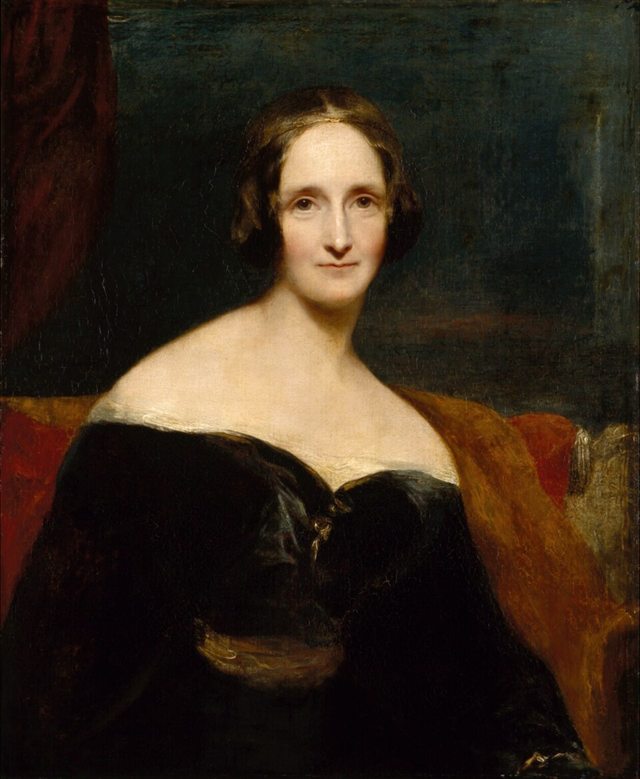
1797–1851
At eighteen she invented science fiction; by twenty-four she had buried three children and a husband, and went on writing for thirty more years.
Mary Shelley is usually reduced to one summer and one book. Both deserve better: *Frankenstein* is a serious argument about responsibility and creation, and the writer who produced it went on to publish an apocalyptic novel, four more books, and the editions that saved her husband's poetry. These five chapters follow the whole career.
The five chapters
- Born to Famous Parents, Raised by Neither — A mother who died, a father who theorised
- The Summer Without a Sun — Lake Geneva, a volcano and a ghost-story competition
- What Frankenstein Is Actually About — Creation, abandonment and responsibility
- Italy, and Almost Everyone Dies — Four years that emptied a household
- Thirty More Years of Work — The Last Man, the editions, and a reputation reclaimed
Chapter 1 · Born to Famous Parents, Raised by Neither
A mother who died, a father who theorised
1797 – 1814 · London · Dundee
Mary Godwin was born in London on 30 August 1797. Eleven days later her mother, Mary Wollstonecraft, died of infection following the birth. She grew up as the daughter of the most famous feminist in England and of William Godwin, the philosopher whose *Political Justice* argued that reason alone should govern human affairs.
She had no formal schooling. What she had instead was Godwin's library, his conversation and his visitors: Coleridge, who read *The Rime of the Ancient Mariner* aloud in the house, and the chemists and radicals who passed through. Family tradition holds that she taught herself to read partly by tracing the letters on her mother's gravestone in St Pancras churchyard, where she habitually went to read and write.
Her father remarried in 1801. Mary and her stepmother, Mary Jane Clairmont, disliked each other, and Mary was sent away to Scotland for long periods in her teens — a separation she later described as formative, giving her space to write.
In 1814, aged sixteen, she met Percy Bysshe Shelley, a poet, political radical and admirer of Godwin who was already married. They declared themselves to each other, family tradition says at Wollstonecraft's grave, and in July eloped to the continent, taking Mary's stepsister Claire Clairmont with them. Godwin, whose books had criticised conventional marriage, refused to speak to his daughter for years.
Why this matters
Mary Shelley grew up inside the Enlightenment argument that human beings could be perfected by reason — the idea Frankenstein would test to destruction.
You have met the girl reading at her mother's grave. What would you ask her about that inheritance?
Ask Mary
- “What was it like growing up as Mary Wollstonecraft's daughter?”
- “What did your father's philosophy teach you about human nature?”
- “How did you educate yourself without going to school?”
- “Why did your father cut you off after you left with Shelley?”
- “What drew you to Percy Shelley at sixteen?”
Chapter 2 · The Summer Without a Sun
Lake Geneva, a volcano and a ghost-story competition
1816 · Lake Geneva · Villa Diodati
In 1816 the Shelleys travelled to Lake Geneva, following Claire Clairmont, who was pregnant by Lord Byron. They took a house near Byron's Villa Diodati, and were trapped indoors by relentless rain and cold. The weather had a cause no one there knew: the eruption of Mount Tambora in Indonesia the previous year had thrown enough ash into the atmosphere to disrupt climates worldwide. 1816 became the 'year without a summer', with failed harvests and famine across Europe and North America.
Indoors, the party read German ghost stories aloud, and Byron proposed that each of them write one. The conversation that followed — she later recalled discussions of Erasmus Darwin's experiments and of galvanism, the recent demonstrations in which electrical current made dead muscles twitch — fed directly into what she produced.
Mary, then eighteen, was the only one to finish anything substantial. Byron abandoned his fragment; John Polidori's contribution became *The Vampyre*, the first modern vampire story in English.
Her own account, given in the 1831 introduction, describes a waking vision of a student kneeling beside the thing he had assembled, and of the horror on his face as it stirred. Whether that memory is exact or shaped by fifteen years of retelling is impossible to know. What is documented is that she began writing that summer, and that the manuscript grew from a short story into a novel over the following year.
Why this matters
Frankenstein was written at a moment when electricity seemed capable of animating dead tissue — which is why it reads as a response to real science rather than to fantasy.
You are at the origin of a genre. What would you ask her about that summer?
Ask Mary
- “What did you know about galvanism when you began writing?”
- “How reliable is your own account of the waking vision?”
- “Why were you the only one who finished the ghost-story challenge?”
- “What was it like to spend a summer indoors under a volcanic sky?”
- “How did a short story turn into a novel?”
Chapter 3 · What Frankenstein Is Actually About
Creation, abandonment and responsibility
1818 – 1831 · Bath · London
*Frankenstein; or, The Modern Prometheus* was published anonymously on 1 January 1818, with a preface written by Percy Shelley and a dedication to Godwin. Many readers assumed Percy was the author, and the claim resurfaces periodically. The surviving manuscripts show he acted as an editor, suggesting wording and some elaboration; the conception, structure and argument are hers.
The novel is routinely misread. Victor Frankenstein does not create a monster; he creates a being who begins innocent, learns language by observing a family, reads *Paradise Lost*, and asks reasonable questions about why he exists. What makes him dangerous is abandonment — his creator takes one look and runs. The horror is not the science but the refusal of responsibility for what one has made.
Its subtitle points to the Greek Titan who stole fire for humanity and was punished eternally, and the book sits inside a live Romantic argument about whether human ambition to master nature is heroic or blasphemous.
There is a case that the novel is also about childbirth and loss. Mary's first baby, born prematurely in 1815, died at a few days old; she recorded a dream of rubbing it before the fire and seeing it revive. She had lost her own mother to childbirth. A story about creating life and being destroyed by it did not come from nowhere.
The 1831 revised edition, which most readers now encounter, makes Victor more a victim of fate and less a free agent — a change some scholars link to Mary's own later, sadder view.
Why this matters
Frankenstein created the template for science fiction: a story that asks not whether something can be made, but who is responsible for it afterwards.
You have the novel's real argument in view. What would you ask her about it?
Ask Mary
- “Is Victor Frankenstein or his creation the real monster of your novel?”
- “How much did Percy contribute to the manuscript?”
- “Why does the creature read Paradise Lost?”
- “How much of the novel comes from your own losses?”
- “Why did you make Victor less responsible in the 1831 revision?”
Chapter 4 · Italy, and Almost Everyone Dies
Four years that emptied a household
1818 – 1822 · Venice · Rome · Gulf of Spezia
The Shelleys moved to Italy in 1818, chasing health, cheapness and distance from English scandal. What followed was catastrophic. Their daughter Clara died in Venice in September 1818, aged one, after a journey Percy insisted on making despite her illness. Their son William, whom Mary called Willmouse, died of malaria in Rome in June 1819, aged three. Within nine months she had lost both surviving children and fell into a severe depression Percy did not handle well.
Her fourth child, Percy Florence, was born in November 1819 and was the only one to live to adulthood. Mary kept writing throughout: *Mathilda*, a bleak novella on a father's incestuous obsession, which Godwin suppressed and which was not published until 1959; *Valperga*, a historical novel researched in Italian archives.
On 8 July 1822, Percy Shelley drowned when his boat went down in a squall in the Gulf of Spezia. He was twenty-nine. Mary was twenty-four, a widow with a two-year-old, in a foreign country, with her father-in-law refusing support unless she surrendered her son.
She returned to England in 1823 and discovered that her novel had become a stage hit — the play *Presumption; or, The Fate of Frankenstein*, which invented the mute, lumbering creature and the assistant that popular culture has used ever since. She went to see it and wrote that she was much amused, while noting how thoroughly the play had altered her book.
Why this matters
The gap between Shelley's novel and its first stage adaptation created the popular 'Frankenstein' — proof of how quickly an adaptation can overwrite the original in public memory.
This is the hardest stretch of her life. What would you ask her about it?
Ask Mary
- “How did you keep writing through the deaths of your children?”
- “Why did your father suppress Mathilda?”
- “What did Percy's drowning leave you facing at twenty-four?”
- “What did the first stage version get wrong about your creature?”
- “What did Sir Timothy Shelley demand in return for supporting your son?”
Chapter 5 · Thirty More Years of Work
The Last Man, the editions, and a reputation reclaimed
1823 – 1851 and after · London · Sussex
Mary Shelley supported herself and her son by writing for nearly three decades after her husband's death. *The Last Man* (1826) imagines a global plague destroying humanity by the end of the twenty-first century, leaving one survivor; it was dismissed at the time and is now recognised as a founding work of apocalyptic fiction. She also wrote *Perkin Warbeck*, *Lodore*, *Falkner*, dozens of biographical essays for Lardner's *Cabinet Cyclopaedia*, short stories, and two volumes of travel writing.
Her most consequential work was editorial. Percy's father forbade a biography, so she published his *Poetical Works* in 1839 with extensive notes that supplied the life obliquely, established reliable texts from chaotic drafts, and largely created his posthumous reputation. She was accused, then and since, of smoothing his atheism and politics into something respectable — a genuine charge, made under real financial and legal pressure.
She died on 1 February 1851, aged fifty-three, after years of headaches and partial paralysis; the symptoms are consistent with a brain tumour.
For over a century she was treated as a one-book author and the caretaker of a great poet. Since the 1970s, scholarly editions of her novels, journals and letters have rebuilt her as a substantial professional writer with a coherent set of concerns: creation and its obligations, the fragility of civilisation, and what happens to people abandoned by those who should care for them.
Why this matters
Mary Shelley's later career shows why literary reputations need re-examining: the standard picture of her as a one-summer wonder survived only because most of her work went unread for a century.
You have seen the whole working life, not just the famous summer. What would you ask her?
Ask Mary
- “What were you exploring in The Last Man that Frankenstein did not reach?”
- “Did you soften Percy's radicalism when you edited his poems?”
- “What was it like earning a living by writing as a widow?”
- “Why do you think your later novels were forgotten?”
- “What would you want readers to notice in Frankenstein that they usually miss?”
What Mary changed
Frankenstein founded science fiction as a form that interrogates the ethics of creation, and its central question — who is responsible for what we build? — is now standard in debates about genetic engineering and artificial intelligence. Mary Shelley also produced the first significant English pandemic-apocalypse novel and the editions that secured Percy Shelley's place in English poetry.
A debate that continues
Scholars still argue about the extent of Percy Shelley's editorial hand in Frankenstein, and about whether the 1818 or the more fatalistic 1831 text should be treated as the standard version.
Keep exploring — ask Mary
- “What should a creator owe to what they have created?”
- “How did losing so many people change what you wrote about?”
- “Which of your books do you wish had been read properly in your lifetime?”
Related lives
- Mary Wollstonecraft — Founder of Modern Feminism
- J. Robert Oppenheimer — Father of the Atomic Bomb
- Charles Darwin — Author of On the Origin of Species
Related themes
Gothic and Romantic literature · The origins of science fiction · Science and ethical responsibility
Debate Mary in the Agora
Reading is the start. On Incandio an idea counts as mastered only once you have argued it against the person with the strongest claim on it, in structured rounds marked against published descriptors.
- Who Made the Monster — “The creature's violence is the direct product of Victor's abandonment, and the novel holds Victor responsible.”
Continue on Incandio
- Talk to Mary — every question on this page is one tap from being asked, and the same page carries the Historical Brief, the achievements and the timeline
- All 280 figures · Incandio — learn every idea, teach it, then defend it