Explore Their Life · Pearson Edexcel International GCSE revision on Incandio
Nicole Oresme: A Life in Five Chapters
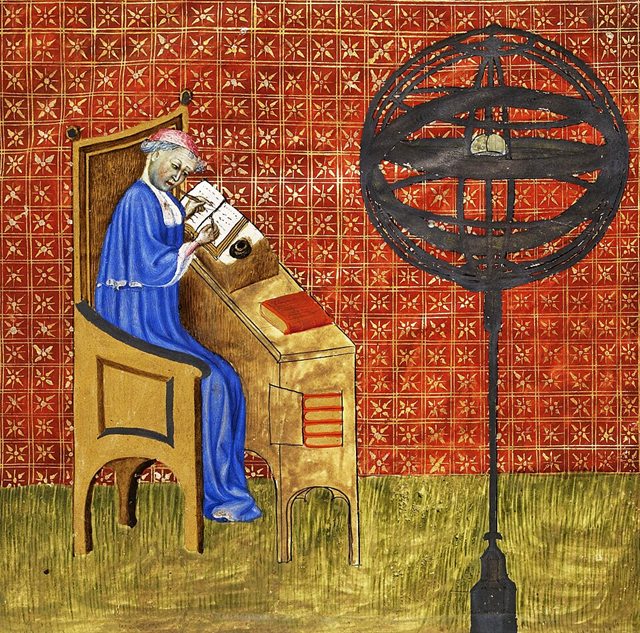
c.1320–1382
A fourteenth-century bishop who invented the graph, proved the area under it means something, argued brilliantly that the Earth rotates — and then said he believed it did not.
Oresme drew a changing quantity as a figure: time along one line, intensity standing up from it, and the area beneath meaning the total. With that picture he proved a theorem about accelerated motion three hundred years before Galileo measured it. These five chapters follow a mind that could argue past its own conclusions.
The five chapters
- The College of Navarre — A Norman scholarship boy in the Paris schools
- Drawing Change Itself — The figure that became the graph
- The Triangle and the Rectangle — Proving the mean-speed theorem without measuring anything
- The Best Argument He Did Not Believe — Why nothing disproves the Earth's rotation
- Coinage, Astrologers and a French Aristotle — The rest of an unusually wide working life
Chapter 2 · Drawing Change Itself
The figure that became the graph
c. 1360 · Paris
In the *Tractatus de configurationibus qualitatum et motuum* Oresme did something nobody had done: he represented a quantity that varies by drawing a picture of the variation.
The construction is this. Draw a horizontal line to stand for the *extension* of the quality — usually time, but it could be the length of a rod whose heat varies along it. At every point of that line, draw a vertical line whose *length* represents the *intensity* of the quality at that instant or place. The tops of those verticals trace out a shape.
A constant intensity gives a rectangle. A uniformly increasing intensity gives a right triangle. Other variations give other figures.
Then comes the move that matters. Oresme argued that the *area* of the figure so produced measures the *total quantity* of the quality — the whole amount of heat in the rod, or the whole distance covered by the motion.
That is the area-under-the-graph rule, stated in the fourteenth century.
It is important to be exact about what he did not have. There are no numbers on his axes and no units. The lengths are proportions, compared with one another, not measurements. He cannot say how fast anything is going. What he has is a way of *reasoning about* change geometrically, and it turns out to be enough to prove things.
“It is impossible to demonstrate by any experience that the heavens move and the Earth does not.”
— Nicole Oresme, Livre du ciel et du monde (1377)
Why this matters
Representing a varying quantity as a figure whose area means the total is one of the most productive representational inventions in the history of science.
You have the figure with time along the bottom. What is your question?
Ask Oresme
- “Why draw a changing quality as a shape at all?”
- “What does the area of your figure actually stand for?”
- “What can you not say without numbers on the lines?”
- “Could the horizontal line stand for something other than time?”
- “Did anyone else see what the figure could do?”
Chapter 3 · The Triangle and the Rectangle
Proving the mean-speed theorem without measuring anything
c. 1360 · Paris · Oxford
At Merton College, Oxford, a group of mathematicians — the Merton calculators — had stated a result about accelerated motion: a body whose speed increases uniformly covers, in a given time, exactly the distance it would have covered moving throughout at the speed it has at the middle instant.
They stated it. Oresme proved it, and the proof takes about a minute to follow.
Draw the figure for uniformly increasing speed: time along the base, speed rising steadily, so the figure is a right triangle. Now draw the figure for constant speed at the mean value: a rectangle on the same base, half the height of the triangle's tallest point.
The triangle and the rectangle have the same area. The little triangle sticking up above the rectangle at the fast end fits exactly into the gap below it at the slow end. And since area is total distance, the two motions cover the same distance.
That is it. No measurement, no numbers, no apparatus — just two figures with the same area.
Galileo used the same theorem three centuries later, with measured times and distances attached to it, and it is the foundation of the equations of uniformly accelerated motion that every physics student learns. The proof Galileo gives is essentially Oresme's.
Why this matters
The mean-speed theorem underlies the standard equations of accelerated motion, and Oresme proved it geometrically three centuries before anyone measured it.
You have the triangle that folds into a rectangle. What would you ask him?
Ask Oresme
- “Show me why the triangle and the rectangle have the same area.”
- “Why is uniformly increasing speed a triangle rather than some other shape?”
- “The Merton men stated it — what did proving it add?”
- “Could you have tested this on a falling body?”
- “What would you have needed to turn this into a formula?”
Chapter 4 · The Best Argument He Did Not Believe
Why nothing disproves the Earth's rotation
1377 · Paris · Lisieux
In the *Livre du ciel et du monde*, his French translation of and commentary on Aristotle's *De caelo*, Oresme took up the question of whether the Earth turns daily or the heavens turn around it.
He went through the objections one by one and demolished them. If the Earth turned, an arrow shot straight up would be left behind — no, because the air and the arrow share the Earth's motion, just as a man on a moving ship dropping something sees it fall straight down to him. All motion we observe is relative; a man on the Earth watching the sky and a man in the sky watching the Earth would see exactly the same appearances. As for Scripture, which says the Sun stands still or moves, it speaks in the ordinary language of common speech, as it does when it attributes human passions to God, and cannot settle a question in natural philosophy.
He added that a rotating Earth is the simpler explanation, since it makes one small body move rather than an immense heaven.
And then he wrote that notwithstanding all this, everyone holds — and he holds too — that the heavens move and not the Earth, and that his arguments were offered to show that faith cannot be overthrown by mere reasoning.
What to make of that has been argued for a century. It may be genuine belief, prudence in a bishop, or a demonstration of how far argument can go without compelling assent.
Why this matters
Oresme assembled the strongest pre-Copernican case for a rotating Earth, including the relativity of observed motion, and then declined to accept it.
You have the argument and the retraction at the end of it. What is your question?
Ask Oresme
- “Why did you conclude the heavens move after arguing so well that they need not?”
- “What does the man dropping something on a moving ship show?”
- “Can Scripture settle a question about how nature works?”
- “Were you being careful, or did you mean it?”
- “Is simplicity a reason to believe something is true?”
Chapter 5 · Coinage, Astrologers and a French Aristotle
The rest of an unusually wide working life
1355 – 1382 · Paris · Rouen · Lisieux
Oresme's range is remarkable even by medieval standards.
He wrote the *De moneta*, one of the earliest treatises on money, arguing that coinage belongs to the community rather than to the prince, and that debasing it to raise revenue is a form of theft — a striking thing to write while advising a king who did exactly that. Charles V, to his credit, largely followed the advice.
He attacked astrology repeatedly and with real force, arguing that its predictions of particular events were unfounded and that princes who relied on it were being defrauded. He also proposed that many apparently marvellous events had natural causes and that people were too quick to reach for the supernatural.
He showed that the harmonic series — a half plus a third plus a quarter and so on — has no finite sum, by grouping the terms so that each group exceeds a half. The proof is still the one taught.
And he translated Aristotle's *Ethics*, *Politics* and *De caelo* into French for Charles V, which required inventing a large amount of French technical vocabulary from scratch.
He became Bishop of Lisieux in 1377 and died there in 1382. The *Tractatus* circulated in manuscript, and the idea at its centre waited three hundred years for anybody to attach numbers to it.
Why this matters
Oresme's treatise on coinage argued that debasing the currency is theft from the community — written by a man advising a king who was doing it.
You have the coinage, the astrologers and the diverging series. What would you ask?
Ask Oresme
- “How do you tell a king to his face that debasing coin is theft?”
- “Why attack the astrologers so hard?”
- “Show me why the harmonic series has no sum.”
- “What was hardest to translate from Aristotle into French?”
- “Did you expect anyone to use your figures after you?”
What Oresme changed
The picture Oresme invented — a quantity plotted against time, with the area beneath it meaning something — is now taught to every schoolchild, and the mean-speed theorem he proved with it is the foundation of the equations of uniformly accelerated motion. Galileo used the same theorem three centuries later with measurements attached. His treatise on coinage and his proof that the harmonic series diverges are both still cited.
A debate that continues
Whether Oresme's final rejection of the Earth's rotation was sincere belief, ecclesiastical prudence, or a deliberate demonstration of the limits of argument has been debated for over a century.
Keep exploring — ask Oresme
- “What would you have drawn if you had had measured numbers?”
- “How far can reason go before belief has to decide?”
- “Which of your books do you think was most useful to the kingdom?”
Related lives
- Galileo Galilei — Father of Modern Science
- Christiaan Huygens — Who Watched From A Moving Boat
- Muhammad al-Khwarizmi — Who Named Algebra And The Algorithm
- René Descartes — Who Conserved The Quantity Of Motion
Related themes
Graphs and motion · Acceleration · Medieval science
Continue on Incandio
- Talk to Oresme — every question on this page is one tap from being asked, and the same page carries the Historical Brief, the achievements and the timeline
- All 280 figures · Incandio — learn every idea, teach it, then defend it