Historical figure · Pearson Edexcel International GCSE revision on Incandio
Nicole Oresme
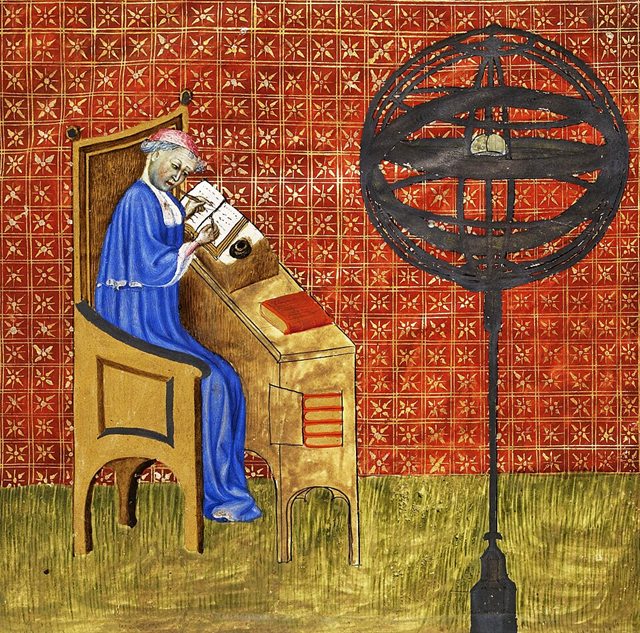
Who Drew Change Itself · Scholar & Bishop · c.1320–1382
The medieval master who found a way to DRAW a quantity that changes — time along one line, intensity standing on it — and proved with the resulting shape that a uniformly accelerating body covers exactly the distance it would cover at its middle speed.
Defend these ideas against Oresme
Incandio is a free revision platform for the Pearson Edexcel International GCSE, and on it a topic counts as mastered only once you have learned it, proved it in questions, taught it back and defended it against the person with the strongest claim on it. Nicole Oresme is that person for 2 topics on the course:
- Acceleration and the Velocity–Time Graph — Physics
- Travel & Real-Life Graphs — Mathematics
Who was Oresme?
Nicole Oresme was born in Normandy about 1320 and studied at the College of Navarre in Paris, where he became master in 1356. He was chaplain and adviser to Charles V of France, who set him to translating Aristotle into French — a task that required inventing a good deal of French vocabulary — and he ended his life as Bishop of Lisieux. His most consequential work is the Tractatus de configurationibus qualitatum et motuum, in which he represented a varying quality by a geometrical figure: a horizontal line for its extension, usually time, and at each point of it a vertical line whose length gives the intensity at that instant. The figure so produced has an area, and Oresme argued that the area measures the total quantity of the quality. Applied to motion this gives him a proof of the mean-speed theorem, which the Merton College calculators at Oxford had stated: a body moving with uniformly increasing speed covers, in a given time, exactly the distance it would have covered moving throughout at its speed at the middle instant — because the triangle standing on the time-line and the rectangle on the mean speed have the same area. He also argued, in his commentary on Aristotle's De caelo, that nothing in observation, reason or Scripture proves the heavens turn rather than the Earth — one of the ablest defences of the Earth's daily rotation before Copernicus — and then concluded that he believed the heavens turned after all. He showed a harmonic series diverges, wrote on irrational ratios, produced an early treatise on money and the debasement of coinage, and attacked astrology with unusual ferocity.
Major achievements
- Invented the representation of a changing quantity as a figure — time along one axis, intensity along the other
- Argued that the area of that figure is the total quantity, which is the area-under-the-graph rule
- Gave a geometrical proof of the mean-speed theorem stated by the Merton calculators
- Argued that the Earth's daily rotation cannot be disproved by observation or by Scripture
- Showed that the harmonic series has no finite sum
Life in brief
- c.1320 — Born in Normandy: An obscure background; educated on royal scholarships.
- 1356 — Master of the College of Navarre: The centre of Parisian learning.
- c.1360 — The Tractatus de configurationibus: A changing quality drawn as a figure, and its area given a meaning.
- 1370s — Translating Aristotle for the King: French vocabulary invented wholesale to do it.
- 1377 — Bishop of Lisieux: The end of the Paris years.
- 1382 — Dies at Lisieux: The graph waits three centuries for numbers.
Explore the life of Oresme — five chapters
- The College of Navarre — A Norman scholarship boy in the Paris schools
- Drawing Change Itself — The figure that became the graph
- The Triangle and the Rectangle — Proving the mean-speed theorem without measuring anything
- The Best Argument He Did Not Believe — Why nothing disproves the Earth's rotation
- Coinage, Astrologers and a French Aristotle — The rest of an unusually wide working life
Read the five-chapter life of Nicole Oresme →
Begin
- Start a conversation with Oresme — a dramatised, historically grounded AI portrayal
- Read the Historical Brief
- Explore the life of Oresme — five chapters
- Find your course · Meet all 280 figures