Explore Their Life · Pearson Edexcel International GCSE revision on Incandio
Percy Bysshe Shelley: A Life in Five Chapters
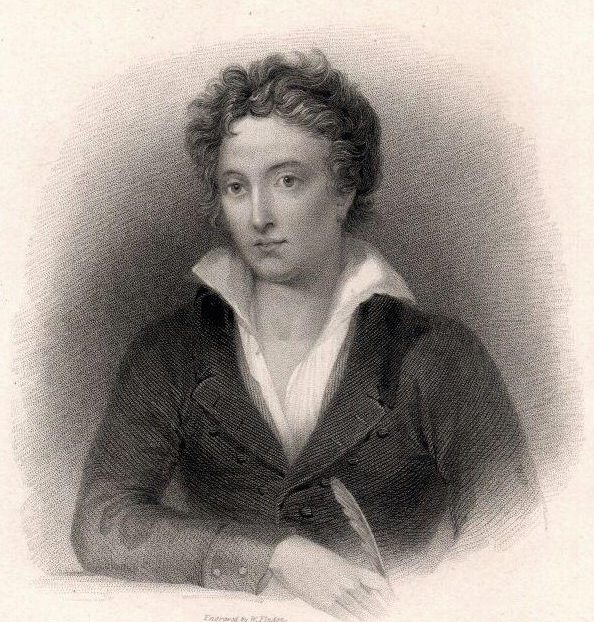
1792–1822
An heir to a baronetcy who was thrown out of Oxford for atheism, wrote the most famous poem in English about the fall of tyrants, and drowned at twenty-nine leaving his most dangerous work unpublished.
Shelley lived only twenty-nine years and was read by almost nobody while he lived. These five chapters follow the expelled student, the two marriages and the death he could never explain away, the sonnet contest that produced Ozymandias, the massacre that produced The Mask of Anarchy, and the last Italian years in which he wrote Love's Philosophy, defended poetry itself and went down in a storm.
The five chapters
- The Necessity of Atheism — A baronet's heir who chose to be thrown out
- Two Households — Mary Godwin, Harriet, and the Lord Chancellor
- Ozymandias — A sonnet contest and a king in the sand
- Ye Are Many — Peterloo and a poem nobody dared print
- Love's Philosophy and the Last Voyage — An argument from nature, a defence of poetry, and the Gulf of Spezia
Chapter 1 · The Necessity of Atheism
A baronet's heir who chose to be thrown out
1792 – 1813 · Field Place, Sussex · Eton · Oxford · Dublin
Percy Bysshe Shelley was born on 4 August 1792 at Field Place near Horsham in Sussex, the eldest son of Timothy Shelley, a Whig Member of Parliament, and grandson of a rich baronet. He was expected to inherit the title, the land and a seat in Parliament.
At Eton he refused to fag for older boys and was tormented for it; the other boys called him 'Mad Shelley'. He read chemistry, set fire to things, and devoured the radical philosophers, above all William Godwin, whose Political Justice argued that government and marriage were forms of coercion that reason would one day make unnecessary.
In 1810 he went to University College, Oxford. Within months he and his friend Thomas Jefferson Hogg printed a short pamphlet, The Necessity of Atheism, and sent it to bishops and heads of colleges. In March 1811 both were expelled for refusing to say whether they had written it. His father demanded a retraction and Shelley refused. The break with his family was never mended.
That August he eloped to Edinburgh with Harriet Westbrook, the sixteen-year-old daughter of a coffee-house owner, partly, he said, to rescue her from an unhappy school. In 1812 the young couple went to Dublin, where Shelley handed out his Address to the Irish People in the street, arguing for Catholic emancipation and the repeal of the Union. In 1813 he privately printed Queen Mab, a long poem attacking kings, priests and commerce, which radicals would later pirate and read in workshops for decades.
Why this matters
Shelley's politics were not a pose of his poetry; they cost him his family, his inheritance's comforts and his university before he had published a single famous poem.
An expelled student handing out pamphlets on a Dublin street. What would you ask him?
Ask Shelley
- “Why send a pamphlet on atheism to the very bishops who would expel you?”
- “What did William Godwin's Political Justice teach you about government?”
- “Why did the boys at Eton call you 'Mad Shelley'?”
- “Why did an English heir argue for the Irish in the streets of Dublin?”
- “Was marrying Harriet at nineteen a rescue or a mistake?”
Chapter 2 · Two Households
Mary Godwin, Harriet, and the Lord Chancellor
1814 – 1817 · London · Lake Geneva · Marlow
Shelley sought out William Godwin in London, and in 1814 fell in love with Godwin's daughter Mary, then sixteen. In July 1814 they left for the Continent together, taking Mary's stepsister Claire Clairmont with them. Harriet was pregnant with their second child, Charles, who was born that November. Shelley's ideas held that a marriage without love should simply end; Harriet was left with a child, a baby on the way and an allowance.
In the summer of 1816 the Shelleys stayed near Lord Byron by Lake Geneva, where Mary began Frankenstein. That December Harriet Westbrook was found drowned in the Serpentine in London. She was twenty-one, alone and pregnant, and her death is generally accepted as suicide. What Shelley felt is hard to know from the outside: his letters at the time blame her family, and he wrote little about her afterwards, but friends recorded that the memory pursued him. It is fair to say that he had abandoned her and that her life after 1814 was desperately unhappy.
Shelley and Mary married on 30 December 1816. Harriet's family went to the Court of Chancery to keep her two children, Ianthe and Charles, from him. In 1817 the Lord Chancellor, Lord Eldon, ruled against Shelley, citing his published opinions on religion and marriage. He never raised his first children.
The household moved to Marlow on the Thames, where Shelley worked on a long revolutionary poem, gave money to the poor of the town, and, in the winter of 1817, entered a sonnet contest with a friend.
Why this matters
The man who wrote against tyranny caused real suffering in his own life; an honest reading of his poems has to hold both facts at once.
A new marriage, a death in the Serpentine, and a court that took his children. What would you ask him?
Ask Shelley
- “Did your belief that loveless marriages should end make it easier to leave Harriet?”
- “What responsibility do you accept for Harriet's unhappiness after 1814?”
- “Why did Lord Eldon think your opinions made you unfit to raise your children?”
- “What did you and Byron argue about by Lake Geneva in the summer of 1816?”
- “How did Mary Godwin change the way you wrote?”
Chapter 3 · Ozymandias
A sonnet contest and a king in the sand
1817 – 1818 · Marlow · London · The British Museum
Late in 1817 Shelley and his friend the banker-poet Horace Smith agreed each to write a sonnet on the same subject: a ruined statue of the Egyptian pharaoh Ramesses II, whom the Greeks called Ozymandias. The ancient historian Diodorus Siculus had recorded an inscription said to stand on one of his statues, boasting that anyone who wished to know how great he was should surpass his works. Europe was excited about Egypt: a colossal granite head of Ramesses had been dragged from Thebes by the adventurer Giovanni Belzoni and was on its way to the British Museum. Shelley never went to Egypt and never needed to.
His poem appeared in Leigh Hunt's radical weekly The Examiner on 11 January 1818, signed 'Glirastes'. It is told at two removes — the poet meets a traveller who describes what he saw — and that distance matters. The statue lies broken in the desert: two legs standing, a shattered face with a sneer of cold command. The sculptor, the poem says, read that passion well. Then comes the king's boast on the pedestal, and then the one plain fact that answers it: nothing else is left, only the sand stretching away.
The sonnet bends its own rules, mixing the patterns of the Italian and English forms, as if the structure itself were cracking. Its target was not only Egypt. In 1817 the British government had suspended habeas corpus and was hanging and transporting protesters. A reader of The Examiner would have heard a warning to the Regent and his ministers: power that rests on fear lasts exactly as long as stone.
“Nothing beside remains.”
— Ozymandias, published in The Examiner, 11 January 1818
Why this matters
Ozymandias is about the arrogance and transience of power, and it was published in a radical newspaper at a moment when that argument was dangerous in Britain.
A broken statue, a sculptor who mocked his king, and a boast answered by sand. What would you ask him?
Ask Shelley
- “Why did you tell the poem through a traveller instead of describing the statue yourself?”
- “Is the sculptor in Ozymandias mocking the king or serving him?”
- “Which British rulers did you want readers of The Examiner to think of?”
- “Why break the usual sonnet rhyme scheme in Ozymandias?”
- “Did you think your sonnet beat Horace Smith's?”
Chapter 4 · Ye Are Many
Peterloo and a poem nobody dared print
1818 – 1819 · Venice · Rome · Livorno · Manchester
In March 1818 the Shelleys left England for Italy, partly for his health and partly to escape debts and hostility. Italy gave him light, ruins and freedom, and it took two of his children: his daughter Clara died in Venice in September 1818 and his son William in Rome in June 1819. Mary fell into a deep depression. Their son Percy Florence, born that November, was the only child of the marriage to survive.
On 16 August 1819 a crowd of perhaps sixty thousand people gathered at St Peter's Field in Manchester to hear the reformer Henry Hunt speak for the vote. Local magistrates sent in the yeomanry, mounted and armed with sabres, to arrest him. Around eighteen people were killed and hundreds were injured. The newspapers called it Peterloo, a bitter joke on Waterloo.
The news reached Shelley near Livorno in September. In a matter of days he wrote The Mask of Anarchy, a long ballad in which the government ministers ride by in a procession of murder, fraud and hypocrisy, led by Anarchy dressed as a king. Its answer is astonishing for its time: the people should assemble in vast numbers, stand still, fold their arms, and let the soldiers strike until they are ashamed. It is one of the earliest poetic statements of mass non-violent resistance.
He sent it to Leigh Hunt to publish. Hunt, who had already been jailed for libelling the Prince Regent, did not dare. The poem was published in 1832, the year of the Reform Act, a decade after Shelley's death.
“Ye are many — they are few.”
— The Mask of Anarchy, written 1819, first published 1832
Why this matters
The Mask of Anarchy shows Shelley the political poet answering a real massacre — the same mind that wrote Ozymandias, now calling the many to act.
A massacre in Manchester, two children dead in Italy, and a ballad nobody would print. What would you ask him?
Ask Shelley
- “Why did you tell the crowd to stand still rather than fight back?”
- “How did news of Peterloo reach you in Italy, and what did you feel?”
- “Why did Leigh Hunt refuse to publish The Mask of Anarchy?”
- “How did the deaths of Clara and William change your work in Italy?”
- “Does a poem about a ruined king connect to a poem about Peterloo?”
Chapter 5 · Love's Philosophy and the Last Voyage
An argument from nature, a defence of poetry, and the Gulf of Spezia
1819 – 1822 · Florence · Pisa · Lerici · Viareggio
In December 1819 Leigh Hunt printed a short lyric of Shelley's in his paper The Indicator under the title Love's Philosophy. It is an argument dressed as a song. The speaker points to fountains mingling with rivers, rivers with the ocean, winds of heaven mixing, mountains kissing the sky and waves clasping one another, and concludes that nothing in the world is single: everything meets by a divine law. So why not you with me? Each stanza ends on a question, and the poem never records an answer. Students argue whether it is a celebration of love as the bond of nature, as Shelley's philosophy taught, or a clever, slightly desperate piece of persuasion whose listener stays silent.
The Shelleys settled in Pisa, at the centre of a circle that included Byron, Edward and Jane Williams and, later, the adventurer Edward Trelawny. Shelley wrote Prometheus Unbound, Ode to the West Wind and, in 1821, A Defence of Poetry, an answer to his friend Peacock's joke that poetry was obsolete. When he heard that John Keats had died in Rome he wrote the elegy Adonais.
In the summer of 1822 the Shelleys and Williamses took a house at Lerici on the Gulf of Spezia. On 8 July Shelley and Edward Williams sailed home from Livorno in their new boat, the Don Juan, with a boat-boy, Charles Vivian. A storm hit and the boat sank. The bodies washed ashore days later. On the beach near Viareggio, with Byron and Hunt present, Trelawny burned Shelley's body, as Italian quarantine law required. He was twenty-nine.
“Poets are the unacknowledged legislators of the World.”
— A Defence of Poetry, written 1821, published 1840
Why this matters
Love's Philosophy applies the same habit of mind as Ozymandias — reading nature as an argument — but turns it from politics to persuasion, and leaves its question unanswered.
A love song shaped as an argument, a defence of poetry, and a storm off Lerici. What would you ask him?
Ask Shelley
- “Is the speaker of Love's Philosophy sincere, or is he just trying to win an argument?”
- “Why does every stanza of Love's Philosophy end on a question?”
- “What did you mean by calling poets unacknowledged legislators?”
- “Why did the death of Keats move you to write Adonais?”
- “Does nature in Love's Philosophy obey the same law as the desert in Ozymandias?”
What Shelley changed
Shelley was barely read in his lifetime, but The Mask of Anarchy was recited at Chartist meetings, reprinted by socialists and quoted by campaigners for non-violent protest well into the twentieth century. Ozymandias became the English language's standard image of fallen power. His wife Mary edited and published his poems after his death and did more than anyone to make him famous.
A debate that continues
Critics still disagree about how to weigh Shelley's ideals against his conduct — whether his treatment of Harriet Westbrook and the women around him undermines his claims about love and liberty, or whether the work must be judged on its own terms.
Keep exploring — ask Shelley
- “Is Ozymandias more hopeful or more despairing about human power?”
- “Can a poet's private failings change how we read his public poems?”
- “Why did a poem about Peterloo take thirteen years to reach print?”
Related lives
- Mary Shelley — Mother of Science Fiction
- John Keats — Who Could Stay In The Uncertainty
- William Wordsworth — Who Was Followed Home By A Mountain
- Mary Wollstonecraft — Founder of Modern Feminism
Related themes
Romantic poetry · The Peterloo Massacre · Power and conflict poetry · Non-violent protest
Continue on Incandio
- Talk to Shelley — every question on this page is one tap from being asked, and the same page carries the Historical Brief, the achievements and the timeline
- All 280 figures · Incandio — learn every idea, teach it, then defend it