Explore Their Life · Pearson Edexcel International GCSE revision on Incandio
Phyllis Schlafly: A Life in Five Chapters
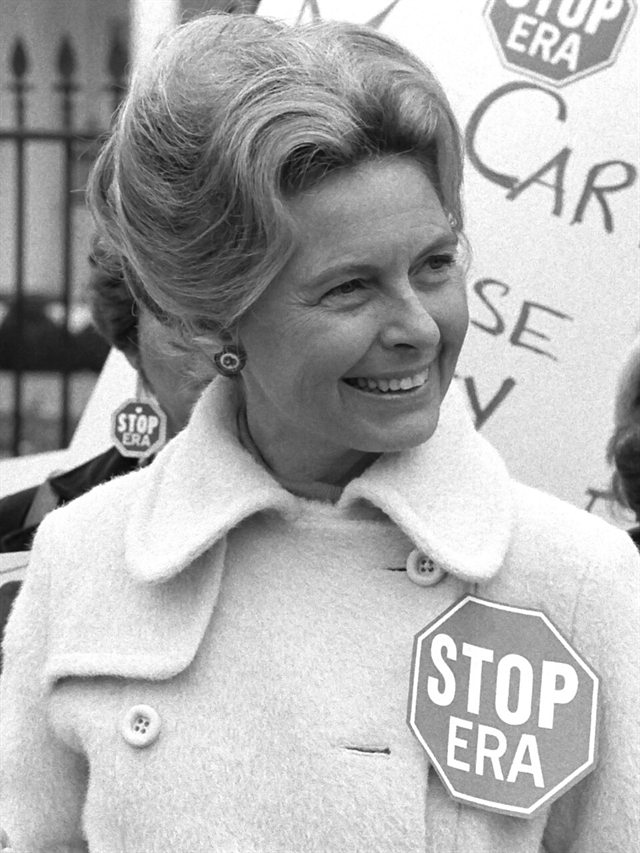
1924–2016
A woman who paid for her degree by testing ammunition on a night shift, wrote a book that sold three million copies, and stopped a constitutional amendment that had already passed Congress and thirty states.
Schlafly is on this course because she won. These five chapters follow the ordnance plant and the degrees, the self-published book that reshaped the Republican Party, the campaign against the Equal Rights Amendment, the argument her opponents made about her own life, and what the defeat of the ERA actually settled.
The five chapters
- The Night Shift — Testing ammunition to pay for a degree
- A Choice Not an Echo — Three million copies, self-published
- STOP ERA — Thirty-five states, and three short
- The Argument Against Her — What her opponents said, in their own terms
- What the Defeat Settled — A movement that lost a symbol and kept its statutes
Chapter 1 · The Night Shift
Testing ammunition to pay for a degree
1924 – 1949 · St Louis · Cambridge, Massachusetts
Phyllis Stewart was born in St Louis in 1924. Her father lost his job in the Depression and was unemployed for years; her mother supported the family working in a library and a department store. The household was Catholic, and money was a constant problem.
She paid her own way through Washington University in St Louis by working the night shift at a wartime ordnance plant, firing rifles and machine guns to test ammunition and observing the results. She worked forty-eight hours a week and graduated in three years.
She then took a master's in government at Radcliffe, the women's college associated with Harvard, and went to Washington to work for a research organisation. She married Fred Schlafly, a lawyer, in 1949, and had six children, whom she taught to read herself before they went to school.
Much later, at fifty-four, she took a law degree at Washington University — against her husband's initial objection, which she overrode.
The biography matters because of what her opponents said about her and what she said in reply. She was not a woman who had stayed at home. She was a graduate of two universities with a national organisation and a staff, arguing that homemaking was a role the law should continue to protect, and she never regarded that as a contradiction.
Why this matters
Schlafly's own career is the first thing anyone raises against her argument, and understanding how she answered it is necessary to understanding why the argument worked.
A degree paid for on a munitions night shift. What would you ask her?
Ask Schlafly
- “What was it like testing ammunition on a night shift at nineteen?”
- “How did the Depression years shape your politics?”
- “Why take a law degree at fifty-four?”
- “Was there any tension between your career and your argument?”
- “What did you want for your daughters?”
Chapter 2 · A Choice Not an Echo
Three million copies, self-published
1952 – 1968 · Alton, Illinois · San Francisco
Schlafly ran for Congress in 1952 and lost, and stayed in Republican politics as an organiser. In 1964 she wrote a short book called A Choice Not an Echo, arguing that Republican presidential nominations were settled in advance by a small group of eastern financiers and party officials, and that ordinary members were offered candidates who barely differed from the Democrats.
She could not find a publisher and printed it herself. It sold something over three million copies, largely through volunteer distribution networks, and it became the organising text of the campaign that won Barry Goldwater the Republican nomination that year.
Goldwater lost the presidential election catastrophically, and the conventional conclusion was that the conservative wing of the party had been finished by it. Schlafly's conclusion was the opposite: that the machinery had been built, that the mailing lists existed, and that the people who had done the work were still there.
She was right. The networks assembled in 1964 are recognisably the ones that nominated Ronald Reagan in 1980, and Schlafly's organisational method — the newsletter, the volunteer chapter, the mailing list, the phone tree — was the model.
She began the Phyllis Schlafly Report in 1967 and wrote it monthly for the rest of her life.
Why this matters
The conservative movement's organisational method was built from a self-published book and a mailing list, and it long outlasted the candidate it was built for.
A self-published book that sold three million. What would you ask her?
Ask Schlafly
- “Why could you not find a publisher?”
- “How did three million copies actually get distributed?”
- “What did you learn from Goldwater's defeat?”
- “What made a newsletter a political weapon?”
- “Were you ever offered a place inside the party leadership?”
Chapter 3 · STOP ERA
Thirty-five states, and three short
1972 – 1982 · Illinois · The state capitols
The Equal Rights Amendment passed Congress in March 1972 with overwhelming majorities and went to the states. Thirty had ratified within a year. It needed thirty-eight and it was expected to get them.
Schlafly had not been interested in it. She read it, concluded it was dangerous, and in 1972 launched STOP ERA — the letters standing for Stop Taking Our Privileges.
Her argument was specific rather than general, which is why it worked. She did not argue that women were inferior. She argued that American law gave women particular protections that a blanket equality clause would remove: exemption from the military draft, which was live in 1972; the presumption in favour of mothers in custody cases; alimony and spousal support; and provisions protecting widows. She argued that single-sex facilities and institutions would fall. And she argued that a homemaker with no independent income was made more vulnerable, not less, by a law that treated her as identical to a wage-earner.
She organised in the state legislatures, which is where ratification actually happened and where the national women's organisations were weakest. Her supporters lobbied legislators directly, in person, in large numbers, and famously brought home-baked bread and jam to state capitols with notes attached.
Ratification stopped at thirty-five states. Five voted to rescind. The deadline, extended once, expired in 1982.
Why this matters
The ERA was defeated in the state legislatures by an argument about specific legal protections, not by a general claim about women's abilities.
Three states short, and bread delivered to legislators. What would you ask her?
Ask Schlafly
- “Which specific protection did you think the ERA would remove first?”
- “How much did the draft matter to your campaign in 1972?”
- “Why concentrate on state legislatures rather than national opinion?”
- “Who were the women who campaigned with you?”
- “Would you have supported a narrower amendment?”
Chapter 4 · The Argument Against Her
What her opponents said, in their own terms
1972 – 1982 · Illinois · Houston
Her opponents made three arguments and it is worth having them stated properly.
The first was about her own life: that a woman with a master's degree, a national organisation, a staff and a public career was telling other women that their place was the home, and that the position was only available to somebody who had already ignored it. Schlafly's answer was that she was arguing for the legal protection of a choice, not for compulsion, and that she had made her own choice under laws she wanted preserved.
The second was that the protections she defended were themselves the problem — that alimony and custody presumptions rested on the assumption that a woman could not support herself, and that removing them was the point rather than a side effect.
The third was practical: that most of what she warned about happened anyway. Women were admitted to the military academies from 1976, laws were made sex-neutral by legislation and by court decisions under the Fourteenth Amendment, and single-sex facilities did not disappear. On this reading the ERA was defeated over consequences it would not have produced.
Against that, her supporters point out that she predicted something her opponents denied at the time — that a constitutional amendment would be interpreted by courts in ways nobody in 1972 could specify — and that arguing about an unwritten future was exactly what a permanent amendment required.
The learner is not obliged to settle this, and the specification does not ask them to.
Why this matters
The ERA argument is the clearest case on this course where both sides made checkable predictions, and where checking them does not produce a simple verdict.
Three arguments against her, and her answers. What would you put to her?
Ask Schlafly
- “How do you answer people who say your own career refutes you?”
- “Were alimony and custody rules protections or assumptions of weakness?”
- “Much of what you warned about happened without the ERA. Were you wrong?”
- “Should an amendment be judged on what courts might make of it?”
- “What did you think of the women who campaigned against you?”
Chapter 5 · What the Defeat Settled
A movement that lost a symbol and kept its statutes
1982 – 2016 · Illinois · Washington
Schlafly ran the Eagle Forum for the rest of her life, wrote her monthly report, published books, and remained a figure in Republican politics until her death in 2016 at ninety-two.
What her victory settled is narrower than it looks. The ERA failed, and the constitutional statement of equality was not made. Almost everything the women's movement had achieved by statute and by litigation survived and grew: the Equal Pay Act of 1963, the sex clause in Title VII of the Civil Rights Act of 1964, Title IX in 1972, the Equal Credit Opportunity Act of 1974, and the line of Supreme Court decisions applying the Fourteenth Amendment to sex discrimination from 1971 onwards.
So the ERA campaign is the movement's most visible defeat and not its most consequential one, and Schlafly's campaign is the conservative movement's clearest demonstration that a determined minority organised in the right places can stop something a large majority appears to want.
That second lesson is the one that mattered most for American politics. The methods used against the ERA — state-level organising, single-issue mobilisation, direct lobbying of legislators, mailing lists and newsletters — became standard, and were used afterwards on a great many issues by people who had never heard of the amendment.
Why this matters
The ERA's defeat is a lesson about political method as much as about the amendment, and the method outlived the argument.
A symbol defeated and the statutes untouched. What would you ask her?
Ask Schlafly
- “Did stopping the ERA change women's legal position at all?”
- “What did you teach other campaigns about how to win?”
- “Should a minority be able to block what a majority wants?”
- “Which of your arguments do you now think was strongest?”
- “What did the women's movement get right?”
What Schlafly changed
Schlafly stopped a constitutional amendment that had passed Congress overwhelmingly and had thirty of the thirty-eight states it needed within a year, and she did it with an argument about specific legal protections rather than about women's capacities. The organising method she used — state-level, single-issue, volunteer, built on a mailing list — became standard in American politics and was used long afterwards by campaigns with nothing else in common with hers.
A debate that continues
Did the ERA's defeat cost American women anything in law, given that Title VII, Title IX and the Fourteenth Amendment delivered most of what it would have declared? Historians of the period are genuinely divided.
Keep exploring — ask Schlafly
- “Can a person argue for a way of life they have not lived?”
- “Is a constitutional statement worth more than a set of statutes?”
- “Why do organised minorities so often defeat unorganised majorities?”
Related lives
- Eleanor Roosevelt — First Lady of the World
- Lyndon B. Johnson — What The Hell's The Presidency For
- Fannie Lou Hamer — Sick And Tired Of Being Sick And Tired
Related themes
The Equal Rights Amendment · The women's movement · American conservatism
Continue on Incandio
- Talk to Schlafly — every question on this page is one tap from being asked, and the same page carries the Historical Brief, the achievements and the timeline
- All 280 figures · Incandio — learn every idea, teach it, then defend it