Explore Their Life · Pearson Edexcel International GCSE revision on Incandio
Sophie Scholl: A Life in Five Chapters
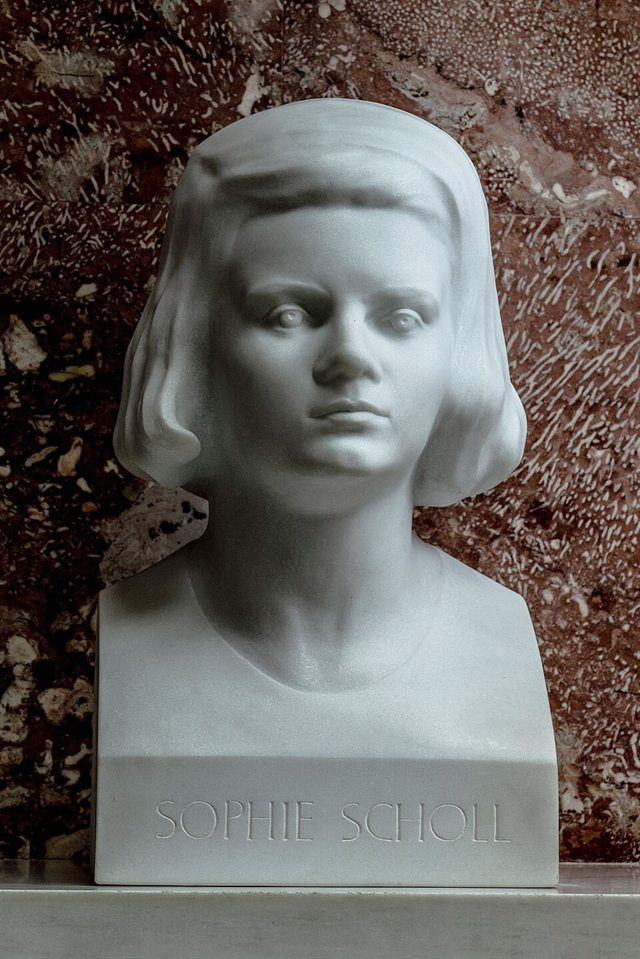
1921–1943
A girl who joined the League of German Girls and enjoyed it, and who at twenty-one pushed a stack of leaflets off a balustrade in Munich because she had decided somebody had to say it out loud.
Sophie Scholl is the best-known figure of German resistance and the hardest to write about honestly, because the temptation is to make her extraordinary from the beginning. She was not. These five chapters follow an ordinary enthusiastic girl, the family that changed her mind, the university year, the leaflets, and the four days between an arrest and an execution.
The five chapters
- The Girl Who Joined — Enthusiasm first, and doubt afterwards
- Munich, and What Her Brother Was Already Doing — A university year that lasted nine months
- The Eighteenth of February — A stack of leaflets and an empty atrium
- The People's Court — Four days from arrest to execution
- Afterwards — A statue, a stamp, and the risk of making her a saint
Chapter 1 · The Girl Who Joined
Enthusiasm first, and doubt afterwards
1921 – 1937 · Forchtenberg · Ulm
Sophie Scholl was born in 1921 at Forchtenberg, a small town in Württemberg where her father Robert was mayor. The family moved to Ulm in the 1930s. She was the fourth of six children in a household that read, argued and sang.
When the Nazis came to power she was eleven, and like most of her generation she joined the youth organisations — the League of German Girls — and she liked it. She was made a squad leader. Her brother Hans was a Hitler Youth flag-bearer and went to the Nuremberg rally. This is the part of the story that is usually hurried past, and it is the part that matters most: the Scholls were not raised in opposition. They were recruited, willingly, like almost everybody else.
What changed was slow and domestic. Their father, a convinced opponent, argued with them at home. Books the regime disapproved of circulated and were read. Hans and other members of the family were briefly arrested in 1937 in a sweep against a banned youth movement, and being questioned by the Gestapo at sixteen is an education of a particular kind.
Sophie went on to train as a kindergarten teacher — partly because she hoped it would count instead of the compulsory National Labour Service, which it did not. She spent six months in the Labour Service and six more as a nursery assistant before she could go to university at all.
Why this matters
Resistance did not come from people raised outside the regime. It came from inside its own youth organisations, which is why the way she changed her mind is the important part.
An enthusiastic squad leader at twelve. What would you ask her?
Ask Sophie
- “What did you enjoy about the League of German Girls when you joined?”
- “How did your father argue with you about it at home?”
- “What did being questioned by the Gestapo at sixteen teach you?”
- “Did the Labour Service feel like service or like a waste of a year?”
- “When did you first think the regime was wrong rather than merely irritating?”
Chapter 2 · Munich, and What Her Brother Was Already Doing
A university year that lasted nine months
May 1942 – February 1943 · Munich · The University of Munich
Sophie arrived at the University of Munich in May 1942 to read biology and philosophy. She was twenty-one. Her brother Hans was already there, studying medicine, and he was already writing leaflets.
The group around him — Alexander Schmorell, Christoph Probst, Willi Graf, and later the philosophy professor Kurt Huber — had produced four leaflets that summer, typed and duplicated and posted to addresses taken from telephone directories, signed The White Rose. Hans did not tell his sister. She found out, and insisted on joining, and from that point she did a great deal of the practical work: buying paper and stamps in small quantities from different shops so that nothing was noticed, addressing envelopes, travelling with a suitcase.
The men in the group were medical students in a student company and were sent to the Eastern Front for three months in the summer of 1942. What they saw there — the treatment of Soviet prisoners, the Warsaw ghetto glimpsed from a train — is recorded in their letters and it hardened everything.
The leaflets themselves are unusual documents. They quote Goethe, Schiller, Aristotle and Novalis, and they are addressed to educated Germans in the language educated Germans respected. The second one states that three hundred thousand Jews had been murdered in Poland — one of very few German texts of the period to say so in print at all.
Why this matters
The White Rose was six people with a duplicating machine, and the second leaflet named the murder of Polish Jews at a time when almost no German document did.
Paper bought in small amounts from different shops. What would you ask her about that year?
Ask Sophie
- “Why did you insist on joining once you found out what Hans was doing?”
- “How did you buy paper and stamps without being noticed?”
- “Why fill the leaflets with Goethe and Schiller?”
- “What did the men bring back from the Eastern Front?”
- “Did you expect the leaflets to change anything?”
Chapter 3 · The Eighteenth of February
A stack of leaflets and an empty atrium
18 February 1943 · The University of Munich
By February 1943 Stalingrad had fallen and the group had become bolder. Slogans had been painted on walls in Munich. A sixth leaflet had been written, addressed to fellow students and calling the war lost.
On the morning of 18 February Hans and Sophie carried a suitcase of leaflets into the university and left them outside lecture-room doors while the lectures were still running. They were about to leave when they realised there were copies left in the case. They went back up to the top floor, and Sophie pushed the remaining stack over the balustrade into the atrium so that they fell through the light well.
The caretaker, Jakob Schmid, saw her do it. He locked the doors and called the authorities. They were arrested within minutes.
Everything after that ran extremely fast. They were interrogated over the next three days. Sophie first denied everything and then, when the evidence made denial pointless, took as much responsibility as she could in an attempt to protect the others — which did not work, because a draft in Hans's pocket carried Christoph Probst's handwriting.
Why she threw the leaflets has been argued about ever since. She never explained it in any surviving document. It is possible it was a mistake made in a hurry. It is possible it was deliberate. Both readings are held by serious historians and neither can be proved.
Why this matters
The most famous act of German student resistance turned on a caretaker looking up, and on a decision nobody has been able to explain.
One stack of paper over a balustrade. What would you ask her?
Ask Sophie
- “Why did you go back for the leaflets that were left?”
- “What did you say in the first hours of the interrogation?”
- “Did you believe you could protect Christoph Probst by taking the blame?”
- “How much had Stalingrad changed what students would risk?”
- “Would you have done it differently if you had known who was watching?”
Chapter 4 · The People's Court
Four days from arrest to execution
22 February 1943 · Munich · Stadelheim Prison
The trial was held on 22 February 1943, four days after the arrest. Roland Freisler, president of the People's Court, travelled from Berlin to conduct it himself — which tells you what the regime thought was at stake in three students and a professor.
The People's Court was not a court in any sense a lawyer would recognise. Defence counsel did not defend. Freisler shouted at defendants, insulted them and interrupted their answers. The verdict was decided before the hearing opened.
Hans, Sophie and Christoph Probst were sentenced to death. Executions under such sentences were normally carried out after an interval of weeks. These were carried out the same afternoon, by guillotine, at Stadelheim prison. Sophie was twenty-one. Christoph Probst had three children, the youngest a few weeks old.
Their parents were allowed a brief visit beforehand. What was said in it is known only from an account written afterwards by their sister Inge, and a number of the sentences that circulate as Sophie's last words come from that account or from later dramatisations rather than from any contemporary record. It is worth saying plainly, because a life this short deserves not to be embroidered.
A second trial in April sentenced Kurt Huber, Willi Graf and Alexander Schmorell to death. The sixth leaflet was smuggled out of Germany and, later that year, was dropped over German cities in millions of copies by Allied aircraft.
Why this matters
The regime sent the president of the People's Court from Berlin to try three students, which is a measure of how dangerous it considered a leaflet.
Four days from a balustrade to a guillotine. What would you ask her?
Ask Sophie
- “What was it like to be shouted at by Freisler in that courtroom?”
- “Did you know the sentence before the trial began?”
- “What did you want your parents to understand when they visited?”
- “Was it worth it, knowing the leaflets reached so few people?”
- “What would you say to a student who wanted to do what you did?”
Chapter 5 · Afterwards
A statue, a stamp, and the risk of making her a saint
1945 – now · Munich · Germany
After the war the White Rose became one of the very few pieces of German history from those years that Germans could point to without qualification, and it was used accordingly. Squares and schools were renamed. The Geschwister-Scholl-Institut was founded at Munich. Sophie appeared on a stamp and in a bust in the Walhalla memorial. Polls have repeatedly placed her among the most admired Germans of the twentieth century.
That is deserved and it carries a risk, and German historians have been the first to say so. A resistance movement of a few dozen people, in a country of sixty-six million, is not evidence that the regime was widely opposed. It is evidence of how few opposed it. The White Rose has sometimes been used to make a national story more bearable than the record supports.
The other risk is to Sophie herself. She is easily turned into a figure of pure conviction who was never anything else, and the documents show a young woman who joined the League of German Girls, enjoyed it, changed her mind slowly under argument at home and from what she read, and then acted. The second version is more useful to anybody trying to work out how a person comes to refuse.
What is not in doubt is what it cost. She had nine months at university and four days between an arrest and a guillotine.
Why this matters
How a country remembers its resisters can tell you as much about the country afterwards as about the resistance.
A stamp, a square and a caution from historians. What would you ask her about being remembered?
Ask Sophie
- “How would you feel about being the face of German resistance?”
- “Does a few dozen resisters prove opposition or prove its absence?”
- “What would you want left out of the story about you?”
- “Why do you think the sixth leaflet ended up dropped from Allied aircraft?”
- “What should a school named after you actually teach?”
What Sophie changed
The White Rose produced six leaflets and lasted about eight months, and it is the piece of German resistance that became a national symbol. Sophie Scholl's real value to anyone studying the period is not that she was exceptional but that she started where almost every German child of her generation started, inside the regime's own youth organisation, and then changed her mind — which makes the question of how somebody comes to refuse a question with an answer rather than a mystery.
A debate that continues
Historians disagree about whether commemorating the White Rose so prominently has helped Germans confront the period or given them a comfortable place to stand while avoiding it.
Keep exploring — ask Sophie
- “Is resistance that cannot succeed still worth its cost?”
- “Why did the regime treat six students with a duplicator as a serious threat?”
- “What does a country choose to remember, and what does the choice reveal?”
Related lives
- Martin Niemöller — He Voted For Them First
- Gustav Stresemann — The Republic's Best Servant, And No Republican
- George Orwell — Chronicler of the Total State
Related themes
Opposition in Nazi Germany · Youth movements and the state · Memory and national history
Continue on Incandio
- Talk to Sophie — every question on this page is one tap from being asked, and the same page carries the Historical Brief, the achievements and the timeline
- All 280 figures · Incandio — learn every idea, teach it, then defend it