Explore Their Life · Pearson Edexcel International GCSE revision on Incandio
Theodore Roosevelt: A Life in Five Chapters
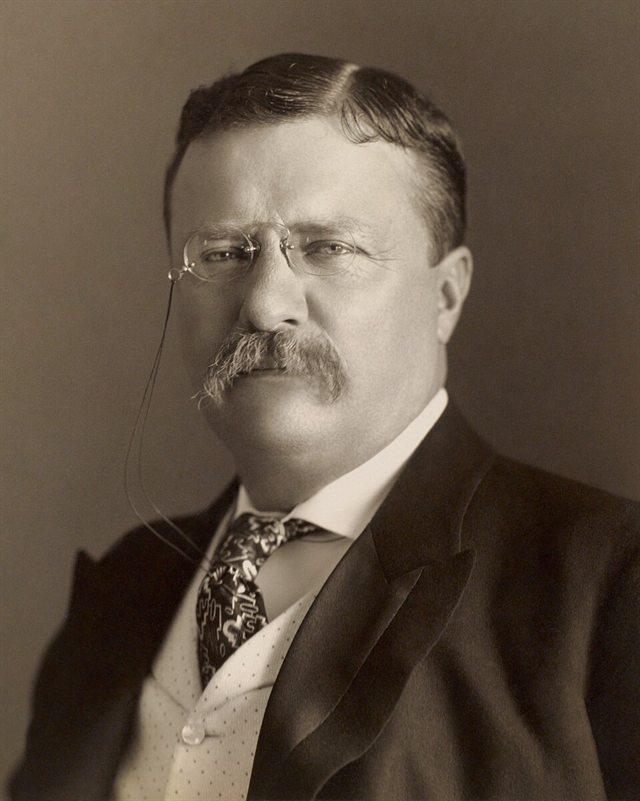
1858–1919
A sickly asthmatic boy who rebuilt himself, became president at forty-two, broke up monopolies, saved 230 million acres of American land — and was an unapologetic imperialist.
Roosevelt was a rancher, a police commissioner, a naturalist, a war hero, an author of about forty books and the youngest president in American history. He expanded what a president could do and used it for both conservation and conquest. These five chapters follow the energy and the harm together.
The five chapters
- The Boy Who Could Not Breathe — Asthma, a father's challenge, and a lifelong theory
- The Light Has Gone Out — Two deaths in one day, and the Dakota Badlands
- The Square Deal — A president who took on the trusts
- Wilderness and the Canal — 230 million acres, and 'I took the Isthmus'
- Bull Moose and the River of Doubt — A split party, a bullet, and an Amazon tributary
Chapter 1 · The Boy Who Could Not Breathe
Asthma, a father's challenge, and a lifelong theory
1858 – 1880 · New York City · Harvard
Theodore Roosevelt was born in New York City on 27 October 1858 into an old, wealthy Dutch-descended family. He was a severely asthmatic child, in an era with no effective treatment; attacks left him fighting for air, and he was educated largely at home because he was too ill for school.
His father — whom he adored and called the best man he ever knew — told him, in the family's account, that he had the mind but not the body, and that he must make his body. The boy took it literally, taking up boxing, weights and relentless outdoor exertion, and built the doctrine he later called the strenuous life around the experience.
He was also, from childhood, a serious naturalist. He kept a 'Roosevelt Museum of Natural History' in his bedroom, learned taxidermy at thirteen, and published on birds while still a teenager. At Harvard he intended to become a scientist and changed course only when he realised laboratory work meant staying indoors.
His father died in 1878 while Theodore was at Harvard, a blow he described as the loss of the only person he had ever entirely depended on. He married Alice Hathaway Lee in 1880, entered Columbia Law School, found it dull, and abandoned it for the New York State Assembly at twenty-three — where he made a name attacking corruption in both parties.
Why this matters
Roosevelt's conservation record and his cult of physical exertion both come from the same source: a childhood spent unable to breathe and a decision to live outdoors.
You have met the boy who rebuilt himself. What would you ask him?
Ask Roosevelt
- “What did your father actually tell you about making your body?”
- “How serious were you about becoming a naturalist?”
- “What did you mean by the strenuous life?”
- “Why did you leave law school for politics at twenty-three?”
- “What did you take on in the New York Assembly?”
Chapter 2 · The Light Has Gone Out
Two deaths in one day, and the Dakota Badlands
1884 – 1898 · Dakota Territory · Washington · New York · Cuba
On 14 February 1884, in the same house, Roosevelt's mother died of typhoid and his wife Alice died of undiagnosed kidney failure two days after giving birth to their daughter. He wrote a large X in his diary and one line beneath it: the light has gone out of my life. He almost never spoke of Alice again, even to their daughter.
He left the baby with his sister and went to the Dakota Badlands, where he ran a cattle ranch for two years, rode with cowboys, hunted, and once tracked and arrested three boat thieves, reading Tolstoy while guarding them. The blizzard of 1886–87 destroyed most of his herd and much of his investment. He came back east having learned the American West at first hand — and having seen the bison nearly exterminated, which shaped his conservation politics permanently.
He married Edith Carow, a childhood friend, in 1886, and they had five more children.
The next decade was a climb through unglamorous offices — the federal Civil Service Commission, then New York City Police Commissioner, where he walked the beats at night to catch officers sleeping, then Assistant Secretary of the Navy. In 1898, with war against Spain declared, he resigned to raise a volunteer cavalry regiment, the Rough Riders, and led the charge up Kettle and San Juan Heights in Cuba. He came home a national hero, was elected Governor of New York, and was made Vice-President in 1900 largely by state bosses who wanted him out of the way.
Why this matters
Roosevelt's years in the Badlands turned an eastern politician into a westerner in his own mind, and gave him the direct experience of vanishing wildlife that drove his conservation programme.
You have seen him lose everything and rebuild. What would you ask him?
Ask Roosevelt
- “How did you carry on after losing your wife and mother on one day?”
- “What did ranching in Dakota teach you?”
- “What did you find when you walked the beats as police commissioner?”
- “Why did you resign your office to go and fight in Cuba?”
- “Did you understand the war with Spain as a war of empire?”
Chapter 3 · The Square Deal
A president who took on the trusts
1901 – 1909 · Washington · Pennsylvania
President McKinley was shot in September 1901 and died eight days later. Roosevelt, forty-two, became the youngest president in American history. One party boss reportedly groaned that a madman was now in the White House.
His programme, which he called the Square Deal, rested on the idea that the federal government should act as an umpire between capital, labour and the public rather than as an ally of business. In 1902 he used the Sherman Antitrust Act against Northern Securities, a railroad combination assembled by J. P. Morgan, and won in the Supreme Court — the first time a president had broken up a major trust. He pursued dozens more, while distinguishing between what he called good and bad trusts, a distinction critics found conveniently vague.
The anthracite coal strike of 1902 was the other precedent. With winter coming and mines shut, Roosevelt summoned owners and miners to the White House and threatened to have the army run the mines. It was the first time a president intervened in a labour dispute as a neutral rather than on the employers' side.
After reading Upton Sinclair's *The Jungle*, he ordered an investigation of the meatpacking industry and drove through the Pure Food and Drug Act and the Meat Inspection Act of 1906 — the beginning of federal consumer protection.
He described the presidency as a bully pulpit, and used publicity as a weapon in a way no predecessor had.
Why this matters
Roosevelt established the modern activist presidency: a federal executive that regulates business, mediates labour disputes and protects consumers, all of which had been largely unthinkable before 1901.
You have the Square Deal in front of you. What would you ask him?
Ask Roosevelt
- “Why did you take on J. P. Morgan's railroad trust?”
- “What is the difference between a good and a bad trust?”
- “Why did you intervene in the coal strike instead of backing the owners?”
- “What did The Jungle make you do?”
- “What did you mean by the bully pulpit?”
Chapter 4 · Wilderness and the Canal
230 million acres, and 'I took the Isthmus'
1901 – 1909 · Yosemite · Grand Canyon · Panama
Roosevelt's conservation record is the most durable part of his presidency. He placed roughly 230 million acres under federal protection: 150 national forests, 51 federal bird reservations, five national parks, and eighteen national monuments created by using the Antiquities Act of 1906 in ways Congress had not anticipated — including the Grand Canyon, which he protected as a monument when a park bill was blocked. He camped in Yosemite with John Muir in 1903, and the two men argued about whether wilderness should be preserved untouched or managed for use, a debate American environmentalism has never settled.
His foreign policy was the other side of the same energy. When Colombia's senate refused terms for a canal across Panama, Roosevelt supported a Panamanian secession, recognised the new republic within days, and had a treaty signed within a fortnight. Construction of the canal followed, at a cost of thousands of workers' lives, most of them Caribbean labourers. He later said, in a phrase that caused a row, that he took the Isthmus.
The Roosevelt Corollary of 1904 asserted a US right to intervene in the Western Hemisphere to prevent European intervention, and was used to justify repeated interventions in Central America and the Caribbean for decades.
His record on race was mixed and, at its worst, indefensible. He invited Booker T. Washington to dine at the White House in 1901, provoking racist fury across the South. In 1906, after an incident at Brownsville, Texas, he ordered the dishonourable discharge of 167 Black soldiers without trial on collective suspicion; the discharges were reversed in 1972, long after almost all the men had died.
Why this matters
Roosevelt's presidency created the American conservation system and the tradition of unilateral US intervention in Latin America — two legacies of the same conviction that a strong executive should act first and argue later.
You have the parks and the canal side by side. What would you ask him?
Ask Roosevelt
- “Why did you protect the Grand Canyon by declaring it a monument?”
- “What did you and John Muir disagree about?”
- “How do you justify what you did in Panama?”
- “Why did you discharge the Brownsville soldiers without a trial?”
- “What made the reaction to dining with Booker T. Washington so violent?”
Chapter 5 · Bull Moose and the River of Doubt
A split party, a bullet, and an Amazon tributary
1909 – 1919 and after · Africa · Milwaukee · Brazil
Roosevelt left office in 1909, having promised not to seek another term, and went on a year-long expedition in East Africa collecting specimens for the Smithsonian. He returned to find his chosen successor, William Howard Taft, drifting toward the party's conservative wing.
In 1912 he challenged Taft for the Republican nomination, lost it in a bitter fight, and ran anyway as the candidate of the Progressive Party — nicknamed the Bull Moose Party after he declared himself as fit as one. His platform was the most radical of any major American candidate to that point: national health insurance, an eight-hour day, women's suffrage, direct election of senators and limits on campaign finance.
In Milwaukee in October he was shot in the chest by a would-be assassin. The bullet was slowed by a folded fifty-page speech and a steel spectacle case in his breast pocket. He assessed that he was not coughing blood, declined to go to hospital, and delivered the speech with the bullet in him, opening by telling the crowd it took more than that to kill a bull moose. He carried the bullet for the rest of his life.
He split the Republican vote, handing the presidency to Woodrow Wilson. In 1913 he joined an expedition to map an unexplored Amazon tributary, the River of Doubt; he suffered a leg wound that became infected, contracted malaria, lost a quarter of his body weight and urged the party to leave him behind. He never fully recovered. His youngest son Quentin was shot down and killed in France in 1918, and Roosevelt died in his sleep on 6 January 1919, aged sixty.
Why this matters
The 1912 Progressive platform set out an agenda — health insurance, labour rights, campaign finance limits — that American politics spent the next century partly enacting and still argues about.
You have the last decade and the unfinished programme. What would you ask him?
Ask Roosevelt
- “Why did you break with Taft and split your own party?”
- “Why give the speech after being shot?”
- “What was in the 1912 platform that America still has not delivered?”
- “Why go to the Amazon at fifty-five?”
- “Did losing Quentin change how you thought about war?”
What Roosevelt changed
Roosevelt created the modern American presidency as an active regulator and public advocate, established federal consumer protection, and built the national conservation system — forests, parks, monuments and wildlife refuges — that still protects hundreds of millions of acres. His Progressive platform of 1912 also set the agenda for much of twentieth-century American reform.
A debate that continues
Historians argue over whether Roosevelt was a genuine reformer or a conservative who regulated capitalism to save it, and over how far his conservation legacy can be separated from an imperialism that treated Latin America as an American sphere and Black soldiers as expendable.
Keep exploring — ask Roosevelt
- “How did you decide when a president should act without Congress?”
- “What did the West mean to you that the East never could?”
- “Which of your decisions do you think aged worst?”
Related lives
- Eleanor Roosevelt — First Lady of the World
- Rachel Carson — Author of Silent Spring
- John F. Kennedy — 35th President · Commander-in-Chief
Related themes
The Progressive Era · Conservation and the environment · American expansion overseas
Continue on Incandio
- Talk to Roosevelt — every question on this page is one tap from being asked, and the same page carries the Historical Brief, the achievements and the timeline
- All 280 figures · Incandio — learn every idea, teach it, then defend it