Explore Their Life · Pearson Edexcel International GCSE revision on Incandio
Theodor Schwann: A Life in Five Chapters
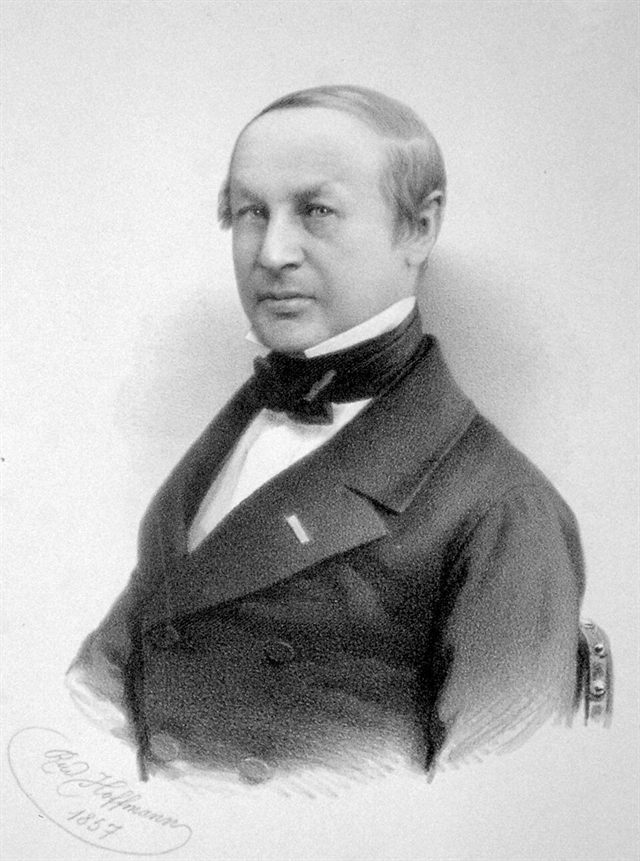
1810–1882
The man who realised that animals are built the same way plants are, published it at twenty-nine, was publicly mocked for a different discovery he was right about, and did almost nothing after thirty-five.
Schwann isolated the first enzyme, proved fermentation is caused by a living organism, and extended cell theory to the whole of the animal kingdom — all before he was thirty. Then two of the most powerful chemists in Europe published a satire ridiculing him, and he withdrew. These five chapters follow a very short and very consequential career.
The five chapters
- Berlin, Under Müller — A goldsmith's son in the best laboratory in Europe
- The Anonymous Satire — Right about yeast, and ridiculed for it in print
- A Dinner in October — A conversation about nuclei, and a tadpole's notochord
- Where a New Cell Comes From — The half of the theory that was wrong
- Forty Years of Quiet — A word coined, a sheath named, and almost nothing else
Chapter 1 · Berlin, Under Müller
A goldsmith's son in the best laboratory in Europe
1810 – 1836 · Neuss · Bonn · Würzburg · Berlin
Theodor Schwann was born at Neuss on the Rhine in December 1810, the son of a goldsmith who became a printer. He was a devout Catholic all his life, and considered the priesthood before turning to medicine.
He studied at Bonn, Würzburg and Berlin, and in Berlin he worked under Johannes Müller — the outstanding physiologist of the age, whose laboratory produced an extraordinary generation of German biologists. Müller was writing his great handbook of physiology and set Schwann to work on the problems it raised.
The intellectual climate mattered. The dominant view in German biology was *vitalism*: the doctrine that living matter is animated by a force of its own, not reducible to chemistry and physics. Müller's students, Schwann among them, spent their careers dismantling it.
Schwann's first major result did exactly that. Digestion was assumed to involve some vital action of the living stomach. In 1836 Schwann isolated from the stomach lining a substance that would digest protein in a test tube, outside any living body. He named it *pepsin* — from the Greek for digestion. It is the first enzyme obtained from animal tissue.
Digestion, it turned out, is chemistry. A substance you can extract, bottle, and use on the bench does the work.
Why this matters
Pepsin was the first enzyme extracted from animal tissue, and it showed that a process assumed to require a living body works perfectly well in a jar.
You have the extract that digests outside the body. What would you ask him?
Ask Schwann
- “What did isolating pepsin prove about digestion?”
- “What was vitalism, and why did you want it gone?”
- “What was it like working in Müller's laboratory?”
- “Did your faith sit awkwardly with a mechanical account of life?”
- “Why does a substance need a name like 'pepsin' at all?”
Chapter 2 · The Anonymous Satire
Right about yeast, and ridiculed for it in print
1837 – 1839 · Berlin · Giessen
In 1837 Schwann examined fermenting sugar solution under the microscope and reported that alcoholic fermentation is caused by yeast — and that yeast is a *living organism*, which multiplies, consumes the sugar, and produces alcohol and carbon dioxide as a by-product of its own life. Charles Cagniard de la Tour and Friedrich Kützing reached the same conclusion independently at almost the same moment.
The reaction from the chemical establishment was savage. Justus von Liebig and Friedrich Wöhler — the two most powerful chemists in Germany — held that fermentation was a purely chemical decomposition, and that dragging living organisms into it was a retreat into mysticism.
In 1839 they published, anonymously, a satire in Wöhler's journal. It purported to describe, with mock scientific precision, the discovery of tiny animals shaped like distilling flasks which swallowed sugar and excreted alcohol from one opening and carbon dioxide from another, and which could be seen mating and dying.
It was funny, it was cruel, and it was written by two men whose authority in German chemistry was close to absolute.
Schwann was right. Louis Pasteur established it beyond argument in the 1850s and 1860s. But Pasteur's vindication came twenty years late, and by then Schwann had withdrawn from public scientific controversy more or less permanently. He was twenty-nine when the satire appeared.
It is one of the clearest cases on record of institutional mockery successfully silencing a correct result.
Why this matters
Schwann was right about fermentation and was driven out of the argument by ridicule from the two most powerful chemists in Germany, twenty years before Pasteur proved it.
You have the correct answer and the satire that buried it. What is your question?
Ask Schwann
- “What did the satire actually say about you?”
- “Why did Liebig and Wöhler object so strongly to living yeast?”
- “Did being mocked change how you worked afterwards?”
- “What would you have said to Pasteur when he proved you right?”
- “How should a scientific community disagree?”
Chapter 3 · A Dinner in October
A conversation about nuclei, and a tadpole's notochord
1837 – 1839 · Berlin
One evening in October 1837 Schwann dined with the botanist Matthias Schleiden, who had been studying plant tissue and described the nuclei he kept finding inside plant cells — a body Robert Brown had named six years earlier.
Schwann had seen the same structures. Not in plants: in the notochord of a tadpole, animal tissue, where he had noticed cells with nuclei that looked to him exactly like the ones Schleiden was describing.
He took Schleiden to his laboratory the same evening and showed him the preparation. Both men saw immediately what it might mean.
Botanists had been converging on the idea that plants are made of cells. Nobody had extended it to animals, and there was a good reason: animal tissues do not look cellular. A plant has visible walls and obvious compartments. Muscle is fibrous, nerve is threadlike, cartilage is a solid matrix, bone is stone. There is no obvious sense in which they are made of anything in common.
Schwann spent two years working through animal tissues — cartilage, muscle, nerve, bone, blood, feather quill — looking for the cell in each and finding it, sometimes obviously and sometimes as the cell's product rather than the cell itself.
*Mikroskopische Untersuchungen* appeared in 1839. Its claim is that plants and animals alike are built of cells, that the cell is the elementary unit of all living structure, and that the wholly unlike tissues of a body are made of cells and of what cells make.
“The elementary parts of all tissues are formed of cells.”
— Theodor Schwann, Mikroskopische Untersuchungen (1839)
Why this matters
Extending cell theory to animals required arguing that cartilage, bone and nerve are cellular despite looking nothing like it, which is why the claim was not obvious.
You have the dinner, the notochord and the two years after. What would you ask?
Ask Schwann
- “What did Schleiden say at dinner that changed everything?”
- “How do you argue that bone is made of cells?”
- “Why had nobody extended cell theory to animals before?”
- “How much of the credit belongs to Schleiden?”
- “What does calling the cell 'elementary' actually commit you to?”
Chapter 4 · Where a New Cell Comes From
The half of the theory that was wrong
1839 – 1855 · Berlin · Louvain
Schwann's book has two halves. The first — that all living tissue is made of cells — is right and is the foundation of biology.
The second is about where new cells come from, and it is wrong.
He proposed that cells form by a process like crystallisation, out of a structureless fluid he called the *cytoblastema*. A nucleus condenses out of the fluid first; material gathers around it; a membrane forms; and a new cell appears where there was none. Cells, on this account, precipitate out of a formless medium, both inside organisms and, in principle, wherever the right fluid exists.
The analogy was to crystal growth, and it fitted his anti-vitalist commitment beautifully: cells arise by ordinary physical processes, requiring nothing living to begin with.
Rudolf Virchow replaced it in 1855 with three words that have held ever since: *omnis cellula e cellula* — every cell from a cell. Cells arise only by the division of existing cells. There is no spontaneous formation from a fluid.
That correction is not a footnote. It is the sentence that makes inheritance thinkable, and growth, and wound healing, and cancer, and the continuity of life back through every ancestor. Everything a modern biologist assumes about lineage depends on it.
Schwann found the unit and got its origin wrong. He was also scrupulous about marking which parts of his book were demonstrated and which were proposed — the cytoblastema is offered as a hypothesis, and he says so.
Why this matters
Virchow's correction — every cell from a cell — is what makes inheritance, growth, healing and cancer thinkable, and it replaced the weaker half of Schwann's theory.
You have the right unit and the wrong origin. What is your question?
Ask Schwann
- “What was the cytoblastema supposed to be?”
- “Why did crystallisation seem like a good analogy?”
- “What does 'every cell from a cell' rule out?”
- “You flagged it as a hypothesis — did that protect you?”
- “Why can cells of the same kind become unlike each other?”
Chapter 5 · Forty Years of Quiet
A word coined, a sheath named, and almost nothing else
1839 – 1882 · Louvain · Liège
In 1839, the year *Mikroskopische Untersuchungen* appeared, Schwann left Germany for a chair at the Catholic University of Louvain, and moved in 1848 to Liège, where he taught for thirty years.
And he essentially stopped. There is no significant scientific work after the age of about thirty-five. He lectured conscientiously, was well liked, worked on a portable respirator for mine rescue, and grew increasingly preoccupied with theological questions, planning a large work reconciling his physiology with his faith which he never completed.
Why is genuinely unclear. The Liebig–Wöhler satire is part of it. So, probably, is the isolation of a devout German Catholic in a Belgian university away from the Berlin laboratories, and a temperament described by everyone who knew him as gentle and retiring.
He left two more permanent things. He described the sheath of cells wrapped around peripheral nerve fibres — the *Schwann cells*, which insulate axons and make rapid conduction possible, one of the most important structures in the nervous system. And he coined the word *metabolism*, for the sum of the chemical changes going on in a living body.
He never married. He died at Cologne in January 1882, aged seventy-one, having been honoured across Europe for work he had finished forty-three years earlier.
His productive scientific life lasted about six years, and it produced the first animal enzyme, the correct account of fermentation, and the cell theory.
Why this matters
Schwann's entire productive scientific career lasted roughly six years, which makes the question of what silenced him worth asking seriously.
You have six years of work and forty years of quiet. What would you ask him?
Ask Schwann
- “Why did you stop?”
- “What are the cells that carry your name doing?”
- “Why did you want a word like 'metabolism'?”
- “What was the book on faith and physiology going to say?”
- “Would you have done more in Berlin?”
What Schwann changed
Cell theory is the foundation the rest of biology is built on, and Schwann supplied the half that made it general: not that plants are made of cells, which Schleiden had, but that animals are too, and that one elementary unit underlies every living structure there is. He also isolated the first animal enzyme, gave the correct account of fermentation twenty years before Pasteur proved it, described the Schwann cells of the nervous system, and coined the word metabolism.
A debate that continues
How the credit for cell theory should be divided between Schwann and Schleiden is still argued, as is how far the Liebig–Wöhler satire is responsible for a career that effectively ended at thirty-five.
Keep exploring — ask Schwann
- “Which tissue was hardest to show was cellular?”
- “What would another twenty years in a Berlin laboratory have produced?”
- “How should a young scientist survive being ridiculed?”
Related lives
- Marcello Malpighi — Founder of Microscopic Anatomy
- Louis Pasteur — Father of Germ Theory
- Robert Brown — Who Refused to Explain It
- Justus von Liebig — Who Weighed What Burned Away
Related themes
Cells and cell theory · Enzymes · Respiration and fermentation
Where Schwann appears in your course
Theodor Schwann has a genuine claim on 1 lesson of the Pearson Edexcel International GCSE science course built into Incandio:
- Comparing Cells, and Stem Cells — Biology: The first half of this page compares a plant cell with an animal cell — and that comparison only makes sense because Schwann established, in 1839, that they are the same kind of thing at all. Before him, animals and plants were assumed to be built on different plans. He also asked the question the second half answers and could not answer it himself: if every cell is one elementary unit, why is a nerve cell nothing like a bone cell?
Continue on Incandio
- Talk to Schwann — every question on this page is one tap from being asked, and the same page carries the Historical Brief, the achievements and the timeline
- All 280 figures · Incandio — learn every idea, teach it, then defend it