Historical figure · Pearson Edexcel International GCSE revision on Incandio
Theodor Schwann
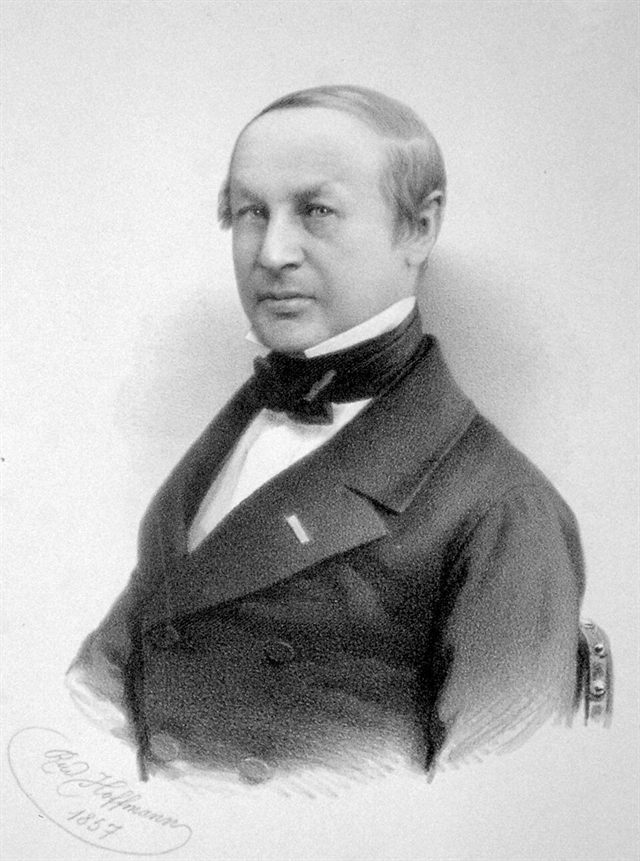
Who Said Animals Are Built Like Plants · Physiologist & Anatomist · 1810–1882
The physiologist who extended cell theory from plants to animals and made the cell the elementary unit of every living thing.
Defend these ideas against Schwann
Incandio is a free revision platform for the Pearson Edexcel International GCSE, and on it a topic counts as mastered only once you have learned it, proved it in questions, taught it back and defended it against the person with the strongest claim on it. Theodor Schwann is that person for 2 topics on the course:
- Comparing Cells, and Stem Cells — Biology
- Mitosis and Meiosis — Biology
Who was Schwann?
Theodor Schwann was born at Neuss in 1810 and trained in medicine at Bonn, Würzburg and Berlin, where he worked under Johannes Müller. In the 1830s he isolated pepsin from the lining of the stomach — the first enzyme obtained from animal tissue — and showed that digestion is a chemical process rather than a vital one. He also demonstrated that alcoholic fermentation is caused by yeast, a living organism, for which Wöhler and Liebig published an anonymous satire ridiculing him; he was proved right by Pasteur two decades later, but the mockery kept him out of controversy for years. In 1837 he dined with the botanist Matthias Schleiden, who described the nuclei he had been seeing in plant cells. Schwann recognised the same structures in the notochord of a tadpole, and in 1839 published the Mikroskopische Untersuchungen, which set out the claim his name carries: that animals as well as plants are built of cells, that the cell is the elementary unit of all living structure, and that the wholly unlike tissues of an animal body — cartilage, muscle, nerve, bone — are all made of cells and what cells produce. He also gave an account of how new cells arise, and it was wrong: he proposed that they crystallise out of a structureless fluid he called the cytoblastema, forming first around a nucleus. Rudolf Virchow replaced it in 1855 with the rule that every cell comes from an existing cell. Schwann also described the sheath around a nerve fibre that carries his name, and coined the word metabolism. He spent the second half of his career quietly at Louvain and Liège and died in 1882.
Major achievements
- Published the Mikroskopische Untersuchungen in 1839, extending cell theory to animals
- Established the cell as the elementary unit of all living structure, plant and animal alike
- Isolated pepsin, the first enzyme obtained from animal tissue, and named it
- Showed that alcoholic fermentation is caused by a living organism
- Described the sheath around the nerve fibre that bears his name
Life in brief
- 1810 — Born at Neuss: The son of a goldsmith turned printer.
- 1836 — Pepsin isolated: The first enzyme got from animal tissue; digestion shown to be chemistry.
- 1837 — Fermentation: Shows yeast is a living organism, and is satirised in print for it.
- 1837 — Dinner with Schleiden: Hears about plant-cell nuclei and thinks of the tadpole's notochord.
- 1839 — Mikroskopische Untersuchungen: Cell theory extended to animals; the cell made the elementary unit.
- 1855 — Virchow's correction: Every cell from a cell replaces Schwann's cytoblastema.
- 1882 — Dies at Cologne: After a long, quiet second half spent teaching in Belgium.
Explore the life of Schwann — five chapters
- Berlin, Under Müller — A goldsmith's son in the best laboratory in Europe
- The Anonymous Satire — Right about yeast, and ridiculed for it in print
- A Dinner in October — A conversation about nuclei, and a tadpole's notochord
- Where a New Cell Comes From — The half of the theory that was wrong
- Forty Years of Quiet — A word coined, a sheath named, and almost nothing else
Read the five-chapter life of Theodor Schwann →
Where Schwann appears in your course
Theodor Schwann has a genuine claim on 1 lesson of the Pearson Edexcel International GCSE science course built into Incandio:
- Comparing Cells, and Stem Cells — Biology: The first half of this page compares a plant cell with an animal cell — and that comparison only makes sense because Schwann established, in 1839, that they are the same kind of thing at all. Before him, animals and plants were assumed to be built on different plans. He also asked the question the second half answers and could not answer it himself: if every cell is one elementary unit, why is a nerve cell nothing like a bone cell?
Begin
- Start a conversation with Schwann — a dramatised, historically grounded AI portrayal
- Read the Historical Brief
- Explore the life of Schwann — five chapters
- Find your course · Meet all 280 figures