Historical figure · Pearson Edexcel International GCSE revision on Incandio
William Blake
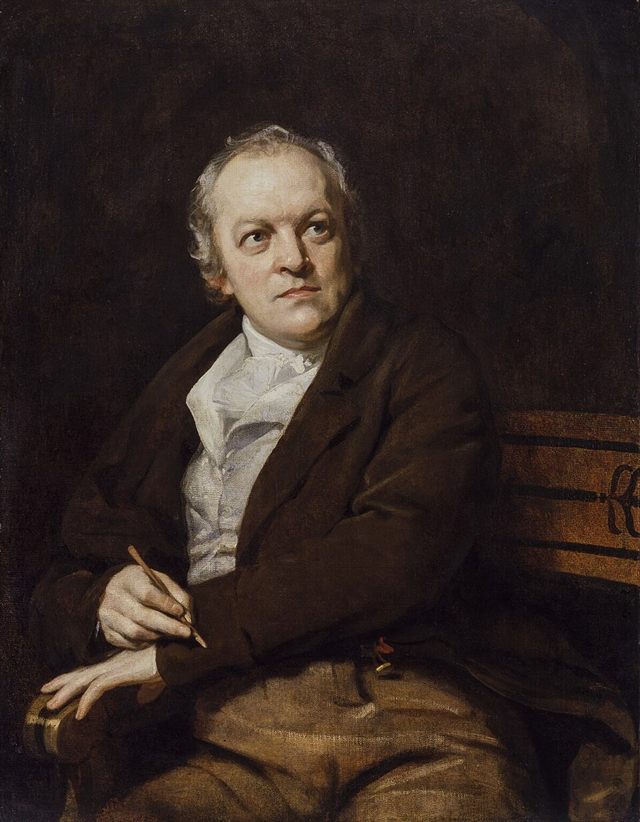
Who Asked And Would Not Answer · Poet & Engraver · 1757–1827
The engraver who printed his own books on copper by a method nobody else used, and put a smith's forge inside a poem about God.
Defend these ideas against Blake
Incandio is a free revision platform for the Pearson Edexcel International GCSE, and on it a topic counts as mastered only once you have learned it, proved it in questions, taught it back and defended it against the person with the strongest claim on it. William Blake is that person for 2 topics on the course:
- London in London — English Literature
- The Tyger in The Tyger — English Literature
Who was Blake?
William Blake was born in Soho in 1757 and apprenticed at fourteen to the engraver James Basire, who set him to draw the tombs in Westminster Abbey — years of solitary work among the Gothic dead that shaped everything he made afterwards. He earned his living engraving other men's designs and was, in his lifetime, almost entirely unread as a poet. His own books he manufactured himself, by a relief-etching process he said his dead brother Robert had shown him in a vision: words and design bitten together into one copper plate, printed, and then coloured by hand, so that no two copies of any book are the same. Songs of Innocence appeared in 1789 and Songs of Experience in 1794, bound together and subtitled as showing the two contrary states of the human soul — a structure in which poems answer each other across the two halves. The Tyger stands in Experience opposite The Lamb in Innocence: six quatrains, almost every one of them a question, and not one of them answered. At the centre of it is a working forge — the hammer, the chain, the furnace, the anvil — which is the trade of the men who were making things in Lambeth while he wrote. He was tried for sedition in 1803 after throwing a soldier out of his garden, and acquitted. He saw visions all his life and said so plainly, and was thought mad for it by almost everybody except his wife Catherine, who learned to print and colour and worked beside him for forty-five years.
Major achievements
- Songs of Innocence (1789) and Songs of Experience (1794)
- Invented the relief-etching method that made words and image one object
- The Marriage of Heaven and Hell, and the prophetic books
- Illustrated Job, Dante and Young's Night Thoughts
- Attacked child labour and state religion in poems children could read
Life in brief
- 1757 — Born in Soho: Son of a hosier; began seeing visions as a child.
- 1772 — Apprenticed to Basire: Seven years engraving, and drawing the tombs in Westminster Abbey.
- 1782 — Marries Catherine Boucher: She learns to read, print and colour beside him.
- 1789 — Songs of Innocence: Printed by relief etching from his own plates.
- 1794 — Songs of Experience: Bound with Innocence; the two contrary states.
- 1803 — Tried for sedition: After throwing a soldier out of his garden; acquitted.
- 1809 — His exhibition fails: Almost nobody comes.
- 1827 — Dies in London: Buried in an unmarked grave at Bunhill Fields.
Explore the life of Blake — five chapters
- Seven Years Among the Tombs — An apprenticeship that shaped everything after
- The Method His Dead Brother Showed Him — Words and pictures bitten into the same copper
- Two Contrary States — A book designed to argue with itself
- The Forge — Six stanzas of questions, and no answer anywhere
- Tried for Sedition, Buried Without a Stone — A soldier in the garden, a failed exhibition, and the Ancients
Read the five-chapter life of William Blake →
Begin
- Start a conversation with Blake — a dramatised, historically grounded AI portrayal
- Read the Historical Brief
- Explore the life of Blake — five chapters
- Find your course · Meet all 280 figures