Explore Their Life · Pearson Edexcel International GCSE revision on Incandio
William Blake: A Life in Five Chapters
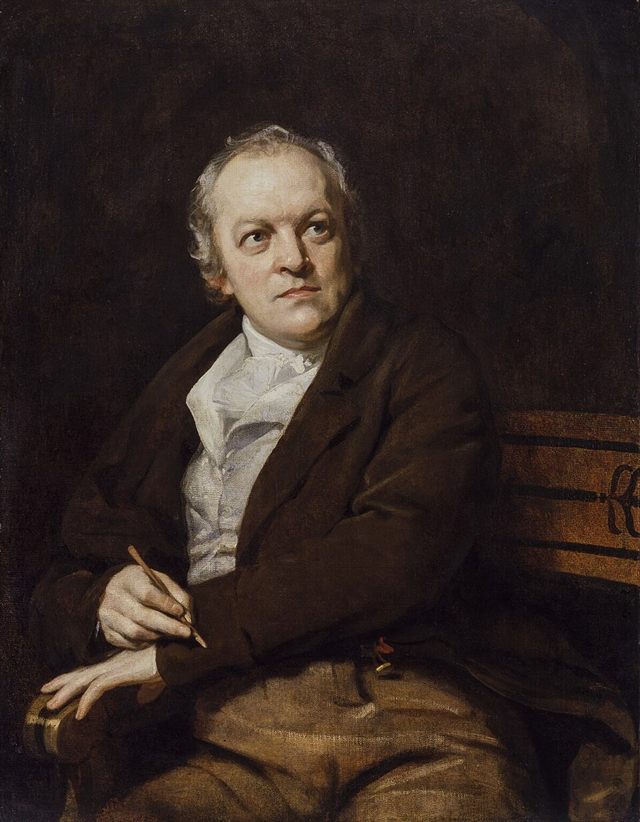
1757–1827
An engraver who manufactured his own books on copper by a method nobody else used, sold perhaps thirty copies, and put a working blacksmith's forge inside a poem about God.
Blake earned his living engraving other men's designs and was almost entirely unread as a poet in his lifetime. He saw visions, said so plainly, was thought mad, was tried for sedition, and died poor. He is now unavoidable. These five chapters follow the trade, the method, the contraries, and the poem that asks six stanzas of questions and answers none.
The five chapters
- Seven Years Among the Tombs — An apprenticeship that shaped everything after
- The Method His Dead Brother Showed Him — Words and pictures bitten into the same copper
- Two Contrary States — A book designed to argue with itself
- The Forge — Six stanzas of questions, and no answer anywhere
- Tried for Sedition, Buried Without a Stone — A soldier in the garden, a failed exhibition, and the Ancients
Chapter 1 · Seven Years Among the Tombs
An apprenticeship that shaped everything after
1757 – 1779 · Soho · Westminster Abbey · London
William Blake was born in Soho in 1757, the son of a hosier. He never went to school. He said he saw a tree filled with angels at Peckham Rye at about eight or nine, told his parents, and was nearly beaten for lying; his mother intervened. He said such things all his life, calmly, as reports rather than claims.
At fourteen he was apprenticed to James Basire, engraver to the Society of Antiquaries — a seven-year indenture in a demanding manual trade. Basire, apparently to keep him away from quarrelsome fellow apprentices, sent him to Westminster Abbey to draw the royal tombs.
He spent years there, alone, among the Gothic effigies. He drew the tomb of Edward III, and he was present when Edward I's coffin was opened in 1774 and the body examined. The stiff, linear, frontal, unmodelled figures of medieval funerary sculpture became his visual language permanently, at a moment when fashionable art was going the other way entirely, toward classical modelling and the Grand Manner.
This is why Blake looks the way he does. It is not naivety and it is not incompetence. He learned to see from thirteenth- and fourteenth-century tomb sculpture, and he never wanted to see any other way.
He entered the Royal Academy schools in 1779 and quarrelled almost immediately with its president, Joshua Reynolds.
Why this matters
Blake's unmistakable visual style comes from years of drawing medieval tombs as an apprentice, not from lack of training — his craft was orthodox and his choices were not.
You have seven years in the Abbey. What would you ask the apprentice?
Ask Blake
- “What did you learn drawing the tombs at Westminster?”
- “What did you see in the tree at Peckham Rye?”
- “Why did you quarrel with Reynolds and the Academy?”
- “Was engraving a craft or an art to you?”
- “You never went to school — did that cost you anything?”
Chapter 2 · The Method His Dead Brother Showed Him
Words and pictures bitten into the same copper
1787 – 1794 · Lambeth · London
Blake's younger brother Robert died in 1787, aged about nineteen or twenty. Blake nursed him and said that at the moment of death he saw Robert's spirit rise through the ceiling clapping its hands for joy. He said afterwards that Robert appeared to him in a vision and showed him a method of printing.
The method is real, and it is genuinely unusual. Ordinary engraving is intaglio: you cut into the plate and the ink sits in the cuts. Blake worked in relief. He wrote and drew directly onto the copper with an acid-resistant varnish, then bathed the plate in acid so that everything he had *not* drawn was eaten away, leaving the words and the image standing up together on the same surface. He printed from that, then he and his wife Catherine coloured each impression by hand.
The consequences are the point. Words and pictures are made in one operation, by one hand, so text and design are not illustration and caption but a single object. Printing is cheap and needs no publisher. And since every copy is hand-coloured, no two are alike — a book that is different for every reader.
Catherine Boucher, whom he married in 1782, could not read or write when they met. He taught her, and she learned to print and colour, and she worked beside him for forty-five years. The books are, materially, made by both of them.
Why this matters
Relief etching let Blake bypass publishers entirely and make text and image one object — a form of artistic independence almost nobody else in his century achieved.
You have the acid, the copper and Catherine at the press. What is your question?
Ask Blake
- “How does relief etching actually work?”
- “Did Robert really show you the method?”
- “What does it change when the words and the picture are one plate?”
- “How much of the finished books are Catherine's work?”
- “Was avoiding publishers freedom or poverty?”
Chapter 3 · Two Contrary States
A book designed to argue with itself
1789 – 1794 · Lambeth
*Songs of Innocence* was printed in 1789. *Songs of Experience* followed in 1794, and Blake bound them together under a single title page: *Songs of Innocence and of Experience, Shewing the Two Contrary States of the Human Soul*.
The design is the argument. Poems answer each other across the two halves. *The Lamb* in Innocence is answered by *The Tyger* in Experience. There are two poems called *The Chimney Sweeper*, two called *Holy Thursday*, two called *Nurse's Song*. In each pair, the Innocence version is trusting and the Experience version looks at the same scene and sees who is profiting from it.
*The Chimney Sweeper* pairing is the sharpest. In Innocence, a small boy is comforted by a dream of an angel and told that if he does his duty he need not fear harm. In Experience, a child in the snow says his parents are at church praising the God and priest and king who make up a heaven of his misery. Blake is writing about a real trade: boys of four and five sent up flues, burned, deformed and killed, in a country whose churches were full.
But Blake's contraries are not a simple correction of naivety by cynicism. His stated position is that *without contraries is no progression*. Neither state is the answer. The book is designed to be argued with, not to be agreed with.
Why this matters
Songs of Innocence and of Experience is one of the few books in English designed so that its poems must be read against one another rather than in sequence.
You have the paired poems and the two contrary states. What would you ask him?
Ask Blake
- “Why print the two books together rather than leave them separate?”
- “Is Experience simply the truth that Innocence gets wrong?”
- “What did you actually know about the chimney boys?”
- “What do you mean that without contraries there is no progression?”
- “Why write attacks on the Church in poems a child could read?”
Chapter 4 · The Forge
Six stanzas of questions, and no answer anywhere
1794 · Lambeth
*The Tyger* is the most anthologised poem in English, and what keeps it alive is that it refuses to answer itself.
It is six quatrains in trochaic tetrameter — a hammering, catalectic beat, stress-first, each line one syllable short of full — and almost every sentence in it is a question. What immortal hand or eye. In what distant deeps or skies. What the hammer, what the chain. Did he smile his work to see. And, at the centre: *Did he who made the Lamb make thee?*
No answer is given. Not in the poem, not on the plate, not anywhere in Blake.
The imagery is not vague sublimity. It is a working forge: hammer, chain, furnace, anvil, and hands that must *dare* to seize the fire. Blake was living in Lambeth among foundries and workshops; the language of the poem is the language of a trade being carried on down the road. The maker in this poem is a smith, sweating over a job, and the question is what kind of workman would take on this commission.
The accompanying illustration is worth knowing about: the tiger Blake actually painted on the plate is not terrifying. In most copies it looks placid, almost comic. Whether that undercuts the poem, or is the joke, or is simply the limit of his animal drawing, is still argued.
“Did he who made the Lamb make thee?”
— William Blake, 'The Tyger', Songs of Experience (1794)
Why this matters
The Tyger is the clearest demonstration in English poetry that an unanswered question can be a stronger structure than a statement.
You have the hammer, the chain and the question nobody answers. What would you ask?
Ask Blake
- “Why is almost every line of The Tyger a question?”
- “Why put a blacksmith's forge in a poem about God?”
- “What answer would you give to your own central question?”
- “Why does the tiger you painted on the plate look so mild?”
- “What changes if a reader meets The Lamb first?”
Chapter 5 · Tried for Sedition, Buried Without a Stone
A soldier in the garden, a failed exhibition, and the Ancients
1803 – 1827 · Felpham · Chichester · Fountain Court · Bunhill Fields
In August 1803, at Felpham in Sussex, Blake found a dragoon named John Scolfield in his garden and threw him out bodily. Scolfield accused him of uttering seditious words against the King — a capital charge in wartime England, and the accusation of a soldier against a known radical. Blake was tried at Chichester in January 1804 and acquitted; the courtroom, by report, applauded.
It is a reminder that Blake's politics were not decorative. He had known Thomas Paine and Mary Wollstonecraft through the publisher Joseph Johnson's circle, and by tradition wore a revolutionary bonnet rouge in the London streets in 1789.
In 1809 he mounted his one public exhibition, in his brother's hosiery shop, with a *Descriptive Catalogue* he wrote himself. Almost nobody came. The single review called him an unfortunate lunatic.
He spent his last years in two rooms at Fountain Court off the Strand, poor, working on illustrations to the Book of Job and to Dante, and was found there by a group of young artists — Samuel Palmer, Edward Calvert, George Richmond — who called themselves the Ancients and treated him as a prophet. It was the only recognition he ever had.
He died on 12 August 1827, singing, according to those present. He was buried in a common grave at Bunhill Fields; the exact spot was lost for nearly two centuries and only marked again in 2018. Catherine survived him by four years and continued to print from his plates.
Why this matters
Blake was a working radical in a country at war, tried on a capital charge, and died in obscurity — the visionary reputation is entirely posthumous.
You have the trial, the empty exhibition and the unmarked grave. What is your question?
Ask Blake
- “What did you actually say to the soldier in your garden?”
- “Did being thought mad protect you or damage you?”
- “Almost nobody came to your exhibition — what did you conclude?”
- “What did the young Ancients understand that your contemporaries did not?”
- “You sold perhaps thirty books — did you expect to be read at all?”
What Blake changed
Blake invented a method of printing that made words and images a single object and freed him from publishers entirely, and he used it to attack child labour, state religion and empire in poems simple enough for a child to read. The Tyger is the most anthologised poem in English. Almost none of this was visible in his lifetime: he sold perhaps thirty copies of Songs of Innocence and of Experience and was buried in an unmarked common grave.
A debate that continues
Blake scholarship is still divided over how far the illuminated plates should govern readings of the poems, how systematic his mythology really is, and whether the mildness of his painted tiger undercuts The Tyger or completes it.
Keep exploring — ask Blake
- “Which of the prophetic books should a reader attempt first?”
- “Is a poem incomplete without the plate it was printed on?”
- “What is wrong with reason left on its own?”
Related lives
- John Keats — Who Could Stay In The Uncertainty
- Mary Wollstonecraft — Founder of Modern Feminism
- Michelangelo — Il Divino · Sculptor of the Sistine
- Christina Rossetti — Who Took Back What She Asked For
Related themes
Romanticism · Printmaking and the book · Religion and dissent
Continue on Incandio
- Talk to Blake — every question on this page is one tap from being asked, and the same page carries the Historical Brief, the achievements and the timeline
- All 280 figures · Incandio — learn every idea, teach it, then defend it