Historical figure · Pearson Edexcel International GCSE revision on Incandio
William Cecil
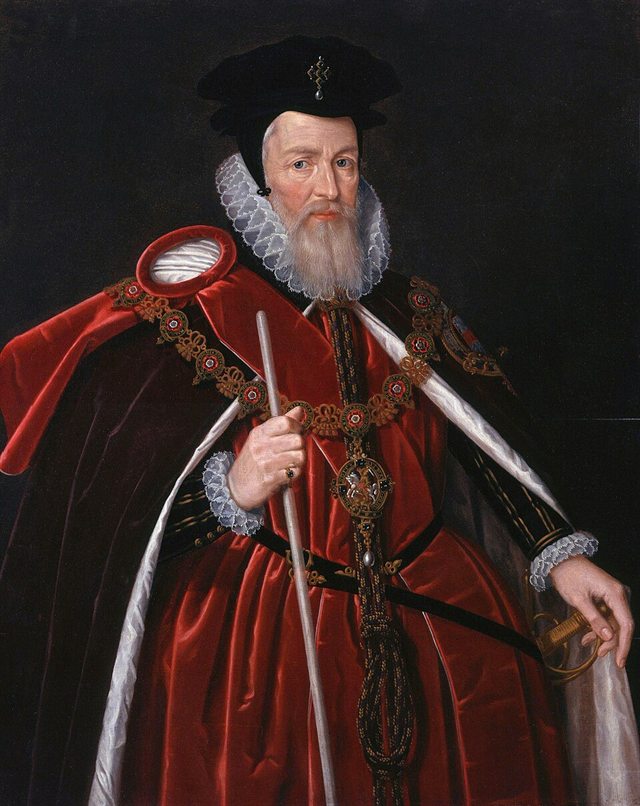
Secretary · Lord Treasurer · The Queen's Spirit · Lord Burghley · 1520–1598
Elizabeth I's chief minister for forty years: Secretary from the first day of her reign, Lord Treasurer from 1572, the architect of the Religious Settlement and the councillor who pressed longest for the execution of Mary, Queen of Scots.
Why Cecil is on Incandio
Incandio is a free revision platform for the Pearson Edexcel International GCSE. Its historical figures are the people a student learns from, questions and — where a specification topic is theirs — defends an idea against. William Cecil can be questioned here in a dramatised, historically grounded portrayal, and the five-chapter life below is written to be read alongside the course.
Who was Cecil?
Born at Bourne in Lincolnshire in 1520, Cecil was educated at Cambridge and Gray's Inn and rose in the service of Edward VI's Protestant government, becoming Secretary of State in 1550. He survived the fall of Somerset and of Northumberland, witnessed the device settling the crown on Lady Jane Grey, and then conformed under Mary I. On 17 November 1558 Elizabeth made him her Secretary. He steered the Religious Settlement of 1559 through Parliament, became Master of the Court of Wards in 1561, Baron Burghley in 1571 and Lord Treasurer in 1572. He helped uncover the Ridolfi Plot, built with Walsingham the Bond of Association of 1584, and sent the warrant for Mary's execution to Fotheringhay in February 1587, for which Elizabeth banished him from her presence. He trained his son Robert to succeed him and died in London on 4 August 1598.
Major achievements
- Managed the Religious Settlement of 1559 through a hostile House of Lords
- Served as Secretary (1558–72) and Lord Treasurer (1572–98) — the longest-serving minister of the reign
- Helped uncover the Ridolfi Plot of 1571
- Framed the Bond of Association of 1584 with Walsingham
- Kept the Crown solvent through a long war with Spain by careful finance
Life in brief
- 1520 — Born at Bourne, Lincolnshire: Son of a minor courtier of Henry VIII.
- 1550 — Secretary of State to Edward VI: Survives the fall of Somerset.
- 1558 — Elizabeth's Secretary: Appointed on 17 November, the day of her accession.
- 1559 — The Religious Settlement: The Acts of Supremacy and Uniformity pass.
- 1571 — Baron Burghley: The Ridolfi Plot is uncovered the same year.
- 1572 — Lord Treasurer: Holds the office until his death.
- 1584 — The Bond of Association: Drawn up with Walsingham after the Throckmorton Plot.
- 1587 — The warrant for Fotheringhay: Mary is executed; Elizabeth banishes him from court for weeks.
Explore the life of Cecil — five chapters
- A Survivor's Apprenticeship — Three reigns, two falls and one conformity
- The Queen's Secretary — A new reign, a new Church, and a vote of three
- The Problem in the North — A queen in England, a rising, a bull and a duke
- The Warrant — A bond, a trial and a queen's fury
- Money, War and the Succession — An old Lord Treasurer and a son to follow him
Read the five-chapter life of William Cecil →
Begin
- Start a conversation with Cecil — a dramatised, historically grounded AI portrayal
- Read the Historical Brief
- Explore the life of Cecil — five chapters
- Find your course · Meet all 280 figures