Pearson Edexcel International GCSE in Biology · 4BI1 · Free · no account needed
Pedigrees and Sex Determination — exam questions
10 original Incandio exam-style questions on Pedigrees and Sex Determination, 24 marks, about 24 minutes of writing. Each one carries the command word, the tariff and the specification statement it assesses, exactly as a paper presents them. This is an original Incandio practice question, written to reflect the structure and demands of the qualification. It is not an official Pearson Edexcel past-paper question.
This is the practice set for Pedigrees and Sex Determination — the lesson that teaches it. Read the lesson first if the idea is new; come here when you want to find out whether you can turn it into marks. Completely free, no account needed to read.
What these questions ask of you
8 command words run through this set, and on Pearson Edexcel International GCSE Biology each one means something precise. Answering the wrong command is the commonest way a candidate who understands the lesson still loses the mark.
- Which (1 mark)
- one option chosen from the set given
- State (1 mark)
- one precise fact, no justification
- Complete (1–5 marks)
- the missing entries in a table, diagram or sentence
- Explain (2–4 marks)
- a causal chain — WHY it happens, each link a separate marking point Misread as: describing what happens without giving the reason it happens
- Describe (2–4 marks)
- developed, linked statements of WHAT happens — no reason required, but detail is Misread as: giving one bare statement where the tariff asked for a developed account
- Suggest (1–3 marks)
- a plausible answer applying taught biology to a situation not taught
- Give (1–2 marks)
- a short factual answer drawn from recall or from the data
- Use (2–5 marks)
- the supplied data, graph or diagram applied to reach a result — the data is not optional
Assessed on Paper 1 (4BI1/1B) and Paper 2 (4BI1/2B), against AO1, AO2, AO3.
Where these sit in the specification
Pearson Edexcel International GCSE Biology (4BI1) — statements 3.26 · 3.27 · 3.24. Incandio is aligned to this specification; it is not published by, endorsed by or affiliated with Pearson, and it reproduces none of Pearson's wording.
The 10 questions
Answer them on paper, then open the lesson's exam practice to have them marked. The mark scheme, the accepted and rejected answers and the annotated model answer are in Incandio and are not printed here — an answer beside its question is not practice.
-
Table 1 — a family in which some members have an inherited condition. Individuals 1 and 2 are the parents of individuals 3, 4 and 5. Individual Sex Has the condition? 1 male no 2 female no 3 female yes 4 male no 5 male no (a)
(1)Give
Give the individual in Table 1 who shows that the allele causing the condition is recessive.
Table 1 — a family in which some members have an inherited condition. Individuals 1 and 2 are the parents of individuals 3, 4 and 5. Individual Sex Has the condition? 1 male no 2 female no 3 female yes 4 male no 5 male no individual = ............................
(b)
(3)Explain
Explain how the genotypes of individuals 1 and 2 can be worked out from Table 1.
Table 1 — a family in which some members have an inherited condition. Individuals 1 and 2 are the parents of individuals 3, 4 and 5. Individual Sex Has the condition? 1 male no 2 female no 3 female yes 4 male no 5 male no (c)
(2)Suggest
Suggest what can and cannot be said about the genotype of individual 4.
Table 1 — a family in which some members have an inherited condition. Individuals 1 and 2 are the parents of individuals 3, 4 and 5. Individual Sex Has the condition? 1 male no 2 female no 3 female yes 4 male no 5 male no (Total for Question 1 = 6 marks)
-
(1)Which
Which pair of sex chromosomes does a human male carry?
Chromosomes A XX B XY C YY D XO (Total for Question 2 = 1 mark)
-
(1)State
State which parent determines the sex of a child.
(Total for Question 3 = 1 mark)
-
(3)Complete
Complete a genetic diagram to show how the sex of a child is determined, giving the parents' chromosomes, their gametes and the possible offspring.
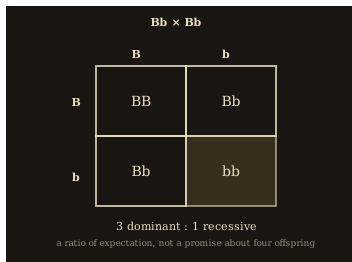
Figure 2 — a genetic diagram for a cross between two heterozygous parents. (Total for Question 4 = 3 marks)
-
(2)Explain
A couple have four sons. Explain why their chance of having a daughter next time is still one half.
(Total for Question 5 = 2 marks)
-
(3)Describe
Describe how to work out from a family pedigree whether an allele is dominant or recessive.

Figure 1 — a family pedigree. Shaded symbols show individuals with the condition. (Total for Question 6 = 3 marks)
-
(3)Suggest
In some reptiles the sex of the offspring is determined by the temperature at which the eggs develop rather than by chromosomes. Suggest one disadvantage of this to the species.
(Total for Question 7 = 3 marks)
-
(5)Use
Use Table 2 to decide whether the condition is caused by a dominant or a recessive allele, and to explain how you can be certain.
Table 2 — four families, showing whether each parent and child has the condition. Family Mother Father Children with the condition Children without 1 unaffected unaffected 1 3 2 unaffected affected 0 4 3 affected unaffected 2 2 4 unaffected unaffected 0 5 (Total for Question 8 = 5 marks)
Have them marked, then defend the answer
Practice tells you the mark; teaching it back tells you whether you understand it. On Incandio a topic counts as mastered only once you have taught it and defended it.
- Mark these questions — 10 questions, marked on Incandio against the authored scheme, with the mistake you actually made named.
- Teach it — explain Pedigrees and Sex Determination to Ember, an AI pupil who does not have it yet and asks the awkward question.
- Defend it — argue it against Aristotle over three rounds, marked against descriptors you can read first.
Completely free. No subscriptions, no paywalls, no account needed to start.
Back to the lesson
- Pedigrees and Sex Determination — Reading a family tree backwards to find genotypes nobody can see — and the one cross whose answer never changes.
- All of Incandio Biology · Incandio Exam Practice