Pearson Edexcel International GCSE in Biology · 4BI1 · Free · no account needed
Ultrafiltration and Selective Reabsorption — exam questions
10 original Incandio exam-style questions on Ultrafiltration and Selective Reabsorption, 22 marks, about 22 minutes of writing. Each one carries the command word, the tariff and the specification statement it assesses, exactly as a paper presents them. This is an original Incandio practice question, written to reflect the structure and demands of the qualification. It is not an official Pearson Edexcel past-paper question.
This is the practice set for Ultrafiltration and Selective Reabsorption — the lesson that teaches it. Read the lesson first if the idea is new; come here when you want to find out whether you can turn it into marks. Completely free, no account needed to read.
What these questions ask of you
6 command words run through this set, and on Pearson Edexcel International GCSE Biology each one means something precise. Answering the wrong command is the commonest way a candidate who understands the lesson still loses the mark.
- Which (1 mark)
- one option chosen from the set given
- Name (1–2 marks)
- the correct term, spelled recognisably
- Explain (2–4 marks)
- a causal chain — WHY it happens, each link a separate marking point Misread as: describing what happens without giving the reason it happens
- Describe (2–4 marks)
- developed, linked statements of WHAT happens — no reason required, but detail is Misread as: giving one bare statement where the tariff asked for a developed account
- Suggest (1–3 marks)
- a plausible answer applying taught biology to a situation not taught
- Give (1–2 marks)
- a short factual answer drawn from recall or from the data
Assessed on Paper 1 (4BI1/1B) and Paper 2 (4BI1/2B), against AO1, AO2, AO3.
Where these sit in the specification
Pearson Edexcel International GCSE Biology (4BI1) — statements 2.75 · 2.77 · 2.76. Incandio is aligned to this specification; it is not published by, endorsed by or affiliated with Pearson, and it reproduces none of Pearson's wording.
The 10 questions
Answer them on paper, then open the lesson's exam practice to have them marked. The mark scheme, the accepted and rejected answers and the annotated model answer are in Incandio and are not printed here — an answer beside its question is not practice.
-
Table 1 — the concentration of four substances in three fluids from the same healthy person, in g per 100 cm³. Substance Blood plasma Glomerular filtrate Urine Protein 7.8 0.00 0.00 Glucose 0.10 0.10 0.00 Urea 0.03 0.03 2.00 Sodium ions 0.32 0.32 0.35 (a)
(1)Give
Give the substance in Table 1 that is filtered out of the blood but does not appear in the urine.
Table 1 — the concentration of four substances in three fluids from the same healthy person, in g per 100 cm³. Substance Blood plasma Glomerular filtrate Urine Protein 7.8 0.00 0.00 Glucose 0.10 0.10 0.00 Urea 0.03 0.03 2.00 Sodium ions 0.32 0.32 0.35 (b)
(3)Explain
Explain why the concentration of urea in the urine is so much higher than in the filtrate.
Table 1 — the concentration of four substances in three fluids from the same healthy person, in g per 100 cm³. Substance Blood plasma Glomerular filtrate Urine Protein 7.8 0.00 0.00 Glucose 0.10 0.10 0.00 Urea 0.03 0.03 2.00 Sodium ions 0.32 0.32 0.35 (c)
(2)Suggest
Suggest what a doctor would conclude if a patient's urine contained 0.9 g of protein per 100 cm³.
Table 1 — the concentration of four substances in three fluids from the same healthy person, in g per 100 cm³. Substance Blood plasma Glomerular filtrate Urine Protein 7.8 0.00 0.00 Glucose 0.10 0.10 0.00 Urea 0.03 0.03 2.00 Sodium ions 0.32 0.32 0.35 (Total for Question 1 = 6 marks)
-
(1)Which
Which substance is normally absent from the glomerular filtrate?
Substance A water B glucose C protein D urea (Total for Question 2 = 1 mark)
-
(1)Name
Name the part of the nephron where glucose is reabsorbed.
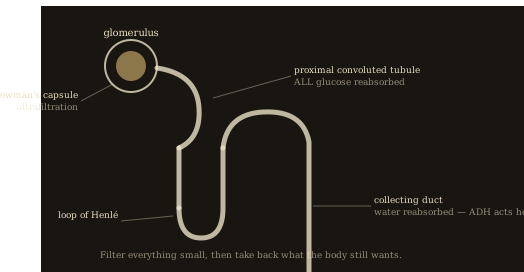
Figure 1 — a nephron, with the blood vessels that surround it. (Total for Question 3 = 1 mark)
-
(2)Explain
Explain why protein molecules do not enter the glomerular filtrate.
Figure 1 — a nephron, with the blood vessels that surround it. (Total for Question 4 = 2 marks)
-
(3)Explain
Explain why the reabsorption of glucose is described as selective.
(Total for Question 5 = 3 marks)
-
(2)Describe
Describe how water is reabsorbed from the collecting duct.
Figure 1 — a nephron, with the blood vessels that surround it. (Total for Question 6 = 2 marks)
-
(3)Suggest
In a person with untreated diabetes, the blood glucose concentration is very high and glucose appears in the urine. Suggest why.
(Total for Question 7 = 3 marks)
-
(4)Explain
Explain why glucose appears in the filtrate in the Bowman's capsule but not in the urine of a healthy person.
(Total for Question 8 = 4 marks)
Have them marked, then defend the answer
Practice tells you the mark; teaching it back tells you whether you understand it. On Incandio a topic counts as mastered only once you have taught it and defended it.
- Mark these questions — 10 questions, marked on Incandio against the authored scheme, with the mistake you actually made named.
- Teach it — explain Ultrafiltration and Selective Reabsorption to Ember, an AI pupil who does not have it yet and asks the awkward question.
- Defend it — argue it against Henri Dutrochet over three rounds, marked against descriptors you can read first.
Completely free. No subscriptions, no paywalls, no account needed to start.
Back to the lesson
- Ultrafiltration and Selective Reabsorption — Squeeze almost everything out of the blood by pressure, then spend energy buying back exactly what you need — including every last molecule of glucose.
- All of Incandio Biology · Incandio Exam Practice