Pearson Edexcel International GCSE in Chemistry · 4CH1 · Free · no account needed
Uses of Metals, and Alloys
Why each metal is used where it is — and why almost none of them is used pure.
Topic 2 · Inorganic chemistry — one of 19 lessons in this topic, and one of 61 in Chemistry.
This lesson ends with Dmitri Mendeleev. Learn Uses of Metals, and Alloys, teach it, then defend it against Dmitri Mendeleev.
What this lesson covers in the specification
Incandio is aligned to this specification. It is not published by, endorsed by or affiliated with Pearson, and it reproduces none of Pearson's wording — the statement numbers are given so you can check every lesson against your own copy.
- 2.25 — Explaining the uses of aluminium, copper, iron and steel from their properties (bold C statement — Paper 2 only)
- 2.26 — An alloy as a mixture of a metal with one or more other elements (bold C statement — Paper 2 only)
- 2.27 — Why alloys are harder than pure metals (bold C statement — Paper 2 only)
Specification section 2(f) Acids, alkalis and titrations — also taught in Acids, Alkalis and the pH Scale, Hydrogen Ions and Neutralisation, Titrations, Solubility Rules and Proton Transfer.
1 · Understand it
No exam language yet. The only question this section answers is: do I actually understand what is happening?
Every use of a metal is a property being exploited, and an exam answer that names the use without naming the property earns nothing. The question is always the same: what does this application need, and which property supplies it?
Statement 2.25 — four metals, and the property behind each use
- ALUMINIUM in aircraft and drink cans: it has a LOW DENSITY, so the structure is light, and it RESISTS CORROSION because of its protective oxide layer.
- ALUMINIUM in overhead power cables: it CONDUCTS ELECTRICITY well and is light enough not to sag between pylons — copper would conduct better but would be far too heavy.
- COPPER in electrical wiring: it is an EXCELLENT CONDUCTOR of electricity and is DUCTILE, so it can be drawn into wire.
- COPPER in pipes and cooking pans: it CONDUCTS HEAT well, is MALLEABLE so it can be shaped, and does not react with water.
- IRON AND STEEL in bridges, cars and buildings: they are STRONG and relatively CHEAP, which is what large structures need above all.
- The trade-off is always visible: aluminium is chosen over copper for cables not because it conducts better but because the weight matters more than the conductivity.
That last point is the one worth carrying into any question. A metal is almost never the best at everything, so choosing one means deciding which property the application cares about most. Copper is the better conductor and aluminium is the better cable, and both statements are true at once.
Now statement 2.26, and it is a definition worth being precise about. An ALLOY is a MIXTURE of a metal with one or more other elements — usually another metal, but sometimes a non-metal, as carbon is in steel. It is a mixture and not a compound: the proportions can be varied continuously, there is no fixed formula, and no chemical reaction has taken place.
Think of it like a crowd of identical soldiers against a crowd of ordinary people
A parade of soldiers of identical height, standing in ranks, can march past one another smoothly — the rows are regular and nothing catches. Now put people of assorted heights and builds into the same ranks and try to slide one row past another: it jams, because the irregularity gets in the way. A pure metal is the parade, with identical ions in regular layers that slide easily, which is why pure metals are soft. An alloy is the mixed crowd. The different-sized atoms disrupt the regular layers so they no longer slide over one another, and the metal is harder.
Statement 2.27 — why an alloy is harder
- In a PURE metal the ions are all the SAME SIZE and are arranged in regular layers.
- Those regular layers can SLIDE over one another easily when a force is applied, which is why pure metals are soft and malleable.
- In an ALLOY, atoms of a DIFFERENT SIZE are present among them.
- These DISRUPT the regular arrangement, so the layers no longer line up neatly.
- The layers can therefore no longer SLIDE over one another so easily.
- So the alloy is HARDER and stronger than the pure metal it was made from.
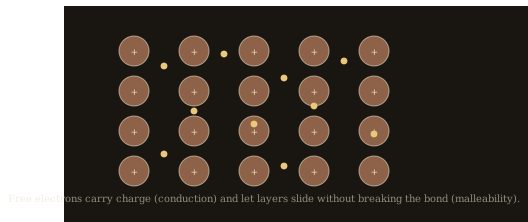
STEEL is the example the specification expects, and it is iron with a small amount of CARBON — often less than 1%. That tiny addition makes an enormous difference, because pure iron is surprisingly soft and bends easily. Adding other elements gives steels for particular purposes: chromium and nickel give STAINLESS STEEL, which resists corrosion and is used for cutlery and surgical instruments.
Choosing a material, with the property named each time
Explain the choice of material for (a) an overhead power cable, (b) the body of an aeroplane, (c) a saucepan base, (d) a bridge.
- (a) ALUMINIUM: it conducts electricity well and has a low density, so long spans do not sag under their own weight. Copper conducts better but is far too heavy.
- (b) An ALUMINIUM ALLOY: low density keeps the aircraft light, the oxide layer resists corrosion, and alloying makes it hard enough to be structural — pure aluminium would be too soft.
- (c) COPPER: it conducts heat well, so the base heats evenly, and it is malleable enough to be shaped and unreactive with water.
- (d) STEEL: it is strong and comparatively cheap, and for a large structure those two properties dominate everything else.
- Notice that (b) needed the alloy point. Almost nothing structural is made of a pure metal, because pure metals are too soft.
Answer: Aluminium for lightness, copper for conduction, steel for strength and cost — and alloys wherever hardness is needed.
2 · Grade 9 Notes
A different job from the section above. You have already understood it; this is the precise set of things to LEARN — definitions to reproduce word for word, processes in order, equations with units, and the answers that score full marks.
Statements 2.26 — the definitions to learn
- Alloy
- A MIXTURE of a metal with one or more other elements. Not a compound: no fixed formula, and no reaction has occurred.
- Steel
- An alloy of iron with a small amount of carbon, usually under 1%. Far harder than pure iron.
- Stainless steel
- Steel alloyed with chromium and nickel, which resists corrosion — used for cutlery and surgical instruments.
Statement 2.25 — use and the property behind it
| Use | Property that makes it suitable | |
|---|---|---|
| Aluminium | Aircraft, drink cans | Low density; resists corrosion through its oxide layer |
| Aluminium | Overhead power cables | Good conductor AND light enough not to sag between pylons |
| Copper | Electrical wiring | Excellent electrical conductor; ductile, so it can be drawn into wire |
| Copper | Pipes and pan bases | Good thermal conductor; malleable; unreactive with water |
| Iron and steel | Bridges, cars, buildings | Strong and relatively cheap |
Statement 2.27 — why alloys are harder
- In a pure metal the ions are all the same size, arranged in regular layers.
- Those layers slide over one another easily, so the pure metal is soft.
- An alloy contains atoms of a DIFFERENT SIZE.
- These disrupt the regular arrangement of the layers.
- The layers can no longer slide over one another easily, so the alloy is harder.
How to answer a 'why is this metal used' question
- NAME THE PROPERTY, not just the use — 'copper is used for wiring because it conducts' earns the mark; 'copper is used for wiring' does not
- Give the property that the application actually needs
- Where a metal is not the best at something, say what it is being traded against — aluminium over copper for cables, because of WEIGHT
- If the item is structural, expect an ALLOY rather than the pure metal
- Corrosion resistance is a property too, and is aluminium's other main advantage
Model answer [4 marks]
Explain why aluminium rather than copper is used for overhead power cables, even though copper is the better conductor. [4]
Copper is the better electrical conductor, but overhead cables must be supported over long distances between pylons, so the weight of the cable is critical. Aluminium has a much lower density than copper, so an aluminium cable is far lighter and does not sag as much under its own weight. Aluminium is still a good enough conductor for the purpose, and it also resists corrosion because of its protective oxide layer. The lower density therefore outweighs the better conductivity of copper in this particular application.
Model answer [4 marks]
Explain why steel is harder than pure iron. [4]
In pure iron all the ions are the same size and are arranged in regular layers, and these layers can slide over one another easily when a force is applied, which makes pure iron relatively soft. Steel is an alloy of iron containing a small proportion of carbon atoms, which are a different size from the iron ions. These carbon atoms disrupt the regular arrangement of the layers, so the layers can no longer slide over one another so easily. Steel is therefore harder and stronger than pure iron.
Not this: An alloy is a compound formed when two metals react together.
This: An alloy is a MIXTURE. No reaction has taken place, there is no fixed formula, and the proportions can be varied continuously — which is why steels can be made with different carbon contents for different jobs.
Mark-losing trap. NAME THE PROPERTY. Stating the use without the property that supplies it earns nothing.
Mark-losing trap. An alloy is a MIXTURE, not a compound — no reaction, no formula.
Mark-losing trap. For hardness say BOTH: different-sized atoms disrupt the layers, so the layers cannot slide.
3 · Prove it — the five questions
The five questions climb Grade 6 → Grade 7 → Grade 8 → Grade 9 → Grade 9 challenge, and are marked inside Incandio on your own device, by rule, with an authored diagnosis of the mistake you actually made. The mark schemes stay in the app so that the practice is worth doing; the questions themselves are here.
- Grade 6 · Define [1 mark] — What is an alloy?
- Grade 7 · Explain [2 marks] — Give the property of copper that makes it suitable for electrical wiring, and one other property that makes it possible to manufacture the wire.
- Grade 8 · Explain [3 marks] — Explain why aluminium alloys, rather than pure aluminium, are used to build aircraft.
- Grade 9 · Explain [6 marks] — Select every statement that belongs in a full-mark explanation of why steel is harder than pure iron, and why this matters for its uses.
- 9+ · Evaluate [6 marks] — An engineer proposes replacing the aluminium in overhead power cables with copper, arguing that copper conducts better so less energy would be wasted as heat. Select every statement that belongs in a full-mark evaluation.
The people behind this science
Two ways into the same idea — the one who chose a material for a job where the choice killed people, and the one who predicted the properties of a metal before anyone had a sample. Inside Incandio each of them answers knowing exactly which lesson you have just finished.
Humphry Davy — the one who chose a material for a job where the choice killed people
This page is about matching a property to a purpose, and Davy's safety lamp is the sharpest case of it. The problem was to give miners light without igniting the methane in the air, and the solution turned on one property of one material: a fine iron gauze conducts heat away from the flame fast enough that the gas outside never reaches its ignition temperature. Nothing about the gauze is chemically special; it is thermal conductivity and geometry doing the whole job. He also refused to patent it, saying his only object was to serve humanity.
- “How does a wire gauze stop a flame passing through it?”
- “What property of the metal were you actually relying on?”
- “How did you test whether the lamp was safe?”
- “Why did you refuse to patent it?”
- “Did the lamp save as many lives as you hoped?”
Dmitri Mendeleev — the one who predicted the properties of a metal before anyone had a sample
This page reasons from properties to uses, and Mendeleev did something considerably harder: he reasoned from a position in a table to properties, for elements nobody had ever isolated. He left a gap below aluminium and predicted the density, melting point and appearance of what he called eka-aluminium. Gallium was discovered six years later and matched — so closely that when the measured density disagreed, Mendeleev wrote to say the sample must be impure, and he was right. He is the right person to ask how far properties can be predicted rather than measured.
- “How did you predict the properties of an element nobody had found?”
- “What did you get right about eka-aluminium?”
- “How did you dare tell the discoverer his measurement was wrong?”
- “What decides a metal's density and melting point?”
- “Could you have predicted which metals would be useful?”
Think you understand it?
Reading is the start. On Incandio a topic counts as mastered only once you have taught it and defended it — the two things a revision guide cannot ask of you.
Incandio this topic → Prove it. Teach it. Defend it. What does “Incandio it” mean?
- Prove it — five questions on Uses of Metals, and Alloys, marked on the spot, that tell you what was missing rather than just what was wrong.
- Teach it — Explain Uses of Metals, and Alloys in your own words to Ember, an AI pupil who does not have it yet and asks the awkward question. Understanding is credited; wording is not required.
- Defend it — Argue Uses of Metals, and Alloys against Dmitri Mendeleev — three rounds, marked against descriptors you can read before you begin.
- Then the exam — read all 12 authored exam-style questions on this unit, each with its command word and its tariff, then have them marked on Incandio with the mistake you actually made named.
Completely free. No subscriptions, no paywalls, no account needed to start.
Carry on through the course
- Previous lesson: Extracting Metals from their Ores
- Next lesson: Acids, Alkalis and the pH Scale
- Group 1 — the Alkali Metals — Metals soft enough to cut with a knife, which set fire to water — and get worse as you go down.
- Group 7 — the Halogens — A green gas, a brown liquid and a grey solid — and a trend that runs the opposite way to Group 1.
- The Gases in the Air — Four gases, one of which is doing almost all the chemistry — and how to measure it without ever touching it.
- Combustion and Carbonates — Three things burning in oxygen, one carbonate breaking apart, and the 0.04% gas that changes the climate.
- The Reactivity Series — Putting eleven metals in order by watching what each one will and will not do.
- All of Chemistry · Chemistry key terms · required practicals · equations · Incandio Science · The 4CH1 specification