Pearson Edexcel International GCSE in Chemistry · 4CH1 · Free · no account needed
Electronic Configurations and the Periodic Table
Why the table has the shape it has: the group number IS the outer-shell electron count, and everything follows from that.
Topic 1 · Principles of chemistry — one of 18 lessons in this topic, and one of 61 in Chemistry.
This lesson ends with Dmitri Mendeleev. Learn Electronic Configurations and the Periodic Table, teach it, then defend it against Dmitri Mendeleev.
The 2 definitions this lesson teaches, word for word — every Chemistry definition.
- Why a group reacts alike
- Elements in the same group have the same number of electrons in their outer shell, so they react in the same way and form ions with the same charge.
- Why the noble gases are unreactive
- Group 0 elements have a full outer shell of electrons, so they have no tendency to lose, gain or share electrons.
What this lesson covers in the specification
Incandio is aligned to this specification. It is not published by, endorsed by or affiliated with Pearson, and it reproduces none of Pearson's wording — the statement numbers are given so you can check every lesson against your own copy.
- 1.18 — How elements are arranged in the Periodic Table: atomic number, groups and periods
- 1.19 — Deducing the electronic configurations of the first 20 elements from position
- 1.20 — Using electrical conductivity and acid–base character of oxides to classify elements as metals or non-metals
- 1.21 — Identifying an element as a metal or non-metal from its position
- 1.22 — How the electronic configuration of a main group element relates to its position
- 1.23 — Why elements in the same group have similar chemical properties
- 1.24 — Why the noble gases do not readily react
Specification section 1(c) Atomic structure — also taught in Inside the Atom.
1 · Understand it
No exam language yet. The only question this section answers is: do I actually understand what is happening?
The Periodic Table is not a list. It is a map, and its two directions mean different things. Going ACROSS a period, you add one proton and one electron at a time, filling up the same shell. Going DOWN a group, you start a new shell — so the outer-shell count resets to the same number every time.
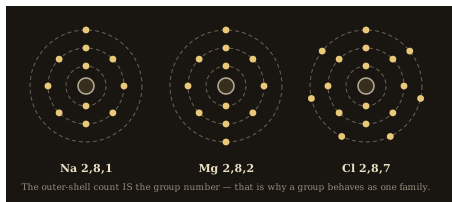
Filling the shells for the first 20 elements
- First shell holds up to 2 electrons.
- Second shell holds up to 8.
- Third shell holds up to 8 (for the first 20 elements).
- Fourth shell then begins — potassium is 2,8,8,1 and calcium is 2,8,8,2.
- So sodium (11 electrons) is 2,8,1 — and that final 1 is why sodium is in Group 1.
This is the whole reason a group behaves as a family. Lithium, sodium and potassium all have exactly one outer electron. When they react, they all do the same thing — lose that one electron — so they all form 1+ ions and all react in the same way with water. Fluorine, chlorine and bromine all have seven, all need one more, and all form 1− ions.
Think of it like coins in a pocket
Group 1 elements all carry a single loose coin they are eager to give away. Group 7 elements all have a pocket one coin short of full and are eager to take one. Group 0 elements already have exactly the right change — nothing to gain, nothing to give — which is precisely why they do not react. 'Full outer shell' is not a magic phrase; it means there is no transaction available.
2 · Grade 9 Notes
A different job from the section above. You have already understood it; this is the precise set of things to LEARN — definitions to reproduce word for word, processes in order, equations with units, and the answers that score full marks.
The rules of the table
- Elements are arranged in order of increasing atomic number
- A GROUP is a vertical column — the group number equals the number of outer-shell electrons
- A PERIOD is a horizontal row — the period number equals the number of occupied shells
- Metals are on the left and in the centre; non-metals are on the upper right
Metal or non-metal — the two tests the specification names
- Electrical conductivity: metals conduct electricity; non-metals generally do not (graphite is the exception)
- The oxide: metal oxides are basic (many are alkaline in water); non-metal oxides are acidic
Electronic configurations worth memorising
- Hydrogen 1 · Helium 2 · Lithium 2,1 · Carbon 2,4 · Nitrogen 2,5 · Oxygen 2,6 · Fluorine 2,7 · Neon 2,8
- Sodium 2,8,1 · Magnesium 2,8,2 · Aluminium 2,8,3 · Silicon 2,8,4 · Phosphorus 2,8,5 · Sulfur 2,8,6 · Chlorine 2,8,7 · Argon 2,8,8
- Potassium 2,8,8,1 · Calcium 2,8,8,2
Learn this definition · Why a group reacts alike
Elements in the same group have the same number of electrons in their outer shell, so they react in the same way and form ions with the same charge.
Learn this definition · Why the noble gases are unreactive
Group 0 elements have a full outer shell of electrons, so they have no tendency to lose, gain or share electrons.
Not this: 'Noble gases are unreactive because they are heavy / because they are gases.'
This: It is entirely about the full outer shell. Helium has only two electrons and is one of the lightest elements, yet it is the least reactive of all.
3 · Prove it — the five questions
The five questions climb Grade 6 → Grade 7 → Grade 8 → Grade 9 → Grade 9 challenge, and are marked inside Incandio on your own device, by rule, with an authored diagnosis of the mistake you actually made. The mark schemes stay in the app so that the practice is worth doing; the questions themselves are here.
- Grade 6 · State [1 mark] — Write the electronic configuration of a magnesium atom, which has 12 electrons. (Type it like 2,8,1.)
- Grade 7 · Explain [3 marks] — Explain why lithium, sodium and potassium all react in a similar way with water.
- Grade 8 · Explain [3 marks] — An element conducts electricity and its oxide dissolves in water to give a solution of pH 12. Explain what this tells you about the element.
- Grade 9 · Explain [3 marks] — Explain why argon does not form compounds, using its electronic configuration.
- 9+ · Predict [4 marks] — Element X is in Period 3 and Group 6. Which set of predictions about X is correct?
The people behind this science
Two ways into the same idea — the one who found the pattern and bet on it, and the one who explained why the pattern is there. Inside Incandio each of them answers knowing exactly which lesson you have just finished.
Dmitri Mendeleev — the one who found the pattern and bet on it
Mendeleev arranged the known elements by their properties, then left empty spaces where he believed undiscovered elements must sit — and predicted their densities and melting points in detail. He was right, and that is why the table is a scientific theory rather than a filing system.
- “Why did you leave gaps rather than simply listing the elements you knew?”
- “How could you predict the properties of an element nobody had found?”
- “What convinced other chemists your arrangement was more than coincidence?”
- “You ordered by atomic mass; we now use atomic number. Where did that change matter?”
- “Why do elements in the same column behave so alike?”
Niels Bohr — the one who explained why the pattern is there
Mendeleev found the pattern but could not say why it existed. Bohr's shells supplied the reason: the group number IS the outer-electron count, and the period number IS the number of occupied shells. The table's shape is a picture of how electrons fill up.
- “Why does the group number tell you the number of outer electrons?”
- “Why does a new period start when a shell is full?”
- “Why do the noble gases refuse to react at all?”
- “How does your model explain why Group 1 metals all behave the same way?”
- “Why did chemists accept a pattern for decades before anyone could explain it?”
Think you understand it?
Reading is the start. On Incandio a topic counts as mastered only once you have taught it and defended it — the two things a revision guide cannot ask of you.
Incandio this topic → Prove it. Teach it. Defend it. What does “Incandio it” mean?
- Prove it — five questions on Electronic Configurations and the Periodic Table, marked on the spot, that tell you what was missing rather than just what was wrong.
- Teach it — Explain Electronic Configurations and the Periodic Table in your own words to Ember, an AI pupil who does not have it yet and asks the awkward question. Understanding is credited; wording is not required.
- Defend it — Argue Electronic Configurations and the Periodic Table against Dmitri Mendeleev — three rounds, marked against descriptors you can read before you begin.
- Then the exam — read all 12 authored exam-style questions on this unit, each with its command word and its tariff, then have them marked on Incandio with the mistake you actually made named.
Completely free. No subscriptions, no paywalls, no account needed to start.
Carry on through the course
- Previous lesson: Inside the Atom
- Next lesson: Solubility and Solubility Curves
- The Three States of Matter — What the particles are doing in a solid, a liquid and a gas — and what really changes when ice melts.
- Pure Substances, Mixtures and How to Separate Them — Why a pure substance melts at one temperature, and which separation technique to reach for when.
- Inside the Atom — Protons, neutrons and electrons — where they are, what they weigh, what they carry, and how isotopes give an element a decimal mass.
- Solubility and Solubility Curves — Why a solution can be full, why hot water holds more, and how one curve tells you exactly how many crystals you will get back.
- Formulae and Balanced Equations — Why the ash weighs more than the metal, what balancing an equation is really doing, and how to add up a formula mass without losing a bracket.
- All of Chemistry · Chemistry key terms · required practicals · equations · Incandio Science · The 4CH1 specification