Pearson Edexcel International GCSE in Chemistry · 4CH1 · Free · no account needed
Pure Substances, Mixtures and How to Separate Them
Why a pure substance melts at one temperature, and which separation technique to reach for when.
On the specification this is separation techniques — 4CH1 statements 1.4 · 1.8 · 1.9 · 1.10 · 1.11 · 1.12 · 1.13.
Topic 1 · Principles of chemistry — one of 18 lessons in this topic, and one of 61 in Chemistry.
One of the 12 Chemistry required practicals · Its equation is on the Chemistry equations page with the other 16.
This lesson ends with Mikhail Tsvet. Learn Pure Substances, Mixtures and How to Separate Them, teach it, then defend it against Mikhail Tsvet.
What this lesson covers in the specification
Incandio is aligned to this specification. It is not published by, endorsed by or affiliated with Pearson, and it reproduces none of Pearson's wording — the statement numbers are given so you can check every lesson against your own copy.
- 1.4 — The terms solvent, solute, solution and saturated solution
- 1.8 — Classifying a substance as an element, compound or mixture
- 1.9 — Pure substances have fixed melting and boiling points; mixtures melt or boil over a range
- 1.10 — Separation techniques: simple distillation, fractional distillation, filtration, crystallisation, paper chromatography
- 1.11 — How a chromatogram gives information about the composition of a mixture
- 1.12 — Using Rf values to identify the components of a mixture
- 1.13 — Practical: investigate paper chromatography using inks or food colourings (required practical)
Specification section 1(a) States of matter — also taught in The Three States of Matter.
1 · Understand it
No exam language yet. The only question this section answers is: do I actually understand what is happening?
An element contains only one kind of atom. A compound contains different atoms chemically bonded together, in fixed proportions — and it takes a chemical reaction to separate them. A mixture is just different substances sitting together, not bonded, in any proportions you like — which is why a mixture can always be separated by a physical method.
Think of it like a fruit salad and a cake
A fruit salad is a mixture: you can pick the grapes back out, and there is no fixed recipe. A cake is a compound: the flour and eggs have reacted, the result has completely different properties from either ingredient, and no amount of picking will get the eggs back. That is why separating a mixture is a job for a sieve or a kettle, and separating a compound is a job for electrolysis.
The melting point test is the neatest consequence. A pure substance melts at one sharp temperature, because every particle is in the same environment and needs the same energy to escape. In a mixture the particles are in different environments, so different amounts of energy are needed and the substance melts gradually over a range. That is genuinely how purity is checked in a laboratory.
Choosing the right separation technique
- Insoluble solid mixed with a liquid → filtration. The solid stays on the filter paper as the residue; the liquid passes through as the filtrate.
- Soluble solid dissolved in a liquid, and you want the SOLID → crystallisation. Evaporate some solvent, leave to cool, and crystals form.
- Soluble solid dissolved in a liquid, and you want the LIQUID → simple distillation. The liquid boils, the vapour is condensed and collected, the solid stays behind.
- Two or more liquids with different boiling points → fractional distillation.
- Coloured substances in solution → paper chromatography.
2 · Grade 9 Notes
A different job from the section above. You have already understood it; this is the precise set of things to LEARN — definitions to reproduce word for word, processes in order, equations with units, and the answers that score full marks.
Statement 1.4 — learn these four definitions
- Solvent
- the liquid a substance dissolves in
- Solute
- the substance that dissolves
- Solution
- the mixture formed when a solute dissolves in a solvent
- Saturated solution
- a solution holding as much dissolved solute as it can at that temperature
Statements 1.8 and 1.9 — the words you are asked to classify with
- Element
- a substance containing only one kind of atom, which cannot be broken down into anything simpler by chemical means
- Compound
- two or more different elements chemically bonded together in fixed proportions
- Mixture
- two or more substances that are not chemically bonded, present in any proportions, and separable by physical means
- Pure substance
- a single element or a single compound, with nothing else in it — so it melts and boils at fixed, sharp temperatures
- 'Pure' in everyday use
- means natural or unadulterated, as in 'pure orange juice'. Chemically that juice is a mixture, and it will not melt sharply
Element, compound, mixture
| Compound | Mixture | |
|---|---|---|
| Bonding | chemically bonded | not bonded |
| Proportions | fixed | any |
| Properties | differ from the elements | each keeps its own |
| Separation | chemical reaction only | physical means |
| Melting point | sharp | over a range |
Choosing the separation technique
- Insoluble solid from a liquid → filtration (solid = residue, liquid = filtrate)
- Soluble solid, want the SOLID → crystallisation
- Soluble solid, want the LIQUID → simple distillation
- Two liquids with different boiling points → fractional distillation
- Dissolved coloured substances → paper chromatography
Crystallisation
- Heat the solution to evaporate some solvent.
- Stop when saturated — a cold glass rod dipped in shows crystals.
- Leave to cool slowly; slow cooling gives larger, purer crystals.
- Filter or decant off the crystals.
- Dry between filter papers, NOT by strong heating, which drives off water of crystallisation.
Simple distillation — separating a solvent FROM a dissolved solid
- Heat the solution so the solvent boils.
- The dissolved solid does not evaporate, so it stays behind in the flask.
- Vapour passes into the condenser, which is cooled by water flowing IN at the bottom and out at the top, so the jacket stays full.
- It condenses and is collected as the pure distillate.
- The thermometer bulb sits level with the side-arm, so it reads the temperature of the vapour actually leaving — not the liquid below.
Fractional distillation — separating two or more LIQUIDS
- Used when the components are miscible liquids with different boiling points, such as ethanol (78 °C) and water (100 °C).
- Heat the mixture. A fractionating column above the flask is hottest at the bottom and coolest at the top.
- Vapour of the higher-boiling liquid condenses on the packing and runs back down; vapour of the lower-boiling liquid continues upwards.
- The liquid with the LOWEST boiling point therefore distils over first, and the thermometer holds steady at its boiling point while it does.
- When the thermometer reading rises, the next fraction is coming over — change the collecting vessel.
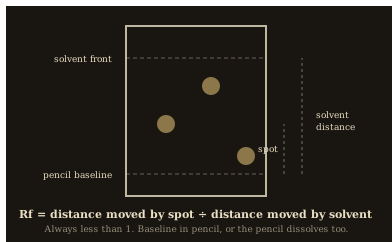
Rf = distance moved by the spot ÷ distance moved by the solvent
Both measured from the pencil baseline; the spot distance is to the CENTRE of the spot.
Units: None — it is a ratio of two lengths. Between 0 and 1, and never above 1.
Model answer [3 marks]
Explain why a pure substance melts at one sharp temperature but a mixture melts over a range. [3]
In a pure substance every particle has the same neighbours and the same forces holding it in place, so every particle needs the same energy to break free and they all do so at one temperature. In a mixture the particles are in a variety of different environments, so different amounts of energy are needed and the substance melts gradually over a range. Impurity also lowers the melting point.
Model answer [3 marks]
A solvent front moves 8.0 cm and a spot moves 3.0 cm. Calculate Rf and explain how it identifies the substance. [3]
Rf = 3.0 ÷ 8.0 = 0.375. It is compared with a reference Rf measured in the same solvent on the same paper, because Rf values change with solvent.
Required practical (1.13): paper chromatography of inks or food colourings
- Draw the baseline in PENCIL about 1 cm from the bottom — ink would dissolve and travel.
- Spot the samples on the baseline, drying between drops to keep spots small.
- Stand the paper so the solvent level is BELOW the baseline, or the spots dissolve into the solvent.
- Let the solvent rise near the top, then mark the solvent front in pencil immediately.
- Measure to the centre of each spot and calculate Rf.
Variables. Independent: the substance spotted. Dependent: distance travelled. Control: same solvent, same paper, same baseline, same run time.
Sources of error and improvement. Spots that are too large smear and have no measurable centre — use a fine capillary and build up in small drops. If the solvent runs off the top, the front cannot be measured and no Rf can be calculated.
Reading a chromatogram
- Number of spots in a lane = number of substances in that mixture
- One spot = a pure substance
- Same Rf in the same solvent = the same substance
- Stays on the baseline = insoluble in that solvent
- Travels with the front = very soluble in that solvent
Mark-losing trap. An Rf above 1 means the fraction is upside down.
Mark-losing trap. Filtration cannot remove a dissolved solid — its particles pass through the paper.
Mark-losing trap. Any melting RANGE means impure; a pure substance melts sharply. Impurity also lowers the melting point.
Mark-losing trap. Remove insoluble impurities by filtering BEFORE crystallising, or they are trapped in the crystals.
Mark-losing trap. Air is a mixture, not a compound — the gases are unbonded and the proportions vary.
3 · Prove it — the five questions
The five questions climb Grade 6 → Grade 7 → Grade 8 → Grade 9 → Grade 9 challenge, and are marked inside Incandio on your own device, by rule, with an authored diagnosis of the mistake you actually made. The mark schemes stay in the app so that the practice is worth doing; the questions themselves are here.
- Grade 6 · Classify [1 mark] — Air contains nitrogen, oxygen, argon and carbon dioxide. They are not chemically bonded to one another, and their proportions vary from place to place. Is air an element, a compound or a mixture?
- Grade 7 · Explain [2 marks] — A student measures the melting point of a white solid and finds it melts between 118 °C and 126 °C. Explain what this tells them.
- Grade 8 · Describe [3 marks] — Describe how you would obtain pure water from sea water in the laboratory.
- Grade 9 · Calculate [3 marks] — A pure sample of dye X has a known Rf of 0.375 in this solvent. An unknown mixture is run on the same paper in the same solvent: the solvent front moves 8.0 cm from the baseline and one of its spots moves 3.0 cm. Calculate the Rf of that spot.
- 9+ · Suggest [4 marks] — A student needs to recover pure copper(II) sulfate crystals from a solution that also contains a small amount of insoluble sand. What is the correct sequence?
The people behind this science
Two ways into the same idea — the one who did it at industrial scale, and the one who separated a mixture nobody knew was a mixture. Inside Incandio each of them answers knowing exactly which lesson you have just finished.
Marie Curie — the one who did it at industrial scale
Crystallisation on this page is a beaker and an evaporating basin. Curie ran the same technique on tonnes of pitchblende — thousands of repeated fractional crystallisations — to isolate a tenth of a gram of radium, and had to invent ways of knowing when a sample was finally pure.
- “How did you separate radium from tonnes of ore using only crystallisation?”
- “How did you know a new element was there before you had ever isolated any of it?”
- “What made the separation so difficult when the chemistry itself was simple?”
- “How did you decide that a sample was finally pure?”
- “Why did you have to repeat the crystallisation thousands of times?”
Louis Pasteur — the one who separated a mixture nobody knew was a mixture
In 1848 Pasteur looked at tartrate crystals under a microscope, noticed two mirror-image shapes, and separated them one by one with tweezers. It is the purest example on this page of the idea that a mixture is separated by a PHYSICAL difference — here, shape — when the chemistry is identical.
- “How did you realise that one pure-looking substance was actually two?”
- “Why could no chemical test tell your two substances apart?”
- “What physical property let you separate them when chemistry could not?”
- “How do you decide whether something is a pure substance or a mixture?”
- “What would you have concluded if the crystals had melted over a range?”
Think you understand it?
Reading is the start. On Incandio a topic counts as mastered only once you have taught it and defended it — the two things a revision guide cannot ask of you.
Incandio this topic → Prove it. Teach it. Defend it. What does “Incandio it” mean?
- Prove it — five questions on Pure Substances, Mixtures and How to Separate Them, marked on the spot, that tell you what was missing rather than just what was wrong.
- Teach it — Explain Pure Substances, Mixtures and How to Separate Them in your own words to Ember, an AI pupil who does not have it yet and asks the awkward question. Understanding is credited; wording is not required.
- Defend it — Argue Pure Substances, Mixtures and How to Separate Them against Mikhail Tsvet — three rounds, marked against descriptors you can read before you begin.
- Then the exam — read all 12 authored exam-style questions on this unit, each with its command word and its tariff, then have them marked on Incandio with the mistake you actually made named.
Completely free. No subscriptions, no paywalls, no account needed to start.
Carry on through the course
- Previous lesson: The Three States of Matter
- Next lesson: Inside the Atom
- The Three States of Matter — What the particles are doing in a solid, a liquid and a gas — and what really changes when ice melts.
- Inside the Atom — Protons, neutrons and electrons — where they are, what they weigh, what they carry, and how isotopes give an element a decimal mass.
- Electronic Configurations and the Periodic Table — Why the table has the shape it has: the group number IS the outer-shell electron count, and everything follows from that.
- Solubility and Solubility Curves — Why a solution can be full, why hot water holds more, and how one curve tells you exactly how many crystals you will get back.
- Formulae and Balanced Equations — Why the ash weighs more than the metal, what balancing an equation is really doing, and how to add up a formula mass without losing a bracket.
- All of Chemistry · Chemistry key terms · required practicals · equations · Incandio Science · The 4CH1 specification