Pearson Edexcel International GCSE in Chemistry · 4CH1 · Free · no account needed
Electronic Configurations and the Periodic Table — exam questions
12 original Incandio exam-style questions on Electronic Configurations and the Periodic Table, 26 marks, about 26 minutes of writing. Each one carries the command word, the tariff and the specification statement it assesses, exactly as a paper presents them. This is an original Incandio practice question, written to reflect the structure and demands of the qualification. It is not an official Pearson Edexcel past-paper question.
This is the practice set for Electronic Configurations and the Periodic Table — the lesson that teaches it. Read the lesson first if the idea is new; come here when you want to find out whether you can turn it into marks. Completely free, no account needed to read.
What these questions ask of you
7 command words run through this set, and on Pearson Edexcel International GCSE Chemistry each one means something precise. Answering the wrong command is the commonest way a candidate who understands the lesson still loses the mark.
- Which (1 mark)
- one option chosen from the set given
- Give (1–2 marks)
- a short factual answer — the most common chemistry command
- State (1 mark)
- one precise fact, no justification
- Explain (2–4 marks)
- the reason, in terms of particles, bonding, energy or equilibrium Misread as: describing the observation without giving the chemistry that causes it
- Describe (2–5 marks)
- developed, linked statements of what happens or what is observed Misread as: giving one bare observation where the tariff asked for a developed account
- Suggest (1–3 marks)
- a plausible answer applying taught chemistry to an unfamiliar substance
- Identify (1–2 marks)
- the correct substance or feature selected from what is given
Assessed on Paper 1 (4CH1/1C) and Paper 2 (4CH1/2C), against AO1, AO2, AO3.
Where these sit in the specification
Pearson Edexcel International GCSE Chemistry (4CH1) — statements 1.18 · 1.19 · 1.22 · 1.23 · 1.24 · 1.20 · 1.21. Incandio is aligned to this specification; it is not published by, endorsed by or affiliated with Pearson, and it reproduces none of Pearson's wording.
The 12 questions
Answer them on paper, then open the lesson's exam practice to have them marked. The mark scheme, the accepted and rejected answers and the annotated model answer are in Incandio and are not printed here — an answer beside its question is not practice.
-
Table 1 — four elements identified only by a letter. The letters are not their chemical symbols. Element Atomic number Electronic configuration Q 9 2,7 R 11 2,8,1 S 18 2,8,8 T 20 2,8,8,2 (a)
(2)Give
Give the group and the period of element T, using Table 1.
Table 1 — four elements identified only by a letter. The letters are not their chemical symbols. Element Atomic number Electronic configuration Q 9 2,7 R 11 2,8,1 S 18 2,8,8 T 20 2,8,8,2 (b)
(2)Identify
Identify the element in Table 1 that is a noble gas, and give a reason for your choice.
Table 1 — four elements identified only by a letter. The letters are not their chemical symbols. Element Atomic number Electronic configuration Q 9 2,7 R 11 2,8,1 S 18 2,8,8 T 20 2,8,8,2 (c)
(3)Explain
Explain which two elements in Table 1 would react together most readily, and what type of compound they would form.
Table 1 — four elements identified only by a letter. The letters are not their chemical symbols. Element Atomic number Electronic configuration Q 9 2,7 R 11 2,8,1 S 18 2,8,8 T 20 2,8,8,2 (d)
(1)Suggest
Suggest one element not in Table 1 that would react with Q in a very similar way to R, and explain your choice.
Table 1 — four elements identified only by a letter. The letters are not their chemical symbols. Element Atomic number Electronic configuration Q 9 2,7 R 11 2,8,1 S 18 2,8,8 T 20 2,8,8,2 (Total for Question 1 = 8 marks)
-
(1)Which
Which property are the elements in the Periodic Table arranged in order of?
Property A relative atomic mass B atomic number C melting point D density (Total for Question 2 = 1 mark)
-
(1)Give
Give the electronic configuration of an atom of magnesium, atomic number 12.
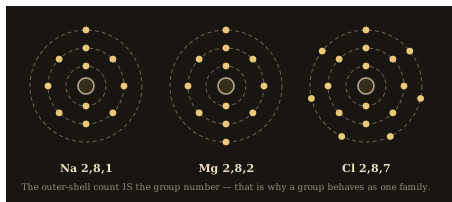
Figure 1 — electrons arranged in shells around a nucleus. (Total for Question 3 = 1 mark)
-
(1)State
State what the group number of a main group element tells you about its atoms.
(Total for Question 4 = 1 mark)
-
(3)Explain
Explain why all the elements in Group 1 have similar chemical properties.
(Total for Question 5 = 3 marks)
-
(2)Explain
Explain why the noble gases are unreactive.
(Total for Question 6 = 2 marks)
-
(3)Describe
Describe two ways of deciding from experiment whether an unknown element is a metal or a non-metal.
(Total for Question 7 = 3 marks)
-
(3)Suggest
Element Z has atomic number 87. Suggest how it reacts with water, and why.
(Total for Question 8 = 3 marks)
-
(4)Explain
An element has the electronic configuration 2,8,7. Explain what this tells you about its position in the periodic table and the ion it will form.
(Total for Question 9 = 4 marks)
Have them marked, then defend the answer
Practice tells you the mark; teaching it back tells you whether you understand it. On Incandio a topic counts as mastered only once you have taught it and defended it.
- Mark these questions — 12 questions, marked on Incandio against the authored scheme, with the mistake you actually made named.
- Teach it — explain Electronic Configurations and the Periodic Table to Ember, an AI pupil who does not have it yet and asks the awkward question.
- Defend it — argue it against Dmitri Mendeleev over three rounds, marked against descriptors you can read first.
Completely free. No subscriptions, no paywalls, no account needed to start.
Back to the lesson
- Electronic Configurations and the Periodic Table — Why the table has the shape it has: the group number IS the outer-shell electron count, and everything follows from that.
- All of Incandio Chemistry · Incandio Exam Practice