Pearson Edexcel International GCSE in Physics · 4PH1 · Free · no account needed
The Motor Effect — exam questions
11 original Incandio exam-style questions on the Motor Effect, 25 marks, about 25 minutes of writing. Each one carries the command word, the tariff and the specification statement it assesses, exactly as a paper presents them. This is an original Incandio practice question, written to reflect the structure and demands of the qualification. It is not an official Pearson Edexcel past-paper question.
This is the practice set for The Motor Effect — the lesson that teaches it. Read the lesson first if the idea is new; come here when you want to find out whether you can turn it into marks. Completely free, no account needed to read.
What these questions ask of you
7 command words run through this set, and on Pearson Edexcel International GCSE Physics each one means something precise. Answering the wrong command is the commonest way a candidate who understands the lesson still loses the mark.
- Which (1 mark)
- one option chosen from the set given
- State (1 mark)
- one precise fact or definition
- Give (1–2 marks)
- a short factual answer
- Explain (2–4 marks)
- the physics that causes it, set out as a line of reasoning Misread as: describing the change without giving the physical reason for it
- Determine (1–4 marks)
- a value obtained by combining a reading or gradient with a relationship
- Suggest (1–3 marks)
- a plausible answer applying taught physics to an unfamiliar arrangement
- Describe (2–4 marks)
- developed, linked statements of what happens — including a named direction where one exists
Assessed on Paper 1 (4PH1/1P) and Paper 2 (4PH1/2P), against AO1, AO2, AO3.
Where these sit in the specification
Pearson Edexcel International GCSE Physics (4PH1) — statements 6.13 · 6.11 · 6.14 · 6.12. Incandio is aligned to this specification; it is not published by, endorsed by or affiliated with Pearson, and it reproduces none of Pearson's wording.
The 11 questions
Answer them on paper, then open the lesson's exam practice to have them marked. The mark scheme, the accepted and rejected answers and the annotated model answer are in Incandio and are not printed here — an answer beside its question is not practice.
-
A stiff copper wire is clamped horizontally so that a 5.0 cm length of it lies between the poles of a magnet standing on a top-pan balance. When a current flows in the wire, the wire is pushed upwards and the balance reading changes. The student recorded the change in reading for several currents.
Table 1 — change in the balance reading Current / A Change in balance reading / g 0.0 0.00 1.0 0.12 2.0 0.25 3.0 0.36 4.0 0.49 (a)
(1)Give
Give the change in balance reading at a current of 3.0 A, using Table 1.
A stiff copper wire is clamped horizontally so that a 5.0 cm length of it lies between the poles of a magnet standing on a top-pan balance. When a current flows in the wire, the wire is pushed upwards and the balance reading changes. The student recorded the change in reading for several currents.
Table 1 — change in the balance reading Current / A Change in balance reading / g 0.0 0.00 1.0 0.12 2.0 0.25 3.0 0.36 4.0 0.49 change = ............................ g
(b)
(2)Describe
Describe the relationship between current and force shown by Table 1.
A stiff copper wire is clamped horizontally so that a 5.0 cm length of it lies between the poles of a magnet standing on a top-pan balance. When a current flows in the wire, the wire is pushed upwards and the balance reading changes. The student recorded the change in reading for several currents.
Table 1 — change in the balance reading Current / A Change in balance reading / g 0.0 0.00 1.0 0.12 2.0 0.25 3.0 0.36 4.0 0.49 (c)
(3)Suggest
Suggest what the student would observe if the connections to the wire were swapped over.
A stiff copper wire is clamped horizontally so that a 5.0 cm length of it lies between the poles of a magnet standing on a top-pan balance. When a current flows in the wire, the wire is pushed upwards and the balance reading changes. The student recorded the change in reading for several currents.
Table 1 — change in the balance reading Current / A Change in balance reading / g 0.0 0.00 1.0 0.12 2.0 0.25 3.0 0.36 4.0 0.49 (Total for Question 1 = 6 marks)
-
(1)Which
Which finger represents the field in the left-hand rule?
Finger A the thumb B the first finger C the second finger D the little finger (Total for Question 2 = 1 mark)
-
(1)State
State the direction of the current relative to a magnetic field for which no force acts on the wire.
(Total for Question 3 = 1 mark)
-
(2)Give
Give two ways of increasing the size of the force on a current-carrying wire in a magnetic field.
(Total for Question 4 = 2 marks)
-
(3)Explain
Explain why a force acts on a current-carrying wire placed at right angles to a magnetic field.
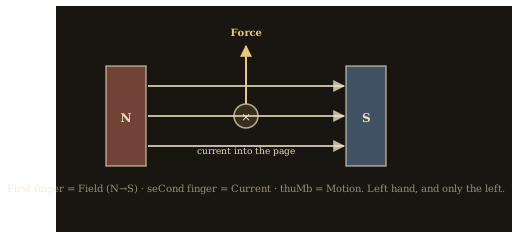
Figure 1 — the left-hand rule (Total for Question 5 = 3 marks)
-
(2)Determine
A wire carries current from left to right through a field pointing away from the reader. Determine the direction of the force on the wire.
(Total for Question 6 = 2 marks)
-
(3)Explain
Explain what happens to the force on the wire if both the current and the magnetic field are reversed.
(Total for Question 7 = 3 marks)
-
(3)Suggest
Suggest how the loudspeaker turns an electrical signal into sound.
Inside a loudspeaker — A loudspeaker has a coil of wire wound on a light tube, free to slide over the central pole of a permanent magnet. The tube is glued to the middle of a stiff paper cone. The signal sent to the coil is an alternating current whose frequency matches the note to be played.
(Total for Question 8 = 3 marks)
-
(4)Explain
Explain what happens to the force on a current-carrying wire in a magnetic field when the current is reversed, when the magnet is turned round, and when both are done at once.
(Total for Question 9 = 4 marks)
Have them marked, then defend the answer
Practice tells you the mark; teaching it back tells you whether you understand it. On Incandio a topic counts as mastered only once you have taught it and defended it.
- Mark these questions — 11 questions, marked on Incandio against the authored scheme, with the mistake you actually made named.
- Teach it — explain the Motor Effect to Ember, an AI pupil who does not have it yet and asks the awkward question.
- Defend it — argue it against Michael Faraday over three rounds, marked against descriptors you can read first.
Completely free. No subscriptions, no paywalls, no account needed to start.
Back to the lesson
- The Motor Effect — Put a current in a magnetic field and something moves — the effect behind every electric motor and every loudspeaker.
- All of Incandio Physics · Incandio Exam Practice