Pearson Edexcel International GCSE in Physics · 4PH1 · Free · no account needed
The Motor Effect
Put a current in a magnetic field and something moves — the effect behind every electric motor and every loudspeaker.
Topic 6 · Magnetism and electromagnetism — one of 6 lessons in this topic, and one of 65 in Physics.
This lesson ends with Michael Faraday. Learn the Motor Effect, teach it, then defend it against Michael Faraday.
The definition this lesson teaches, word for word — every Physics definition.
- The motor effect
- The force experienced by a current-carrying conductor placed in a magnetic field, provided the current is not parallel to the field. It arises because the field of the current and the field of the magnet reinforce on one side of the wire and cancel on the other.
What this lesson covers in the specification
Incandio is aligned to this specification. It is not published by, endorsed by or affiliated with Pearson, and it reproduces none of Pearson's wording — the statement numbers are given so you can check every lesson against your own copy.
- 6.11 — The force on a charged particle moving non-parallel to a magnetic field (bold P statement — Paper 2 only)
- 6.12 — Why a force acts on a current-carrying wire in a field, and its use in motors and loudspeakers
- 6.13 — Use the left-hand rule to predict the direction of the force
- 6.14 — How the force changes with the magnitude and direction of the field and the current
Specification section 6(c) Electromagnetism — also taught in Induced Magnetism and Field Patterns, Electromagnets.
1 · Understand it
No exam language yet. The only question this section answers is: do I actually understand what is happening?
A wire carrying a current has its own circular magnetic field, from the last page. Put that wire into the field of a permanent magnet and there are now TWO fields in the same region of space. They do not politely ignore one another: on one side of the wire the two fields point the same way and reinforce, and on the other side they point opposite ways and partly cancel. The result is a region of strong field on one side of the wire and weak field on the other, and the wire is pushed from the strong side towards the weak side. That is the MOTOR EFFECT, and it is statement 6.12.
Think of it like a boat in a river with a current on one bank only
A rowing boat sitting still in the middle of a river feels nothing much. But suppose the water on the left bank is racing past and the water on the right is almost still. The boat does not stay where it is: the imbalance across it pushes it sideways, away from the crowded side and towards the empty one. The two magnetic fields do the same thing. Where they reinforce, the field lines are crowded; where they cancel, they are sparse — and the wire is pushed out of the crowded region into the sparse one. This picture also tells you the direction is not along the current and not along the field but at right angles to both, because 'sideways' here means sideways to both of them at once.
That direction is found with FLEMING'S LEFT-HAND RULE, statement 6.13. Hold the thumb, first finger and second finger of your LEFT hand at right angles to each other, like the corner of a box. The FIRST finger is the FIELD, pointing from north to south. The seCond finger is the CURRENT, in the conventional direction from positive to negative. The thuMb then gives the MOTION — the direction of the force on the wire.
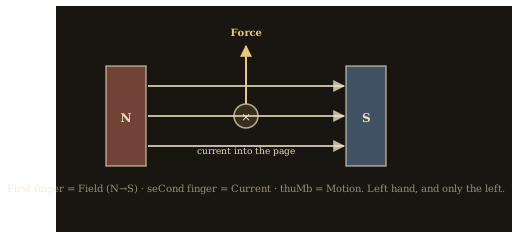
Two things about the rule are worth fixing now, because they cause most of the lost marks. It is the LEFT hand — the right hand is for the field around a current and, later, for induction — and mixing them up reverses every answer. And all three quantities must be MUTUALLY PERPENDICULAR: if the current runs PARALLEL to the field there is no force at all, which is statement 6.11 stated the other way round. A charged particle moving along the field lines feels nothing; one moving across them feels the maximum force; one moving at some angle between feels something in between.
Statement 6.11 is the same physics one level down. A current is charge in motion, so what is really being pushed is not the wire but the moving CHARGES inside it, and they drag the wire along with them. This means the effect does not need a wire at all: any charged particle moving through a magnetic field, in any direction other than parallel to it, experiences a force at right angles to both its motion and the field. The particle's path curves rather than straightening, because the force is always perpendicular to the velocity and so keeps changing direction with it.
How to make the force bigger, and how to reverse it — statement 6.14
- INCREASE THE CURRENT. More charge moving each second means a bigger force.
- INCREASE THE STRENGTH OF THE MAGNETIC FIELD — a stronger magnet, or magnets closer together.
- INCREASE THE LENGTH OF WIRE that is inside the field, for instance by using a coil of many turns instead of a single wire.
- ANGLE MATTERS. The force is greatest when the current is at 90° to the field, falls as the angle closes, and is ZERO when the current runs parallel to the field.
- TO REVERSE THE FORCE — reverse the current, OR reverse the field. Reversing BOTH leaves the force exactly as it was, which is a favourite exam trick.
Two devices on the specification run on this. In a LOUDSPEAKER, a coil is attached to a paper cone and sits in the field of a permanent magnet. An alternating current in the coil produces a force that reverses direction every time the current does, so the coil and cone are pushed in and out, and the moving cone makes the air vibrate — a sound wave whose frequency is the frequency of the current. In an ELECTRIC MOTOR, a coil in a magnetic field carries a current; the force on one side of the coil is upwards and on the other side downwards, because the current runs in opposite directions along the two sides, and that pair of opposite forces turns the coil.
Predicting a direction, and then changing it
A wire runs horizontally between the poles of a magnet, with the field pointing from left to right across the page and the conventional current flowing into the page. (a) Which way is the force? (b) What happens if the current is reversed AND the magnet is turned round?
- (a) LEFT hand. First finger along the field: point it to the right.
- Second finger along the current: point it into the page.
- With the first finger right and the second into the page, the thumb points DOWNWARDS. The force on the wire is downwards.
- (b) Reversing the current alone would flip the force to upwards. Reversing the field alone would also flip it to upwards.
- Doing BOTH flips it twice, so the force is downwards again — exactly as it started.
Answer: (a) Downwards. (b) Still downwards — two reversals cancel.
2 · Grade 9 Notes
A different job from the section above. You have already understood it; this is the precise set of things to LEARN — definitions to reproduce word for word, processes in order, equations with units, and the answers that score full marks.
Learn this definition · The motor effect
The force experienced by a current-carrying conductor placed in a magnetic field, provided the current is not parallel to the field. It arises because the field of the current and the field of the magnet reinforce on one side of the wire and cancel on the other.
Fleming's left-hand rule
- Use the LEFT hand, and hold thumb, first finger and second finger at right angles to one another.
- FIRST finger = FIELD, pointing from north to south.
- seCond finger = CURRENT, conventional, from positive to negative.
- thuMb = MOTION, the direction of the force on the conductor.
- Check the hand is left and not right, then read off the thumb.
Statement 6.14 — what changes the size of the force
- A LARGER CURRENT gives a larger force
- A STRONGER MAGNETIC FIELD gives a larger force
- A GREATER LENGTH of wire in the field gives a larger force — a coil of many turns rather than one wire
- The ANGLE matters: maximum at 90° to the field, zero when PARALLEL to it
- Reverse the current OR the field to reverse the force; reverse BOTH and the force is unchanged
The left hand against the right hand
A. LEFT HAND — the motor effect. A current in a field produces a FORCE. Field, current, motion.
B. RIGHT HAND — the grip rule for the field around a current, and the generator rule for inducing a voltage by moving a conductor.
The two devices named by statement 6.12
- LOUDSPEAKER — a coil on a paper cone in a permanent magnet's field; alternating current reverses the force, so the cone vibrates and produces sound at the current's frequency
- MOTOR — a coil in a field; the current runs opposite ways along the two sides, so one side is forced up and the other down, and the coil turns
- Both rely on the force reversing when the current does
Model answer [4 marks]
Explain why a force acts on a current-carrying wire placed at right angles to a magnetic field. [4]
The current in the wire produces its own magnetic field, which forms circles around the wire. This field and the field of the magnet occupy the same region of space. On one side of the wire the two fields are in the same direction and reinforce one another, giving a stronger field; on the other side they are in opposite directions and partly cancel, giving a weaker field. The wire is therefore pushed from the region of stronger field towards the region of weaker field, and this force acts at right angles to both the current and the field.
Model answer [4 marks]
A loudspeaker contains a coil attached to a paper cone, sitting in the field of a permanent magnet. Explain how an alternating current in the coil produces sound. [4]
The current in the coil is in the magnetic field of the permanent magnet, so a force acts on the coil by the motor effect. Because the current is alternating, it reverses direction many times each second, and the force on the coil therefore reverses with it. The coil is pushed backwards and forwards, and the paper cone attached to it moves with the coil. The moving cone pushes on the air, producing a sound wave whose frequency is the same as the frequency of the alternating current.
Not this: The force on the wire is in the direction of the magnetic field, or in the direction of the current.
This: The force is at RIGHT ANGLES TO BOTH. That is the whole content of Fleming's left-hand rule: three quantities, mutually perpendicular, and the force is the one your thumb gives.
Mark-losing trap. LEFT hand for the motor effect. Using the right hand reverses every answer you give.
Mark-losing trap. Current PARALLEL to the field means NO force at all — the effect needs the two to cross.
Mark-losing trap. Reverse the current AND the field and the force is unchanged, because it has been flipped twice.
Mark-losing trap. The first finger points N → S, not S → N. Getting this backwards inverts the answer.
3 · Prove it — the five questions
The five questions climb Grade 6 → Grade 7 → Grade 8 → Grade 9 → Grade 9 challenge, and are marked inside Incandio on your own device, by rule, with an authored diagnosis of the mistake you actually made. The mark schemes stay in the app so that the practice is worth doing; the questions themselves are here.
- Grade 6 · State [1 mark] — A charged particle travels through a magnetic field, moving exactly parallel to the field lines. What force does the magnetic field exert on it?
- Grade 7 · Predict [2 marks] — A horizontal wire lies between the poles of a magnet. The magnetic field points from left to right across the page, and the conventional current flows into the page. In which direction does the force on the wire act?
- Grade 8 · Explain [3 marks] — A student sets up a wire in a magnetic field and observes a force on it. They then reverse the direction of the current AND turn the magnet round so that the field is reversed too. Explain what happens to the force.
- Grade 9 · Explain [6 marks] — Select every statement that belongs in a full-mark explanation of why a force acts on a current-carrying wire placed at right angles to a magnetic field, and of how that force can be made larger.
- 9+ · Analyse [6 marks] — A student building a simple motor finds that the coil turns through a quarter of a turn, stops, and jerks back. They conclude that the magnet is too weak. Select every statement that belongs in a full-mark analysis.
The people behind this science
Two ways into the same idea — the one who built the first thing that turned because of electricity, and the one who explained why the force has to be perpendicular to both. Inside Incandio each of them answers knowing exactly which lesson you have just finished.
Michael Faraday — the one who built the first thing that turned because of electricity
In 1821, a year after Ørsted's discovery, Faraday made a wire hanging in a dish of mercury rotate continuously around a magnet. It is the first conversion of electrical energy into continuous mechanical motion — the ancestor of every motor on this page — and it was built in a few days by a man trying to understand what Ørsted's circular force implied. The episode also produced a serious quarrel: Faraday published without adequately crediting William Hyde Wollaston, whose ideas he had discussed, and the accusation of plagiarism shadowed him for years. He is worth asking both about the physics and about that.
- “How did you make a wire rotate around a magnet?”
- “What did Ørsted's result make you think was possible?”
- “Why does the force act sideways to both the current and the field?”
- “What was the quarrel with Wollaston about?”
- “Did you realise what a rotating wire would eventually become?”
James Clerk Maxwell — the one who explained why the force has to be perpendicular to both
Fleming's left-hand rule tells a learner what the answer is and never why it should be so, and 'at right angles to both' is a genuinely odd thing for a force to do — no other force met on this course behaves that way. Maxwell is the person who turned that oddity into mathematics, showing that the mutually perpendicular arrangement is not a quirk of the apparatus but a consequence of how fields combine. He is also honest about the limits of the picture: his own account went through mechanical models he later discarded, which is a useful thing for a learner to hear about a rule they are being asked to trust.
- “Why must the force be at right angles to both the current and the field?”
- “Is there any force in physics that behaves like this one?”
- “What is really being pushed — the wire or the charges in it?”
- “Why does a current parallel to the field feel nothing at all?”
- “Did you believe your own mechanical models of the field?”
Think you understand it?
Reading is the start. On Incandio a topic counts as mastered only once you have taught it and defended it — the two things a revision guide cannot ask of you.
Incandio this topic → Prove it. Teach it. Defend it. What does “Incandio it” mean?
- Prove it — five questions on the Motor Effect, marked on the spot, that tell you what was missing rather than just what was wrong.
- Teach it — Explain the Motor Effect in your own words to Ember, an AI pupil who does not have it yet and asks the awkward question. Understanding is credited; wording is not required.
- Defend it — Argue the Motor Effect against Michael Faraday — three rounds, marked against descriptors you can read before you begin.
- Then the exam — read all 11 authored exam-style questions on this unit, each with its command word and its tariff, then have them marked on Incandio with the mistake you actually made named.
Completely free. No subscriptions, no paywalls, no account needed to start.
Carry on through the course
- Previous lesson: Electromagnets
- Next lesson: Electromagnetic Induction
- Magnets and Magnetic Fields — Why only repulsion proves you are holding a magnet, and what a field line is actually a picture of.
- Induced Magnetism and Field Patterns — Why an iron nail sticks to a magnet at all, why it never pushes back, and how to plot a field you cannot see.
- Electromagnets — The four pages of Latin that showed a current makes a field — and why that field goes round the wire rather than along it.
- Electromagnetic Induction — Move a magnet near a coil and a voltage appears from nowhere — provided something is changing.
- Transformers — Two coils that never touch, the reason the National Grid runs at 400 000 volts, and why none of it works on a battery.
- All of Physics · Physics key terms · required practicals · equations · Incandio Science · The 4PH1 specification