Pearson Edexcel International GCSE in Physics · 4PH1 · Free · no account needed
Half-Life
Half of what is left, every time — which is why a radioactive sample never quite runs out.
Topic 7 · Radioactivity and particles — one of 9 lessons in this topic, and one of 65 in Physics.
This lesson ends with Marie Curie. Learn half-Life, teach it, then defend it against Marie Curie.
The 2 definitions this lesson teaches, word for word — every Physics definition.
- Half-life
- The time taken for the activity of a radioactive source to fall to half its value, or equivalently the time for half of the undecayed nuclei present to decay. It is a fixed property of the isotope.
- Activity
- The number of nuclei that decay each second in a source, measured in becquerels. One becquerel is one decay per second.
What this lesson covers in the specification
Incandio is aligned to this specification. It is not published by, endorsed by or affiliated with Pearson, and it reproduces none of Pearson's wording — the statement numbers are given so you can check every lesson against your own copy.
- 7.11 — Activity decreases over time and is measured in becquerels
- 7.12 — The definition of half-life, and that it differs between isotopes
- 7.13 — Half-life calculations, including graphical methods
Specification section 7(b) Radioactivity — also taught in Alpha, Beta and Gamma, Nuclear Equations, Detecting Radiation and Background, Uses and Dangers of Radiation.
1 · Understand it
No exam language yet. The only question this section answers is: do I actually understand what is happening?
The ACTIVITY of a source is the number of nuclei decaying each second, measured in BECQUERELS. One becquerel is one decay per second. Activity falls with time, and the reason is almost too simple to notice: every time a nucleus decays, it is gone. There are fewer undecayed nuclei left than there were, so fewer decays happen in the next second.
That gives the pattern its characteristic shape. The activity does not fall by a fixed amount each second; it falls by a fixed PROPORTION. The HALF-LIFE is the time taken for the activity of a source to fall to HALF its value — equivalently, the time for half the undecayed nuclei present to decay.
The words 'half its value' are doing careful work, and the whole topic turns on them. It is half of whatever is there NOW, not half of what was there originally. So after one half-life you have a half left; after two, a half of a half, which is a quarter; after three, an eighth; after four, a sixteenth. On the model curve it never reaches zero, because taking half of something always leaves something. (Strictly, a real sample contains a finite number of nuclei, so eventually the last one decays — but for any sample you will meet, that is so many half-lives away that the halving rule is what matters.)
Think of it like eating half a cake, then half of what remains
Take a cake and eat half of it. Tomorrow eat half of what is left, so a quarter of the original, and the day after eat half of the remainder again. You will never finish the cake — the pieces get absurdly small but there is always something on the plate. Now notice what happens if you make the mistake this page exists to prevent, and eat half the ORIGINAL cake every day: you finish it in two days flat. That is exactly the difference between the true rule and the one most learners reach for, and it explains why a source with a two-hour half-life is not spent after four hours but is still going, at a quarter strength, and will still be detectable long after that.
Half-lives forwards, and then backwards
(a) A source has an activity of 800 Bq and a half-life of 3 hours. What is its activity after 12 hours? (b) A different source falls from 4800 Bq to 300 Bq in 20 minutes. What is its half-life?
- (a) Number of half-lives = total time ÷ half-life = 12 ÷ 3 = 4 half-lives.
- Halve four times: 800 → 400 → 200 → 100 → 50. The activity is 50 Bq.
- (b) Work out how many halvings take 4800 down to 300: 4800 → 2400 → 1200 → 600 → 300. That is 4 halvings.
- So 4 half-lives took 20 minutes.
- Half-life = 20 ÷ 4 = 5 minutes.
Answer: (a) 50 Bq. (b) A half-life of 5 minutes.
The method in part (b) is worth naming, because it is the one most questions want: count the HALVINGS between the two activities, then divide the elapsed time by that number. Counting halvings on your fingers is faster and more reliable than any formula, and it works just as well in reverse when a question gives you the half-life and asks how long something took.
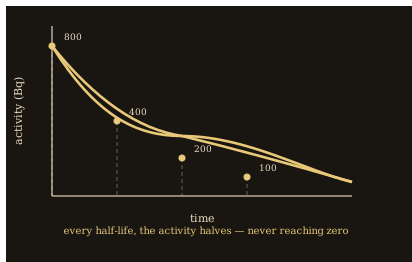
Reading a half-life off a decay curve
- First correct every plotted point for background, or the curve will flatten out at the background level instead of approaching zero and every reading will be too long.
- Pick a convenient starting activity on the curve — the initial value is usually easiest.
- Halve it, and read off the time at which the curve passes through that halved value.
- The difference between the two times is one half-life.
- Repeat starting from a different point on the curve and take a mean, because decay is random and a single reading is unreliable.
- Check: the answer should be the same wherever you start, since the halving time does not depend on how much is there.
Half-lives differ enormously between isotopes, and that is a property of the isotope rather than of the sample. Some are fractions of a second; carbon-14 is 5730 years; uranium-238 is about 4500 million years. Nothing you do to a sample alters its half-life — the same point made on the previous page about heating applies here, because the half-life is a property of the nucleus.
One last consequence, because it sounds paradoxical until it does not. A LONG half-life means a LOW activity for a given amount of material, because the decays are spread over a longer time. A short half-life means an intense source that quickly becomes useless. So 'more dangerous' cannot be read off the half-life alone: a short half-life means an intense but short-lived hazard, while a long one means a weak hazard that will still be there in ten thousand years.
2 · Grade 9 Notes
A different job from the section above. You have already understood it; this is the precise set of things to LEARN — definitions to reproduce word for word, processes in order, equations with units, and the answers that score full marks.
Learn this definition · Half-life
The time taken for the activity of a radioactive source to fall to half its value, or equivalently the time for half of the undecayed nuclei present to decay. It is a fixed property of the isotope.
Learn this definition · Activity
The number of nuclei that decay each second in a source, measured in becquerels. One becquerel is one decay per second.
Working out an activity after a given time
- Number of half-lives = total time ÷ half-life.
- Start from the initial activity and halve it that many times.
- Count the halvings on your fingers rather than reaching for a formula.
- Check the answer is smaller than the original but not zero.
- If the question gives a fraction remaining, count the halvings needed to reach it instead.
Finding a half-life from two activities and an elapsed time
- Write down the starting activity and the final activity.
- Count how many halvings take the first to the second.
- Half-life = elapsed time ÷ number of halvings.
- From a graph instead: read the time at any activity, then the time at half that activity, and subtract.
- Repeat from a different starting point and take a mean, because decay is random.
The fractions to have ready
- After 1 half-life: 1/2 remains — 50%
- After 2 half-lives: 1/4 remains — 25%
- After 3 half-lives: 1/8 remains — 12.5%
- After 4 half-lives: 1/16 remains — 6.25%
- After 5 half-lives: 1/32 remains — about 3%
- It NEVER reaches zero, because half of something is always something
What a half-life does and does not depend on
- It is a fixed property of the ISOTOPE — carbon-14 is 5730 years wherever it is found
- It does NOT depend on how much material there is
- It does NOT depend on temperature, pressure or chemical state
- A LONG half-life means a LOW activity for a given quantity, and a hazard that lasts
- A SHORT half-life means an intense source that quickly becomes useless
Model answer [3 marks]
A source has an activity of 6400 Bq and a half-life of 15 minutes. Calculate its activity after 1 hour. [3]
One hour is 60 minutes, so the number of half-lives is 60 ÷ 15 = 4. Halving the activity four times gives 6400 → 3200 → 1600 → 800 → 400. The activity after one hour is therefore 400 Bq.
Model answer [4 marks]
Explain why the activity of a radioactive source falls with time, and why it never reaches zero. [4]
Each time a nucleus decays it is no longer able to decay again, so the number of undecayed nuclei in the source steadily falls. The activity is the number of decays each second, which depends on how many undecayed nuclei remain, so the activity falls as well. Because a fixed proportion rather than a fixed number decays in each interval, the activity halves in each half-life. Halving a quantity always leaves something, so in principle the activity approaches zero without ever reaching it.
Not this: After two half-lives the source has completely decayed, since two halves make a whole.
This: Each half-life removes half of WHAT IS LEFT, not half of the original. After two half-lives a QUARTER remains, after three an eighth, and the activity approaches zero without ever reaching it.
Mark-losing trap. Half-life is half of what is left NOW, never half of the original amount.
Mark-losing trap. Correct for background BEFORE plotting, or the curve levels off and every half-life reads too long.
Mark-losing trap. Nothing changes a half-life — not heat, not pressure, not chemistry. It is a property of the nucleus.
3 · Prove it — the five questions
The five questions climb Grade 6 → Grade 7 → Grade 8 → Grade 9 → Grade 9 challenge, and are marked inside Incandio on your own device, by rule, with an authored diagnosis of the mistake you actually made. The mark schemes stay in the app so that the practice is worth doing; the questions themselves are here.
- Grade 6 · Calculate [2 marks] — A source has an activity of 480 Bq and a half-life of 2 hours. What is its activity after 4 hours?
- Grade 7 · Define [2 marks] — What is meant by the half-life of a radioactive source?
- Grade 8 · Calculate [3 marks] — The activity of a source falls from 3200 Bq to 200 Bq in 1 hour. Calculate its half-life in minutes.
- Grade 9 · Describe [6 marks] — Select every statement that belongs in a full-mark description of how to determine the half-life of a source experimentally from measurements of its activity over time.
- 9+ · Analyse [6 marks] — Two sources contain the same number of undecayed nuclei. Source A has a half-life of 6 hours, source B a half-life of 6000 years. A student says source B is the more dangerous 'because it stays radioactive for far longer'. Select every statement that belongs in a full-mark analysis.
The people behind this science
Two ways into the same idea — the one who introduced the idea that decay has a characteristic time, and the one whose measurements the whole idea rests on. Inside Incandio each of them answers knowing exactly which lesson you have just finished.
Ernest Rutherford — the one who introduced the idea that decay has a characteristic time
Half-life is Rutherford's concept, arrived at while he and Soddy were working on thorium at McGill. The striking thing is what it let them do: because each isotope has its own fixed halving time, the rate at which an unknown substance decayed became a way of IDENTIFYING it — a fingerprint that no chemical test could give. That is how the decay chains were untangled, one characteristic time at a time. He is the right person to ask why a quantity describing something entirely unpredictable turns out to be one of the most reliable numbers in physics.
- “How can something random have a fixed half-life?”
- “How did you first notice the activity halving in equal times?”
- “Why does a half-life identify which substance you have?”
- “What did you and Soddy make of a decay that never finishes?”
- “Why does nothing you do to a sample change its half-life?”
Marie Curie — the one whose measurements the whole idea rests on
Every decay curve on this page is a set of measurements taken over time, and Curie is the person who established how to make them trustworthy. Her method was to measure how strongly a sample ionised the air, which gave a number rather than an impression, and to insist that the number be reproducible before any conclusion was drawn from it. She is also the right figure to ask about the range of half-lives: radium's is about 1600 years, which she could not have measured by watching it fall, and working out how such a number can be known at all is a genuinely interesting problem.
- “How do you measure a half-life of over a thousand years?”
- “What did you actually measure to get a number for activity?”
- “How did you know your measurements were reliable?”
- “Why does radium stay warm to the touch?”
- “What is the difference between a strong source and a long-lived one?”
Think you understand it?
Reading is the start. On Incandio a topic counts as mastered only once you have taught it and defended it — the two things a revision guide cannot ask of you.
Incandio this topic → Prove it. Teach it. Defend it. What does “Incandio it” mean?
- Prove it — five questions on half-Life, marked on the spot, that tell you what was missing rather than just what was wrong.
- Teach it — Explain half-Life in your own words to Ember, an AI pupil who does not have it yet and asks the awkward question. Understanding is credited; wording is not required.
- Defend it — Argue half-Life against Marie Curie — three rounds, marked against descriptors you can read before you begin.
- Then the exam — read all 11 authored exam-style questions on this unit, each with its command word and its tariff, then have them marked on Incandio with the mistake you actually made named.
Completely free. No subscriptions, no paywalls, no account needed to start.
Carry on through the course
- Previous lesson: Detecting Radiation and Background
- Next lesson: Uses and Dangers of Radiation
- Atomic Structure and Isotopes — A nucleus ten thousand times smaller than the atom around it, and why two atoms of the same element can weigh different amounts.
- Alpha, Beta and Gamma — Three emissions from unstable nuclei, arriving at random — and why the one that is easiest to stop is the one to be most careful with.
- Nuclear Equations — What each kind of decay does to the numbers — and why losing a negative particle makes the charge go up.
- Detecting Radiation and Background — How you measure something invisible, and why the counter clicks even with no source in the room.
- Uses and Dangers of Radiation — Choosing a source by its half-life and its penetration — and the difference between being irradiated and being contaminated.
- All of Physics · Physics key terms · required practicals · equations · Incandio Science · The 4PH1 specification