Pearson Edexcel International GCSE in Physics · 4PH1 · Free · no account needed
Nuclear Fission — exam questions
11 original Incandio exam-style questions on Nuclear Fission, 25 marks, about 25 minutes of writing. Each one carries the command word, the tariff and the specification statement it assesses, exactly as a paper presents them. This is an original Incandio practice question, written to reflect the structure and demands of the qualification. It is not an official Pearson Edexcel past-paper question.
This is the practice set for Nuclear Fission — the lesson that teaches it. Read the lesson first if the idea is new; come here when you want to find out whether you can turn it into marks. Completely free, no account needed to read.
What these questions ask of you
9 command words run through this set, and on Pearson Edexcel International GCSE Physics each one means something precise. Answering the wrong command is the commonest way a candidate who understands the lesson still loses the mark.
- Which (1 mark)
- one option chosen from the set given
- State (1 mark)
- one precise fact or definition
- Name (1 mark)
- the correct quantity, unit or component
- Describe (2–4 marks)
- developed, linked statements of what happens — including a named direction where one exists
- Explain (2–4 marks)
- the physics that causes it, set out as a line of reasoning Misread as: describing the change without giving the physical reason for it
- Compare (2–4 marks)
- explicit comparison naming both cases
- Suggest (1–3 marks)
- a plausible answer applying taught physics to an unfamiliar arrangement
- Give (1–2 marks)
- a short factual answer
- Calculate (1–5 marks)
- select the equation, substitute, evaluate — and state the unit Misread as: giving a bare number with no equation and no unit
Assessed on Paper 1 (4PH1/1P) and Paper 2 (4PH1/2P), against AO1, AO2, AO3.
Where these sit in the specification
Pearson Edexcel International GCSE Physics (4PH1) — statements 7.18 · 7.19 · 7.17. Incandio is aligned to this specification; it is not published by, endorsed by or affiliated with Pearson, and it reproduces none of Pearson's wording.
The 11 questions
Answer them on paper, then open the lesson's exam practice to have them marked. The mark scheme, the accepted and rejected answers and the annotated model answer are in Incandio and are not printed here — an answer beside its question is not practice.
-
An engineer compared the energy released by three ways of getting energy out of one kilogram of material. All three figures are for complete use of the kilogram.
Table 1 — energy released per kilogram Process Energy released / J per kg Burning coal 3 × 10⁷ Fission of uranium-235 8 × 10¹³ Fusion of hydrogen 6 × 10¹⁴ (a)
(1)Give
Give the energy released per kilogram by the fission of uranium-235, using Table 1.
An engineer compared the energy released by three ways of getting energy out of one kilogram of material. All three figures are for complete use of the kilogram.
Table 1 — energy released per kilogram Process Energy released / J per kg Burning coal 3 × 10⁷ Fission of uranium-235 8 × 10¹³ Fusion of hydrogen 6 × 10¹⁴ ............................ J
(b)
(3)Calculate
Calculate how many times more energy per kilogram fission of uranium releases than burning coal, using Table 1.
An engineer compared the energy released by three ways of getting energy out of one kilogram of material. All three figures are for complete use of the kilogram.
Table 1 — energy released per kilogram Process Energy released / J per kg Burning coal 3 × 10⁷ Fission of uranium-235 8 × 10¹³ Fusion of hydrogen 6 × 10¹⁴ (c)
(3)Explain
Explain why the nuclear processes in Table 1 release so much more energy per kilogram than burning coal.
An engineer compared the energy released by three ways of getting energy out of one kilogram of material. All three figures are for complete use of the kilogram.
Table 1 — energy released per kilogram Process Energy released / J per kg Burning coal 3 × 10⁷ Fission of uranium-235 8 × 10¹³ Fusion of hydrogen 6 × 10¹⁴ (Total for Question 1 = 7 marks)
-
(1)Which
Which particle is absorbed by a uranium-235 nucleus to make it split?
Particle A a proton B an electron C a neutron D an alpha particle (Total for Question 2 = 1 mark)
-
(1)State
State what is produced when a uranium-235 nucleus undergoes fission, apart from energy.
(Total for Question 3 = 1 mark)
-
(1)Name
Name the store of energy that is emptied when a nucleus undergoes fission.
(Total for Question 4 = 1 mark)
-
(4)Describe
Describe what happens when a uranium-235 nucleus absorbs a neutron.
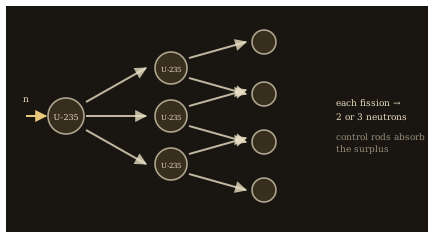
Figure 1 — fission and a chain reaction (Total for Question 5 = 4 marks)
-
(3)Explain
Explain why a neutron rather than a proton is used to start fission.
(Total for Question 6 = 3 marks)
-
(3)Compare
Compare nuclear fission with radioactive decay as ways in which a nucleus changes.
(Total for Question 7 = 3 marks)
-
(3)Suggest
Suggest why the spent fuel rods must be stored underwater for years after they are removed.
The cooling pond — When fuel rods are taken out of a reactor they are moved, still underwater, into a deep pond beside it. The pond water is continuously circulated and cooled. Rods stay there for several years before being moved to dry storage. A rod removed from the water would become hot enough to damage itself within hours.
(Total for Question 8 = 3 marks)
-
(2)Give
Give two reasons why the fuel rods in a reactor remain dangerous for a long time after they are removed.
(Total for Question 9 = 2 marks)
Have them marked, then defend the answer
Practice tells you the mark; teaching it back tells you whether you understand it. On Incandio a topic counts as mastered only once you have taught it and defended it.
- Mark these questions — 11 questions, marked on Incandio against the authored scheme, with the mistake you actually made named.
- Teach it — explain Nuclear Fission to Ember, an AI pupil who does not have it yet and asks the awkward question.
- Defend it — argue it against Lise Meitner over three rounds, marked against descriptors you can read first.
Completely free. No subscriptions, no paywalls, no account needed to start.
Back to the lesson
- Nuclear Fission — A single neutron splits a nucleus in half, and the pieces weigh less than what you started with.
- All of Incandio Physics · Incandio Exam Practice