Pearson Edexcel International GCSE in Physics · 4PH1 · Free · no account needed
Nuclear Fission
A single neutron splits a nucleus in half, and the pieces weigh less than what you started with.
Topic 7 · Radioactivity and particles — one of 9 lessons in this topic, and one of 65 in Physics.
This lesson ends with Lise Meitner. Learn Nuclear Fission, teach it, then defend it against Lise Meitner.
The definition this lesson teaches, word for word — every Physics definition.
- Nuclear fission
- The splitting of a large unstable nucleus into two roughly equal daughter nuclei, releasing two or three neutrons and a large amount of energy. It is usually induced by the nucleus absorbing a neutron.
What this lesson covers in the specification
Incandio is aligned to this specification. It is not published by, endorsed by or affiliated with Pearson, and it reproduces none of Pearson's wording — the statement numbers are given so you can check every lesson against your own copy.
- 7.17 — Fission, fusion and radioactive decay as sources of energy
- 7.18 — How a U-235 nucleus is split by a neutron, releasing kinetic energy
- 7.19 — Fission of U-235 produces two radioactive daughter nuclei and a few neutrons
1 · Understand it
No exam language yet. The only question this section answers is: do I actually understand what is happening?
There are three ways of getting energy out of a nucleus, and the specification names all three. RADIOACTIVE DECAY is the one already met: an unstable nucleus breaks up on its own, releasing a small amount of energy each time, at a rate nobody can alter. FISSION is a large nucleus being SPLIT into two roughly equal pieces, releasing a great deal of energy. FUSION is small nuclei being JOINED into a larger one, releasing even more; that is the next lesson.
Fission does not usually happen by itself. A nucleus of URANIUM-235 must ABSORB A NEUTRON first. The neutron enters the nucleus — it can, because it has no charge and so is not repelled by the positive nucleus — and the nucleus becomes uranium-236, which is so unstable that it immediately splits.
That parenthesis about charge is the reason the neutron is the right tool and nothing else would do. Fire a proton or an alpha particle at a uranium nucleus and it is pushed away by the enormous positive charge before it can arrive. A neutron sails in unopposed. Chadwick's discovery of the neutron in 1932 is therefore what made fission possible seven years later, and it explains why it took until then.
What a single fission event produces — statement 7.19
- A U-235 nucleus absorbs a neutron and becomes U-236, which is highly unstable.
- It splits into TWO DAUGHTER NUCLEI of roughly similar size — barium and krypton are common examples, though the split is not always the same.
- Both daughter nuclei are themselves RADIOACTIVE, which is where most of the troublesome waste from a reactor comes from.
- TWO OR THREE NEUTRONS are released as well, and it is these that make a chain reaction possible.
- A large amount of energy is released, almost all of it as the KINETIC ENERGY of the fragments flying apart.
Where does the energy come from? Add up the masses of everything produced — the two daughter nuclei and the neutrons — and the total is slightly LESS than the mass of the uranium nucleus and the neutron that went in. Mass has disappeared. That missing mass has become energy, according to Einstein's relation that energy equals mass multiplied by the speed of light squared. Because the speed of light is enormous and it is squared, a tiny loss of mass gives an enormous amount of energy.
Think of it like a bill settled in a currency with a colossal exchange rate
Imagine a currency where one gram exchanges for ninety million million joules. You would never notice a gram going missing from your account, and yet the payment it made would be vast. That is the exchange rate between mass and energy, and the square of the speed of light is what sets it. In a fission event the amount of mass that vanishes is about a thousandth of the nucleus, which is nothing at all on any scale you could weigh — but converted at that rate it gives roughly a million times the energy of burning the same mass of coal. This is why a nuclear power station consumes a lorry-load of fuel a year where a coal station consumes trainloads a day, and it is also why the waste is measured in cubic metres rather than in mountains of ash.
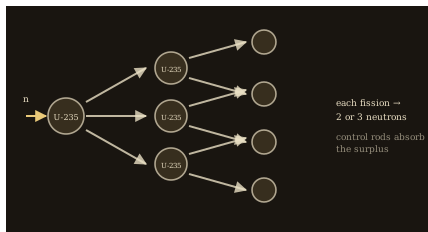
It is worth comparing the three sources honestly. Radioactive decay releases the least energy per event and cannot be controlled at all — it is useful for tracers and for heating spacecraft power sources, not for a power station. Fission releases a great deal and CAN be controlled, which is why it runs reactors. Fusion releases more still per unit mass, but requires conditions so extreme that no one has yet built a station that produces more than it consumes.
Counting the particles in a fission equation
A U-235 nucleus (atomic number 92) absorbs a neutron and splits into barium-141 (atomic number 56) and krypton-92 (atomic number 36), plus some neutrons. How many neutrons are released?
- Mass numbers on the left: 235 from the uranium plus 1 from the neutron = 236.
- Mass numbers of the named products: 141 + 92 = 233.
- The difference is 236 − 233 = 3, and a neutron has a mass number of 1, so THREE neutrons are released.
- Check the atomic numbers, which must also balance: left is 92 + 0 = 92, right is 56 + 36 = 92, and the three neutrons contribute 0.
- Both lines balance, so the equation is consistent.
Answer: Three neutrons — found from the mass numbers, and confirmed by the atomic numbers balancing.
2 · Grade 9 Notes
A different job from the section above. You have already understood it; this is the precise set of things to LEARN — definitions to reproduce word for word, processes in order, equations with units, and the answers that score full marks.
Learn this definition · Nuclear fission
The splitting of a large unstable nucleus into two roughly equal daughter nuclei, releasing two or three neutrons and a large amount of energy. It is usually induced by the nucleus absorbing a neutron.
Statement 7.19 — the products of one fission event
- TWO daughter nuclei of roughly similar size — barium and krypton are common examples
- Both daughter nuclei are themselves RADIOACTIVE, and are the source of most reactor waste
- TWO OR THREE neutrons, which make a chain reaction possible
- A large amount of energy, almost all as the KINETIC ENERGY of the fragments flying apart
- The split is not always the same — a range of daughter nuclei is produced
How a U-235 nucleus is split
- A neutron approaches the nucleus and is not repelled, because it has no charge.
- The nucleus absorbs the neutron and becomes U-236.
- U-236 is highly unstable and splits almost immediately.
- Two daughter nuclei fly apart, together with two or three neutrons.
- The total mass of the products is slightly less than that of the uranium plus the neutron, and the missing mass has become energy.
The three nuclear energy sources
| Radioactive decay | Fission | Fusion | |
|---|---|---|---|
| What happens | An unstable nucleus breaks up on its own | A large nucleus is split into two | Small nuclei are joined into a larger one |
| Energy released | Least, per event | Large | Greatest, per unit mass |
| Can it be controlled? | No | Yes, in a reactor | Not yet, for net power |
| Where it is used | Tracers, spacecraft power sources | Nuclear power stations | Stars; experimental reactors on Earth |
uranium-235 + neutron → barium-141 + krypton-92 + 3 neutrons
Conditions: One possible fission. Mass: 235 + 1 = 141 + 92 + 3. Charge: 92 + 0 = 56 + 36. Other splits give different daughters.
Why a neutron is the right particle to use
- A neutron has NO CHARGE, so it is not repelled by the positive nucleus
- A proton or an alpha particle would be pushed away before it could arrive
- This is why fission had to wait for Chadwick's discovery of the neutron in 1932
- It is also why the neutrons released by one fission can go on to cause more
Model answer [4 marks]
Describe what happens when a uranium-235 nucleus absorbs a neutron, and state what is produced. [4]
The neutron is absorbed by the nucleus, which is possible because a neutron has no charge and is therefore not repelled by the positively charged nucleus. The nucleus becomes uranium-236, which is extremely unstable and splits almost at once. It splits into two daughter nuclei of roughly similar size, both of which are themselves radioactive, together with two or three neutrons. A large amount of energy is released, almost all of it as the kinetic energy of the fragments as they fly apart.
Model answer [3 marks]
Explain where the energy released in nuclear fission comes from. [3]
The total mass of the products — the two daughter nuclei and the neutrons released — is slightly less than the total mass of the uranium nucleus and the neutron that was absorbed. This missing mass has been converted into energy, according to the relation that energy equals mass multiplied by the square of the speed of light. Because the speed of light is very large and is squared, even a very small loss of mass releases an extremely large amount of energy.
Not this: Fission is the same as radioactive decay, just on a larger scale.
This: Decay is SPONTANEOUS and produces a small particle from a nucleus that is only slightly altered. Fission has to be INDUCED by absorbing a neutron, splits the nucleus roughly in half, and releases further neutrons that can cause more fissions.
Mark-losing trap. A neutron is used because it has NO CHARGE and so is not repelled by the nucleus.
Mark-losing trap. Fission releases TWO OR THREE neutrons — that surplus is what makes a chain reaction possible.
Mark-losing trap. Both daughter nuclei are RADIOACTIVE. That is where reactor waste comes from.
Mark-losing trap. The energy comes from MASS that has disappeared, not from a chemical bond breaking.
3 · Prove it — the five questions
The five questions climb Grade 6 → Grade 7 → Grade 8 → Grade 9 → Grade 9 challenge, and are marked inside Incandio on your own device, by rule, with an authored diagnosis of the mistake you actually made. The mark schemes stay in the app so that the practice is worth doing; the questions themselves are here.
- Grade 6 · State [1 mark] — What must happen to a uranium-235 nucleus before it undergoes fission?
- Grade 7 · Explain [2 marks] — Explain why a neutron is used to induce fission rather than a proton.
- Grade 8 · Calculate [3 marks] — A uranium-235 nucleus absorbs a neutron and splits into strontium-90 and xenon-143, plus some neutrons. How many neutrons are released?
- Grade 9 · Describe [6 marks] — Select every statement that belongs in a full-mark description of what happens when a uranium-235 nucleus undergoes fission, and where the energy comes from.
- 9+ · Analyse [6 marks] — A student says: 'Fission releases energy by splitting a big nucleus, and fusion releases energy by joining small ones. Since these are opposite processes, one of them must actually absorb energy rather than release it.' Select every statement that belongs in a full-mark analysis.
The people behind this science
Two ways into the same idea — the one who explained it, named it, and was left off the paper, and the one whose equation converts the missing mass into the number. Inside Incandio each of them answers knowing exactly which lesson you have just finished.
Lise Meitner — the one who explained it, named it, and was left off the paper
Statement 7.18 is Meitner's explanation. In December 1938 Otto Hahn wrote to her in exile reporting that bombarding uranium with neutrons had produced BARIUM — an element about half uranium's size, which his chemistry made certain and which physics said was impossible, since nothing known could take that much off a nucleus. Meitner, with no laboratory, walked in the snow at Kungälv with her nephew Otto Frisch, treated the nucleus as a liquid drop that could stretch and split, calculated the missing mass and converted it to energy. The numbers agreed. She named the process fission; Hahn published without her and took the Nobel Prize alone.
- “What did Hahn's letter say, and why was it impossible?”
- “How does picturing a nucleus as a liquid drop explain splitting?”
- “Where does the energy of a fission actually come from?”
- “How did you calculate it with no laboratory at all?”
- “Why do you think your name was left off the paper?”
Albert Einstein — the one whose equation converts the missing mass into the number
The mass that vanishes in a fission is turned into energy by the relation Einstein published in 1905, more than thirty years before anyone split a nucleus, and as a consequence of relativity rather than as a claim about nuclei at all. He is the right figure here because the equation is so often quoted and so rarely explained: the reason a thousandth of a nucleus gives so much is that the exchange rate is the speed of light SQUARED. He also signed the 1939 letter to Roosevelt warning that fission might be turned into a weapon, and afterwards called it the one great mistake of his life.
- “Why does squaring the speed of light matter so much?”
- “Did you expect mass ever to be converted into energy in practice?”
- “How can mass simply disappear?”
- “Why did you sign the letter to Roosevelt?”
- “What did you mean by calling it the one great mistake of your life?”
Think you understand it?
Reading is the start. On Incandio a topic counts as mastered only once you have taught it and defended it — the two things a revision guide cannot ask of you.
Incandio this topic → Prove it. Teach it. Defend it. What does “Incandio it” mean?
- Prove it — five questions on Nuclear Fission, marked on the spot, that tell you what was missing rather than just what was wrong.
- Teach it — Explain Nuclear Fission in your own words to Ember, an AI pupil who does not have it yet and asks the awkward question. Understanding is credited; wording is not required.
- Defend it — Argue Nuclear Fission against Lise Meitner — three rounds, marked against descriptors you can read before you begin.
- Then the exam — read all 11 authored exam-style questions on this unit, each with its command word and its tariff, then have them marked on Incandio with the mistake you actually made named.
Completely free. No subscriptions, no paywalls, no account needed to start.
Carry on through the course
- Previous lesson: Uses and Dangers of Radiation
- Next lesson: Chain Reactions and Reactors
- Atomic Structure and Isotopes — A nucleus ten thousand times smaller than the atom around it, and why two atoms of the same element can weigh different amounts.
- Alpha, Beta and Gamma — Three emissions from unstable nuclei, arriving at random — and why the one that is easiest to stop is the one to be most careful with.
- Nuclear Equations — What each kind of decay does to the numbers — and why losing a negative particle makes the charge go up.
- Detecting Radiation and Background — How you measure something invisible, and why the counter clicks even with no source in the room.
- Half-Life — Half of what is left, every time — which is why a radioactive sample never quite runs out.
- All of Physics · Physics key terms · required practicals · equations · Incandio Science · The 4PH1 specification