Pearson Edexcel International GCSE in Physics · 4PH1 · Free · no account needed
The Electromagnetic Spectrum — exam questions
12 original Incandio exam-style questions on the Electromagnetic Spectrum, 26 marks, about 26 minutes of writing. Each one carries the command word, the tariff and the specification statement it assesses, exactly as a paper presents them. This is an original Incandio practice question, written to reflect the structure and demands of the qualification. It is not an official Pearson Edexcel past-paper question.
This is the practice set for The Electromagnetic Spectrum — the lesson that teaches it. Read the lesson first if the idea is new; come here when you want to find out whether you can turn it into marks. Completely free, no account needed to read.
What these questions ask of you
9 command words run through this set, and on Pearson Edexcel International GCSE Physics each one means something precise. Answering the wrong command is the commonest way a candidate who understands the lesson still loses the mark.
- Which (1 mark)
- one option chosen from the set given
- State (1 mark)
- one precise fact or definition
- Name (1 mark)
- the correct quantity, unit or component
- Complete (1–4 marks)
- the missing entries in a table, circuit or diagram
- Give (1–2 marks)
- a short factual answer
- Describe (2–4 marks)
- developed, linked statements of what happens — including a named direction where one exists
- Explain (2–4 marks)
- the physics that causes it, set out as a line of reasoning Misread as: describing the change without giving the physical reason for it
- Suggest (1–3 marks)
- a plausible answer applying taught physics to an unfamiliar arrangement
- Identify (1–2 marks)
- the correct item selected from what is shown
Assessed on Paper 1 (4PH1/1P) and Paper 2 (4PH1/2P), against AO1, AO2, AO3.
Where these sit in the specification
Pearson Edexcel International GCSE Physics (4PH1) — statements 3.10 · 3.11. Incandio is aligned to this specification; it is not published by, endorsed by or affiliated with Pearson, and it reproduces none of Pearson's wording.
The 12 questions
Answer them on paper, then open the lesson's exam practice to have them marked. The mark scheme, the accepted and rejected answers and the annotated model answer are in Incandio and are not printed here — an answer beside its question is not practice.
-
Sunlight reaching the Earth contains radiation from several parts of the electromagnetic spectrum. A satellite above the atmosphere measures the wavelength of each kind arriving from the Sun.
Table 1 — radiation arriving from the Sun, measured above the atmosphere Radiation Typical wavelength / m P 1 × 10⁻¹² Q 5 × 10⁻⁷ R 1 × 10⁻⁵ S 1 × 10⁻⁸ T 1 × 10⁻² (a)
(1)Identify
Identify the radiation in Table 1 with the longest wavelength.
Sunlight reaching the Earth contains radiation from several parts of the electromagnetic spectrum. A satellite above the atmosphere measures the wavelength of each kind arriving from the Sun.
Table 1 — radiation arriving from the Sun, measured above the atmosphere Radiation Typical wavelength / m P 1 × 10⁻¹² Q 5 × 10⁻⁷ R 1 × 10⁻⁵ S 1 × 10⁻⁸ T 1 × 10⁻² (b)
(2)Identify
Identify the two radiations in Table 1 with frequencies higher than that of visible light.
Sunlight reaching the Earth contains radiation from several parts of the electromagnetic spectrum. A satellite above the atmosphere measures the wavelength of each kind arriving from the Sun.
Table 1 — radiation arriving from the Sun, measured above the atmosphere Radiation Typical wavelength / m P 1 × 10⁻¹² Q 5 × 10⁻⁷ R 1 × 10⁻⁵ S 1 × 10⁻⁸ T 1 × 10⁻² (c)
(3)Explain
Explain why all five radiations in Table 1 take the same time to travel from the Sun to the Earth.
Sunlight reaching the Earth contains radiation from several parts of the electromagnetic spectrum. A satellite above the atmosphere measures the wavelength of each kind arriving from the Sun.
Table 1 — radiation arriving from the Sun, measured above the atmosphere Radiation Typical wavelength / m P 1 × 10⁻¹² Q 5 × 10⁻⁷ R 1 × 10⁻⁵ S 1 × 10⁻⁸ T 1 × 10⁻² (Total for Question 1 = 6 marks)
-
(1)Which
Which statement about electromagnetic waves travelling through a vacuum is correct?
Statement A Gamma rays travel fastest. B Radio waves travel fastest. C They all travel at the same speed. D Visible light travels fastest. (Total for Question 2 = 1 mark)
-
(1)State
State the speed of light in free space.
............................ m/s
(Total for Question 3 = 1 mark)
-
(1)Name
Name the electromagnetic radiation that lies between visible light and X-rays in the spectrum.
(Total for Question 4 = 1 mark)
-
(3)Complete
Complete the electromagnetic spectrum in order of increasing frequency: radio waves, __________, infrared, visible light, __________, X-rays, __________
(Total for Question 5 = 3 marks)
-
(2)Give
Give the colour at the long-wavelength end of the visible spectrum and the colour at the short-wavelength end.
(Total for Question 6 = 2 marks)
-
(3)Describe
Describe how the wavelength and the frequency of electromagnetic radiation change as you move along the spectrum from radio waves to gamma rays.
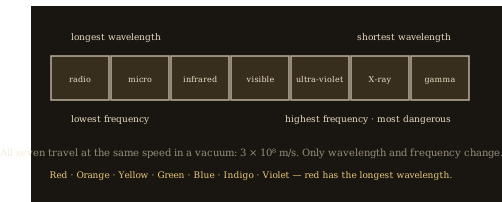
Figure 1 — the electromagnetic spectrum (Total for Question 7 = 3 marks)
-
(2)Explain
Explain why the electromagnetic spectrum is described as continuous.
(Total for Question 8 = 2 marks)
-
(3)Suggest
Suggest which region of the electromagnetic spectrum this radiation belongs to, and justify the choice from the data given.
An unidentified radiation — A detector records an electromagnetic radiation of wavelength 8 × 10⁻⁷ m. For reference: visible light spans roughly 4 × 10⁻⁷ m to 7 × 10⁻⁷ m, and radiation of wavelength 1 × 10⁻⁵ m is felt as warmth on the skin. The detector is not the human eye.
(Total for Question 9 = 3 marks)
-
(4)Explain
Explain why every part of the electromagnetic spectrum travels at the same speed in a vacuum, although the parts differ enormously in wavelength.
(Total for Question 10 = 4 marks)
Have them marked, then defend the answer
Practice tells you the mark; teaching it back tells you whether you understand it. On Incandio a topic counts as mastered only once you have taught it and defended it.
- Mark these questions — 12 questions, marked on Incandio against the authored scheme, with the mistake you actually made named.
- Teach it — explain the Electromagnetic Spectrum to Ember, an AI pupil who does not have it yet and asks the awkward question.
- Defend it — argue it against James Clerk Maxwell over three rounds, marked against descriptors you can read first.
Completely free. No subscriptions, no paywalls, no account needed to start.
Back to the lesson
- The Electromagnetic Spectrum — Seven names for one thing — and the two properties that change as you go along it.
- All of Incandio Physics · Incandio Exam Practice