Pearson Edexcel International GCSE in Physics · 4PH1 · Free · no account needed
The Electromagnetic Spectrum
Seven names for one thing — and the two properties that change as you go along it.
Topic 3 · Waves — one of 10 lessons in this topic, and one of 65 in Physics.
This lesson ends with James Clerk Maxwell. Learn the Electromagnetic Spectrum, teach it, then defend it against James Clerk Maxwell.
The definition this lesson teaches, word for word — every Physics definition.
- Electromagnetic spectrum
- The continuous range of electromagnetic waves, from radio waves at the longest wavelengths to gamma rays at the shortest. All of them are transverse waves and all travel at the same speed in a vacuum.
What this lesson covers in the specification
Incandio is aligned to this specification. It is not published by, endorsed by or affiliated with Pearson, and it reproduces none of Pearson's wording — the statement numbers are given so you can check every lesson against your own copy.
- 3.10 — Light as part of a continuous electromagnetic spectrum, all travelling at the same speed in free space
- 3.11 — The order of the electromagnetic spectrum, including the colours of the visible spectrum
Specification section 3(b) Properties of waves — also taught in What a Wave Is, The Wave Equation, The Doppler Effect, Uses and Dangers of Electromagnetic Radiation.
1 · Understand it
No exam language yet. The only question this section answers is: do I actually understand what is happening?
Radio waves, microwaves, infrared, visible light, ultraviolet, X-rays and gamma rays sound like seven different phenomena, and they are not. They are one phenomenon — an ELECTROMAGNETIC WAVE, a transverse wave of oscillating electric and magnetic fields — appearing at seven different wavelengths. The names are historical: each was discovered separately, by different people, before anyone realised they were the same thing.
Two facts define the spectrum. The first is that it is CONTINUOUS: there are no gaps and no natural boundaries. The dividing lines between, say, ultraviolet and X-rays are conventions, not features of nature, and the properties change gradually along the whole range. The second is that in a vacuum ALL of them travel at exactly the same speed, 3.0 × 10⁸ m/s. A gamma ray and a radio wave cross a room in the same time.
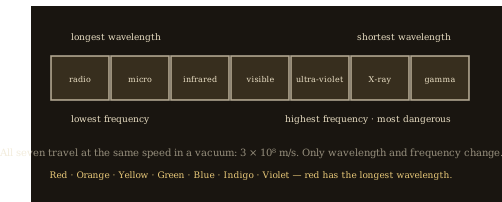
Think of it like a piano with seven named octaves
A piano keyboard is one continuous run of notes, and dividing it into octaves is a convenience rather than a discovery — nothing physically changes at the boundary between one and the next. The electromagnetic spectrum is the same: one continuous range of wavelengths, arbitrarily divided into seven named bands because they were found at different times by different people using different instruments. And our eyes, on this comparison, can hear about one octave out of the entire keyboard. Everything else is happening around us constantly and we have no sense that detects it at all.
The order, and what changes along it
- The order from LONGEST wavelength to SHORTEST is: RADIO, MICROWAVE, INFRARED, VISIBLE, ULTRAVIOLET, X-RAY, GAMMA.
- As the wavelength DECREASES along that order, the frequency INCREASES — necessarily, since the speed is fixed and v = f × λ.
- The energy carried by the radiation also INCREASES as the frequency increases, which is why the dangerous end of the spectrum is the short-wavelength end.
- Within the VISIBLE band the order from longest wavelength to shortest is RED, ORANGE, YELLOW, GREEN, BLUE, INDIGO, VIOLET.
- So red light sits next to infrared and violet light sits next to ultraviolet, which is exactly how those two were named — below red and beyond violet.
That last point is worth pausing on, because it makes the order impossible to forget. Infrared means 'below red' and it lies just beyond the red end of the visible band; ultraviolet means 'beyond violet' and lies just past the other end. The names of the two invisible bands nearest us are directions from the visible spectrum, and if you can remember which end red is at, you can reconstruct the neighbours.
Scale is worth a sentence too, because the numbers are extraordinary. A long radio wave can be kilometres from crest to crest. Visible light is a few hundred nanometres — a few ten-millionths of a metre. A gamma ray is smaller than an atom. These are the same kind of wave, differing in wavelength by a factor of more than a million million, and travelling at identical speed.
One last thing about statement 3.10. Light is not a special case that happens to resemble the others; it is an arbitrary slice of a continuous range, and the only reason it seems central is that our eyes evolved to detect the wavelengths the Sun produces most of. A creature on a different star would draw the boundary somewhere else, and its 'visible spectrum' would be a different sliver of the same strip.
2 · Grade 9 Notes
A different job from the section above. You have already understood it; this is the precise set of things to LEARN — definitions to reproduce word for word, processes in order, equations with units, and the answers that score full marks.
Statement 3.11 — the order, from longest wavelength to shortest
- RADIO — longest wavelength, lowest frequency, lowest energy.
- MICROWAVE.
- INFRARED.
- VISIBLE LIGHT — red, orange, yellow, green, blue, indigo, violet, in that order from longest wavelength to shortest.
- ULTRAVIOLET.
- X-RAY.
- GAMMA — shortest wavelength, highest frequency, highest energy.
Learn this definition · Electromagnetic spectrum
The continuous range of electromagnetic waves, from radio waves at the longest wavelengths to gamma rays at the shortest. All of them are transverse waves and all travel at the same speed in a vacuum.
What is the same, and what changes, across the spectrum
- THE SAME for all of them: they are transverse waves; they travel at 3.0 × 10⁸ m/s in a vacuum; they need no medium; they can be reflected and refracted
- CHANGING along the spectrum: the wavelength falls, the frequency rises, and the energy carried rises with the frequency
- The spectrum is CONTINUOUS — the boundaries between the seven bands are conventions, not natural divisions
- VISIBLE light is a very narrow band near the middle, and is the only part the eye detects
The two ends, and why they behave so differently
A. LONG WAVELENGTH end (radio): low frequency, low energy per unit of radiation, generally harmless, and easily diffracted around obstacles.
B. SHORT WAVELENGTH end (X-ray, gamma): high frequency, high energy, penetrating and able to damage living cells — which is why the dangers are concentrated there.
Model answer [2 marks]
State the order of the electromagnetic spectrum from the longest wavelength to the shortest. [2]
Radio waves, microwaves, infrared, visible light, ultraviolet, X-rays, gamma rays.
Model answer [4 marks]
Explain why all electromagnetic waves travel at the same speed in a vacuum but have very different properties. [4]
All electromagnetic waves are the same kind of wave — a transverse wave of oscillating electric and magnetic fields — and in a vacuum they all travel at 3.0 × 10⁸ m/s. What differs between them is the wavelength, and because the speed is fixed, v = f × λ means a shorter wavelength corresponds to a higher frequency. The energy carried increases with the frequency, so the short-wavelength radiations carry far more energy than the long-wavelength ones. That difference in energy is what gives them such different effects, from harmlessly passing through a building to damaging living cells.
Not this: Gamma rays travel faster than radio waves, which is why they are more penetrating.
This: In a vacuum every electromagnetic wave travels at exactly the same speed. Gamma rays are more penetrating because they have a much higher frequency and carry much more energy, not because they move faster.
Mark-losing trap. All of them travel at the SAME speed in a vacuum. Nothing on the spectrum is faster than anything else.
Mark-losing trap. Learn the order in ONE direction and say which. 'Radio to gamma' is longest wavelength to shortest.
Mark-losing trap. Infrared is BELOW red and ultraviolet is BEYOND violet — the names give you the order.
3 · Prove it — the five questions
The five questions climb Grade 6 → Grade 7 → Grade 8 → Grade 9 → Grade 9 challenge, and are marked inside Incandio on your own device, by rule, with an authored diagnosis of the mistake you actually made. The mark schemes stay in the app so that the practice is worth doing; the questions themselves are here.
- Grade 6 · State [1 mark] — Which electromagnetic radiation has the longest wavelength?
- Grade 7 · State [2 marks] — How fast does an X-ray travel through a vacuum, compared with a radio wave?
- Grade 8 · Calculate [3 marks] — Green light has a wavelength of 5.0 × 10⁻⁷ m. Electromagnetic waves travel at 3.0 × 10⁸ m/s. Calculate the frequency of this light, in terahertz (1 THz = 10¹² Hz).
- Grade 9 · Explain [5 marks] — Select every statement that belongs in a full-mark explanation of why all electromagnetic waves travel at the same speed in a vacuum yet have very different effects.
- 9+ · Analyse [6 marks] — A student says: 'Visible light must be the most important part of the spectrum, since it is the part we can see and the part the Sun gives out.' Select every statement that belongs in a full-mark analysis.
The people behind this science
Two ways into the same idea — the one who found that white light is a mixture, not a purity, and the one who showed the spectrum must extend far past what we can see. Inside Incandio each of them answers knowing exactly which lesson you have just finished.
Isaac Newton — the one who found that white light is a mixture, not a purity
The visible half of statement 3.11 is Newton's result. It had been assumed that a prism ADDED colour to white light, corrupting something pure; Newton showed with a second prism that the separated colours could be recombined into white, and that a single colour passed through another prism stayed unchanged. So white light is a mixture and the prism merely separates it — and the order in which the colours emerge, red through to violet, is the order this page asks you to learn.
- “What did the second prism show that the first one could not?”
- “Why did people believe the prism was adding the colours?”
- “Why do the colours always come out in the same order?”
- “How did you decide where one colour ended and the next began?”
- “Is white a colour at all, on your account?”
James Clerk Maxwell — the one who showed the spectrum must extend far past what we can see
Newton found the colours; Maxwell found that they are a sliver of something enormous. His equations described a wave of oscillating electric and magnetic fields with no restriction at all on its wavelength, so the visible band could not be the whole story — there had to be electromagnetic waves far longer and far shorter than anything the eye responds to. Hertz produced and detected radio waves within a decade of his death, and X-rays and gamma rays followed. The continuity that statement 3.10 insists on is his conclusion.
- “How could you know there were waves beyond the ones we can see?”
- “What is actually oscillating in an electromagnetic wave?”
- “Why do all of them travel at the same speed?”
- “Is there any limit to how long or how short the wavelength can be?”
- “What did it mean to find that light was a kind of electricity?”
Think you understand it?
Reading is the start. On Incandio a topic counts as mastered only once you have taught it and defended it — the two things a revision guide cannot ask of you.
Incandio this topic → Prove it. Teach it. Defend it. What does “Incandio it” mean?
- Prove it — five questions on the Electromagnetic Spectrum, marked on the spot, that tell you what was missing rather than just what was wrong.
- Teach it — Explain the Electromagnetic Spectrum in your own words to Ember, an AI pupil who does not have it yet and asks the awkward question. Understanding is credited; wording is not required.
- Defend it — Argue the Electromagnetic Spectrum against James Clerk Maxwell — three rounds, marked against descriptors you can read before you begin.
- Then the exam — read all 12 authored exam-style questions on this unit, each with its command word and its tariff, then have them marked on Incandio with the mistake you actually made named.
Completely free. No subscriptions, no paywalls, no account needed to start.
Carry on through the course
- Previous lesson: The Doppler Effect
- Next lesson: Uses and Dangers of Electromagnetic Radiation
- What a Wave Is — Something crosses the room and nothing gets to the other side — the idea that makes the rest of the topic possible.
- The Wave Equation — Two equations that connect everything on the previous page — and one of them you could have worked out yourself.
- The Doppler Effect — Why an ambulance changes note as it passes — and why the siren itself never does.
- Uses and Dangers of Electromagnetic Radiation — Seven bands, seven jobs — and why the danger rises steadily as you move along the spectrum.
- Reflection and Ray Diagrams — One rule, drawn correctly — and why the image in a mirror is behind it.
- All of Physics · Physics key terms · required practicals · equations · Incandio Science · The 4PH1 specification