Pearson Edexcel International GCSE in Physics · 4PH1 · Free · no account needed
Total Internal Reflection — exam questions
11 original Incandio exam-style questions on Total Internal Reflection, 27 marks, about 27 minutes of writing. Each one carries the command word, the tariff and the specification statement it assesses, exactly as a paper presents them. This is an original Incandio practice question, written to reflect the structure and demands of the qualification. It is not an official Pearson Edexcel past-paper question.
This is the practice set for Total Internal Reflection — the lesson that teaches it. Read the lesson first if the idea is new; come here when you want to find out whether you can turn it into marks. Completely free, no account needed to read.
What these questions ask of you
9 command words run through this set, and on Pearson Edexcel International GCSE Physics each one means something precise. Answering the wrong command is the commonest way a candidate who understands the lesson still loses the mark.
- State what is meant by (1–2 marks)
- the definition
- Which (1 mark)
- one option chosen from the set given
- Calculate (1–5 marks)
- select the equation, substitute, evaluate — and state the unit Misread as: giving a bare number with no equation and no unit
- Describe (2–4 marks)
- developed, linked statements of what happens — including a named direction where one exists
- Explain (2–4 marks)
- the physics that causes it, set out as a line of reasoning Misread as: describing the change without giving the physical reason for it
- Show that (2–4 marks)
- a derivation to a printed value, worked to at least one more decimal place than the value given Misread as: restating the printed value instead of deriving it
- Suggest (1–3 marks)
- a plausible answer applying taught physics to an unfamiliar arrangement
- Identify (1–2 marks)
- the correct item selected from what is shown
- Give (1–2 marks)
- a short factual answer
Assessed on Paper 1 (4PH1/1P) and Paper 2 (4PH1/2P), against AO1, AO2, AO3.
Where these sit in the specification
Pearson Edexcel International GCSE Physics (4PH1) — statements 3.21 · 3.20 · 3.22. Incandio is aligned to this specification; it is not published by, endorsed by or affiliated with Pearson, and it reproduces none of Pearson's wording.
The 11 questions
Answer them on paper, then open the lesson's exam practice to have them marked. The mark scheme, the accepted and rejected answers and the annotated model answer are in Incandio and are not printed here — an answer beside its question is not practice.
-
An optical fibre is a thin thread of very pure glass, called the core, surrounded by a coating of a different glass called the cladding. Light is sent along the core and stays inside it, even where the fibre curves. A fibre carrying a telephone signal may run for tens of kilometres between one amplifier and the next.
Table 1 — refractive indices of four transparent materials Material Refractive index Water 1.33 Fibre cladding 1.44 Fibre core 1.48 Diamond 2.42 (a)
(1)Identify
Identify the material in Table 1 with the smallest critical angle.
An optical fibre is a thin thread of very pure glass, called the core, surrounded by a coating of a different glass called the cladding. Light is sent along the core and stays inside it, even where the fibre curves. A fibre carrying a telephone signal may run for tens of kilometres between one amplifier and the next.
Table 1 — refractive indices of four transparent materials Material Refractive index Water 1.33 Fibre cladding 1.44 Fibre core 1.48 Diamond 2.42 (b)
(3)Calculate
Calculate the critical angle for light passing from water into air, using Table 1.
An optical fibre is a thin thread of very pure glass, called the core, surrounded by a coating of a different glass called the cladding. Light is sent along the core and stays inside it, even where the fibre curves. A fibre carrying a telephone signal may run for tens of kilometres between one amplifier and the next.
Table 1 — refractive indices of four transparent materials Material Refractive index Water 1.33 Fibre cladding 1.44 Fibre core 1.48 Diamond 2.42 critical angle = ............................ °
(c)
(3)Explain
Explain why the fibre core is made of glass with a higher refractive index than the cladding around it.
An optical fibre is a thin thread of very pure glass, called the core, surrounded by a coating of a different glass called the cladding. Light is sent along the core and stays inside it, even where the fibre curves. A fibre carrying a telephone signal may run for tens of kilometres between one amplifier and the next.
Table 1 — refractive indices of four transparent materials Material Refractive index Water 1.33 Fibre cladding 1.44 Fibre core 1.48 Diamond 2.42 (Total for Question 1 = 7 marks)
-
(1)State what is meant by
State what is meant by the critical angle.
(Total for Question 2 = 1 mark)
-
(1)Which
Which pair of conditions is needed for total internal reflection?
Conditions A Light going into a denser material, angle of incidence below the critical angle B Light going into a denser material, angle of incidence above the critical angle C Light going into a less dense material, angle of incidence below the critical angle D Light going into a less dense material, angle of incidence above the critical angle (Total for Question 3 = 1 mark)
-
(3)Calculate
Calculate the critical angle for a glass of refractive index 1.52.
critical angle = ............................ °
(Total for Question 4 = 3 marks)
-
(4)Describe
Describe what happens to a ray of light inside a glass block as the angle of incidence at the inside surface is increased from 20° to 60°.
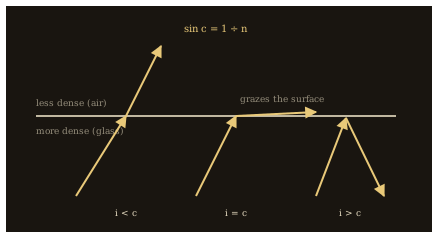
Figure 1 — a ray meeting the inside of a boundary (Total for Question 5 = 4 marks)
-
(3)Explain
Explain why binoculars use glass prisms rather than mirrors to fold the light path.
(Total for Question 6 = 3 marks)
-
(3)Show that
The refractive index of diamond is 2.42. Show that the critical angle for diamond is about 24°.
(Total for Question 7 = 3 marks)
-
(3)Suggest
Suggest why an endoscope needs two separate bundles of fibres rather than one.
Looking inside the body — An endoscope is a flexible tube of optical fibres passed into the body so that a surgeon can see inside it. There is no light source at the far end of the tube and no daylight inside a patient. The image the surgeon sees must show the shape of what is there, not merely how bright it is.
(Total for Question 8 = 3 marks)
-
(2)Give
Give the two conditions that must both be met for total internal reflection to occur.
(Total for Question 9 = 2 marks)
Have them marked, then defend the answer
Practice tells you the mark; teaching it back tells you whether you understand it. On Incandio a topic counts as mastered only once you have taught it and defended it.
- Mark these questions — 11 questions, marked on Incandio against the authored scheme, with the mistake you actually made named.
- Teach it — explain Total Internal Reflection to Ember, an AI pupil who does not have it yet and asks the awkward question.
- Defend it — argue it against John Tyndall over three rounds, marked against descriptors you can read first.
Completely free. No subscriptions, no paywalls, no account needed to start.
Back to the lesson
- Total Internal Reflection — The angle beyond which light cannot get out at all — and the technology built on it.
- All of Incandio Physics · Incandio Exam Practice