Pearson Edexcel International GCSE in Physics · 4PH1 · Free · no account needed
Total Internal Reflection
The angle beyond which light cannot get out at all — and the technology built on it.
On the specification this is meaning of critical angle — 4PH1 statements 3.20–3.22.
Topic 3 · Waves — one of 10 lessons in this topic, and one of 65 in Physics.
This lesson ends with John Tyndall. Learn Total Internal Reflection, teach it, then defend it against John Tyndall.
The 2 definitions this lesson teaches, word for word — every Physics definition.
- Critical angle
- The angle of incidence, inside the denser medium, at which the refracted ray emerges along the boundary at 90°. It is the largest angle at which any light still escapes.
- Total internal reflection
- The complete reflection of light back into the denser medium, which happens when light travels from a denser to a less dense medium and strikes the boundary at an angle of incidence greater than the critical angle.
Its equation is on the Physics equations page with the other 37.
What this lesson covers in the specification
Incandio is aligned to this specification. It is not published by, endorsed by or affiliated with Pearson, and it reproduces none of Pearson's wording — the statement numbers are given so you can check every lesson against your own copy.
- 3.20 — The role of total internal reflection in optical fibres and prisms
- 3.21 — The meaning of critical angle
- 3.22 — Use sin c = 1 ÷ n
Specification section 3(c) The electromagnetic spectrum — also taught in Reflection and Ray Diagrams, Refraction and Refractive Index.
1 · Understand it
No exam language yet. The only question this section answers is: do I actually understand what is happening?
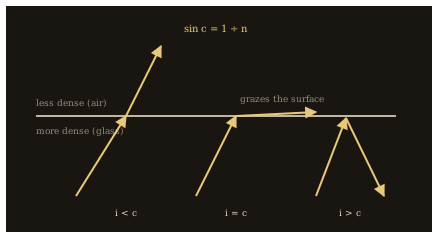
Light leaving glass for air bends AWAY from the normal, so the angle outside is always larger than the angle inside. Increase the angle inside and the refracted ray swings further and further round, until at some particular angle it is refracted to 90° — grazing straight along the surface. Push past that angle and there is nowhere left for the refracted ray to go. It does not appear at all. Every bit of the light is reflected back inside, and that is TOTAL INTERNAL REFLECTION.
What happens as the angle inside the glass is increased
- At a SMALL angle of incidence inside the glass, most of the light refracts out, bent away from the normal, and a little is reflected back in.
- As the angle INCREASES, the refracted ray bends further from the normal and gets dimmer, while the internally reflected ray gets brighter.
- At the CRITICAL ANGLE, c, the refracted ray emerges at exactly 90° — travelling along the boundary itself. This is the last angle at which any light escapes.
- BEYOND the critical angle, no light is refracted out at all. ALL of it is reflected back into the glass, obeying the ordinary law of reflection.
- Two conditions are needed and both must be stated: the light must be going from a DENSER to a LESS DENSE medium, and the angle of incidence must be GREATER THAN the critical angle.
The critical angle depends on the refractive index and on nothing else: sin c = 1 ÷ n. For glass with n = 1.5 the critical angle is about 42°, and for water with n = 1.33 it is about 49°. The relationship makes sense in words — a material that bends light more strongly reaches the escape limit sooner, so a higher refractive index means a smaller critical angle.
Finding a critical angle, and using it
A glass has a refractive index of 1.52. Find its critical angle, and say what happens to a ray striking the inside surface at 50°.
- sin c = 1 ÷ n = 1 ÷ 1.52 = 0.658.
- c = sin⁻¹(0.658) = 41.1°.
- The ray strikes at 50°, which is greater than the critical angle of 41.1°.
- It is therefore totally internally reflected — no light escapes, and it reflects with an angle of reflection of 50°.
Answer: The critical angle is 41.1°, and a ray at 50° is totally internally reflected.
Think of it like a ball skimming under a low ceiling
Imagine throwing a ball up at a ceiling with a gap along the top of the far wall. Thrown steeply, it goes out through the gap. Thrown at a shallower angle, it only just squeezes through. Below some particular angle it cannot reach the gap at all and simply bounces back off the ceiling, every time, with none of it getting out. Light inside glass is in the same position: the refracted ray swings towards the surface as the angle grows, and once it would have to emerge at more than 90° there is no direction left for it. Nothing has blocked it — it has simply run out of available angles.
OPTICAL FIBRES are the application that matters most. A fibre is a thin core of very pure glass surrounded by a CLADDING of glass with a LOWER refractive index. Light entering one end strikes the boundary between core and cladding at an angle greater than the critical angle, so it is totally internally reflected, and it goes on being reflected thousands of times along the length of the fibre — round bends and over great distances — without escaping. Because the reflection is TOTAL, almost no energy is lost at each bounce, which is why a signal can travel many kilometres.
That is why the world's telephone and internet traffic runs on glass rather than copper. A fibre carries far more information than a copper cable, loses far less over distance, and is immune to the electrical interference that affects wires. The same principle carries light and images into the body in an ENDOSCOPE, using one bundle of fibres to illuminate and another to bring the picture back.
PRISMS use total internal reflection to turn light through exact angles. A right-angled glass prism with a critical angle of about 42° will totally internally reflect any ray striking its long face at 45°, because 45° is greater than 42°. One such prism turns light through 90°, and two turn it through 180° — which is how periscopes, binoculars and single-lens reflex cameras redirect light. A prism is used in preference to a mirror because the reflection is total rather than partial, giving a brighter image, and because a mirror's silvered backing can tarnish and produce faint secondary reflections.
2 · Grade 9 Notes
A different job from the section above. You have already understood it; this is the precise set of things to LEARN — definitions to reproduce word for word, processes in order, equations with units, and the answers that score full marks.
sin c = 1 ÷ n
c is the critical angle in degrees, n is the refractive index of the denser medium
Units: Degrees for c; n has no units. Rearranged: n = 1 ÷ sin c. A higher refractive index gives a SMALLER critical angle.
Learn this definition · Critical angle
The angle of incidence, inside the denser medium, at which the refracted ray emerges along the boundary at 90°. It is the largest angle at which any light still escapes.
Learn this definition · Total internal reflection
The complete reflection of light back into the denser medium, which happens when light travels from a denser to a less dense medium and strikes the boundary at an angle of incidence greater than the critical angle.
The two conditions — both must be stated for the marks
- The light must be travelling from a DENSER medium into a LESS DENSE one
- The angle of incidence must be GREATER THAN the critical angle
- If either condition fails, some light refracts out and the reflection is only partial
- Below the critical angle: mostly refraction, a little reflection. AT the critical angle: the refracted ray grazes along the surface. ABOVE it: reflection only
Statement 3.20 — how an optical fibre works, the answer to write
- The fibre has a core of glass surrounded by cladding of LOWER refractive index.
- Light entering the core strikes the core–cladding boundary at an angle greater than the critical angle.
- It is therefore totally internally reflected, and no light escapes into the cladding.
- This is repeated thousands of times along the fibre, so the light follows the fibre round bends.
- Because the reflection is total, very little energy is lost, so a signal can travel many kilometres.
Why a prism is used instead of a mirror
| Prism using total internal reflection | Silvered mirror | |
|---|---|---|
| How much light is reflected | all of it — the reflection is total | most of it; some is absorbed by the silvering |
| Image quality | one bright image | faint secondary images from the glass surface as well as the silvering |
| Durability | no coating to deteriorate | the silvered backing can tarnish over time |
| Where used | periscopes, binoculars, reflex cameras | everyday mirrors, where cost matters more than quality |
Model answer [3 marks]
A glass block has a refractive index of 1.48. Calculate its critical angle. [3]
Using sin c = 1 ÷ n, sin c = 1 ÷ 1.48 = 0.676. Taking the inverse sine, c = 42.5°.
Model answer [4 marks]
Explain how light is carried along an optical fibre. [4]
An optical fibre has a core of glass surrounded by cladding of lower refractive index. Light entering the core strikes the boundary between the core and the cladding at an angle of incidence greater than the critical angle, and because it is passing from a denser to a less dense medium it is totally internally reflected rather than escaping. This happens repeatedly along the whole length of the fibre, so the light follows the fibre even round bends. Because the reflection is total, very little energy is lost at each reflection, so the signal can travel many kilometres.
Not this: Total internal reflection happens whenever light hits a boundary at a large angle.
This: BOTH conditions are needed. The light must be going from a denser medium to a less dense one, AND the angle must exceed the critical angle. Light striking a glass surface from the air at a large angle simply refracts, however steep the angle is.
Mark-losing trap. State BOTH conditions: denser to less dense, AND greater than the critical angle.
Mark-losing trap. sin c = 1 ÷ n gives the SINE of the angle. Take the inverse sine to get c itself.
Mark-losing trap. A higher refractive index means a SMALLER critical angle — check your answer against that.
Mark-losing trap. In a fibre the cladding has a LOWER refractive index than the core, or nothing works.
3 · Prove it — the five questions
The five questions climb Grade 6 → Grade 7 → Grade 8 → Grade 9 → Grade 9 challenge, and are marked inside Incandio on your own device, by rule, with an authored diagnosis of the mistake you actually made. The mark schemes stay in the app so that the practice is worth doing; the questions themselves are here.
- Grade 6 · State [1 mark] — What is the critical angle?
- Grade 7 · State [2 marks] — Total internal reflection needs two conditions to be met. One is that the angle of incidence must be greater than the critical angle. What is the other?
- Grade 8 · Calculate [3 marks] — A transparent material has a refractive index of 1.36. Calculate its critical angle.
- Grade 9 · Explain [5 marks] — Select every statement that belongs in a full-mark explanation of how an optical fibre carries light along its length.
- 9+ · Analyse [6 marks] — A student shines a ray from air onto a glass block at an angle of incidence of 70°, which is greater than the glass's critical angle of 42°. They expect total internal reflection and are surprised when the light enters the glass. Select every statement that belongs in a full-mark analysis.
The people behind this science
Two ways into the same idea — the one who first described light trapped inside glass, and the one who made people feel how far a signal travels in a moment. Inside Incandio each of them answers knowing exactly which lesson you have just finished.
Johannes Kepler — the one who first described light trapped inside glass
Kepler is remembered for planetary orbits, but in 1611 he published Dioptrice, a study of how light passes through lenses, written to explain why Galileo's telescope worked. In the course of it he described total internal reflection — light striking a glass–air boundary from inside at a sufficiently steep angle and failing to emerge at all. He also searched for the law of refraction and did not find it, arriving at an approximation that works only for small angles, which places him precisely between Ibn al-Haytham's negative result and Snell's positive one.
- “What did you see happening to light inside a piece of glass?”
- “Why did you write a book about lenses when your work was on the planets?”
- “How close did you get to a law of refraction?”
- “What made Galileo's telescope work, in your account?”
- “Why does light sometimes fail to escape from glass altogether?”
Grace Hopper — the one who made people feel how far a signal travels in a moment
Hopper used to hand out lengths of wire almost a foot long and call them nanoseconds — the distance a signal travels in a thousand-millionth of a second — so that engineers would stop treating transmission delay as negligible. That is exactly the quantity optical fibres exist to manage: how much information can be pushed down a channel, how far it goes before it fades, and how long it takes. She is the person on this page who understood that a communication technology is judged by what it does to time.
- “Why did you hand out pieces of wire and call them nanoseconds?”
- “What did engineers keep getting wrong about how long a signal takes?”
- “Does it matter what a communication cable is actually made of?”
- “How do you make people take a very small delay seriously?”
- “What limits how much information a single channel can carry?”
Think you understand it?
Reading is the start. On Incandio a topic counts as mastered only once you have taught it and defended it — the two things a revision guide cannot ask of you.
Incandio this topic → Prove it. Teach it. Defend it. What does “Incandio it” mean?
- Prove it — five questions on Total Internal Reflection, marked on the spot, that tell you what was missing rather than just what was wrong.
- Teach it — Explain Total Internal Reflection in your own words to Ember, an AI pupil who does not have it yet and asks the awkward question. Understanding is credited; wording is not required.
- Defend it — Argue Total Internal Reflection against John Tyndall — three rounds, marked against descriptors you can read before you begin.
- Then the exam — read all 11 authored exam-style questions on this unit, each with its command word and its tariff, then have them marked on Incandio with the mistake you actually made named.
Completely free. No subscriptions, no paywalls, no account needed to start.
Carry on through the course
- Previous lesson: Refraction and Refractive Index
- Next lesson: Sound Waves
- What a Wave Is — Something crosses the room and nothing gets to the other side — the idea that makes the rest of the topic possible.
- The Wave Equation — Two equations that connect everything on the previous page — and one of them you could have worked out yourself.
- The Doppler Effect — Why an ambulance changes note as it passes — and why the siren itself never does.
- The Electromagnetic Spectrum — Seven names for one thing — and the two properties that change as you go along it.
- Uses and Dangers of Electromagnetic Radiation — Seven bands, seven jobs — and why the danger rises steadily as you move along the spectrum.
- All of Physics · Physics key terms · required practicals · equations · Incandio Science · The 4PH1 specification