Explore Their Life · Pearson Edexcel International GCSE revision on Incandio
Ambroise Paré: A Life in Five Chapters
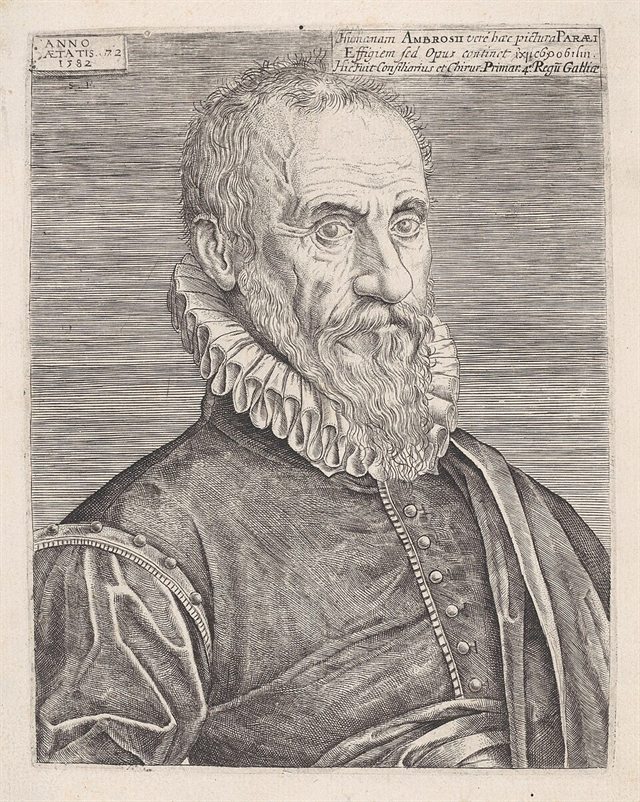
c. 1510–1590
A barber-surgeon who ran out of boiling oil on a battlefield, discovered that kindness healed better, tied arteries instead of burning them, and wrote it all in French for surgeons who could not read Latin.
Ambroise Paré began as a barber-surgeon, the lowest rank of medical practitioner, and ended as First Surgeon to four kings of France. These five chapters follow his training, the night at Turin in 1537, the ligature, his life at court, and his battles with the learned physicians of Paris.
The five chapters
- The Barber's Apprentice — From a village in Maine to the Hôtel-Dieu
- The Night at Turin — When the boiling oil ran out
- Thread Instead of Fire — Tying arteries in amputations
- Surgeon to Four Kings — Court, wars of religion and a cruel experiment
- Writing in French — A surgeon against the Faculty
Chapter 1 · The Barber's Apprentice
From a village in Maine to the Hôtel-Dieu
c. 1510 – 1536 · Bourg-Hersent · Laval · Paris
Ambroise Paré was born around 1510 at Bourg-Hersent, near Laval in the province of Maine in north-west France. Nobody recorded the year exactly. His family were craftspeople, and he had no university education and very little Latin.
In sixteenth-century France, medicine had a strict hierarchy. At the top were physicians, educated at universities, who wrote and read in Latin and studied Galen; they diagnosed and prescribed but rarely touched a wound. Below them were surgeons, and below those the barber-surgeons, who cut hair, pulled teeth, let blood, set bones and dressed wounds. Paré trained as a barber-surgeon, probably first with a relative and then in Paris.
His real education came at the Hôtel-Dieu, the great hospital beside Notre-Dame in Paris, where he worked for about three years as a resident surgeon in the 1530s. It was crowded and dangerous; patients often shared beds. But it gave Paré something university physicians lacked: experience of hundreds of wounds, fractures and diseases, and of what actually happened to patients after treatment.
He also learned to dissect, and he later wrote about anatomy, drawing heavily on Vesalius. By around 1536 he was ready to take the qualification of master barber-surgeon and to follow an army.
Why this matters
Paré's lowly training gave him practical experience that learned physicians lacked, which is why he was willing to trust what he saw over what the books said.
A barber-surgeon with little Latin and years in a Paris hospital. What would you ask him?
Ask Paré
- “What was the difference between a physician and a barber-surgeon in your day?”
- “What did you learn at the Hôtel-Dieu that a university could not teach?”
- “Did your lack of Latin hold you back?”
- “How did you learn anatomy without studying at a university?”
- “Why does nobody know the exact year you were born?”
Chapter 2 · The Night at Turin
When the boiling oil ran out
1537 · Turin · Piedmont
In 1537 Paré joined the French army campaigning in Italy as surgeon to the commander René de Montejan. It was his first experience of war — and of gunshot wounds.
Guns were still fairly new in warfare, and the leading surgical writers, especially the Italian Giovanni da Vigo, taught that gunshot wounds were poisoned by gunpowder. The standard treatment was to pour boiling oil of elder into the wound to burn out the poison. It was agonising.
At the siege of Turin there were so many wounded that Paré ran out of oil. For the remaining men he made a dressing from egg yolk, oil of roses and turpentine and applied it cold. In his own account, he could not sleep that night, fearing that he would find these men dead from poison the next morning.
Instead he found the opposite. The men treated with his gentle dressing had slept, with little pain or swelling. Those treated with boiling oil were feverish and in great pain. Paré wrote that he resolved never again to burn wounded men so cruelly.
This was a chance discovery, forced by a shortage, but what made it important was Paré's response: he noticed the result, trusted it, and changed his practice. In 1545 he published his method in a book on gunshot wounds, written in French.
“I dressed him, and God healed him.”
— Paré's own account of his campaigns, Apologie et traité contenant les voyages faits en divers lieux (1585); French: 'Je le pansay, Dieu le guarist'
Why this matters
The Turin episode is the classic example of war and chance leading to a change in surgery — but only because a surgeon was willing to observe and act.
A sleepless night after the boiling oil ran out. What would you ask him?
Ask Paré
- “Why did surgeons believe gunshot wounds were poisoned by gunpowder?”
- “What was in the dressing you made when the oil ran out at Turin?”
- “Why did you lie awake that night after treating the soldiers?”
- “Was your new treatment a discovery or a lucky accident?”
- “What did you mean by saying that you dressed the wound and God healed it?”
Chapter 3 · Thread Instead of Fire
Tying arteries in amputations
1545 – 1564 · Damvillers · Metz · Paris
When a limb was badly shattered, surgeons amputated it. The great danger was bleeding. The usual method was to seal the cut blood vessels with a red-hot iron — cauterisation — which stopped the bleeding but caused terrible pain and tissue damage.
At the siege of Damvillers in 1552, Paré amputated a soldier's leg and tied off the arteries with ligatures — threads of silk — instead of burning them. The soldier survived. Paré went on to recommend ligatures in his later writings and designed a pair of forceps, the bec de corbin or 'crow's beak', to grip the artery while it was tied.
It is important to be precise about what Paré did. He did not invent the ligature: ancient writers such as Celsus and Galen had described tying blood vessels. What Paré did was revive the method, apply it to amputations and promote it in print.
The ligature also had serious problems. Without any knowledge of germs, the threads could carry infection deep into the wound, and the ends were left hanging out until they rotted away. Many surgeons, and some physicians who attacked Paré, preferred the hot iron as quicker and, in their view, safer. Cauterisation remained common for a long time.
Paré also designed artificial limbs for amputees and described 'phantom limb' pain — the feeling of pain in a limb that has been removed.
Why this matters
Paré's ligatures show that a better idea could spread slowly when infection and pain — problems not solved until the 19th century — made it risky.
Silk thread in place of a red-hot iron. What would you ask him?
Ask Paré
- “What happened to the soldier at Damvillers whose arteries you tied?”
- “If ancient writers knew about ligatures, why had surgeons stopped using them?”
- “How did the crow's beak forceps work?”
- “Why did some surgeons still prefer the hot iron to your threads?”
- “What did your patients tell you about pain in a leg that was no longer there?”
Chapter 4 · Surgeon to Four Kings
Court, wars of religion and a cruel experiment
1552 – 1585 · Paris · The French court
Paré's skill brought him to the royal court. He served four kings of France in turn: Henry II, Francis II, Charles IX and Henry III, eventually becoming First Surgeon to the King.
In 1559 Henry II was wounded in a joust when a splinter from his opponent's lance pierced his eye and entered his head. Paré worked to treat him, alongside Andreas Vesalius. According to accounts, they studied the heads of executed criminals to understand the injury. The king died about ten days later; there was nothing either man could do.
France in these years was torn by the Wars of Religion between Catholics and Protestants (Huguenots). In August 1572 thousands of Protestants were killed in the Saint Bartholomew's Day Massacre. A famous story, told by the writer Brantôme, says that Charles IX hid Paré in his own room to protect him because he was a Protestant. Historians dispute this: there is no firm evidence that Paré was a Protestant, and he was buried in a Catholic church.
One episode is uncomfortable. In 1567 Paré tested the claim that a bezoar stone — a hard mass from an animal's stomach — could cure any poison. A cook condemned to hang agreed to take poison and then the stone, in return for his freedom if he survived. He died in agony after several hours. The experiment disproved the bezoar's power, but at a terrible human cost.
Why this matters
Paré's court career shows how royal patronage raised a barber-surgeon's status, while the bezoar test shows the ethical limits of experiment in his age.
Four kings, a massacre, and a test on a condemned man. What would you ask him?
Ask Paré
- “What did you and Vesalius try for Henry II after the lance splinter?”
- “Is the story that Charles IX hid you during the 1572 massacre true?”
- “Was it right to test the bezoar stone on a condemned cook?”
- “How did serving the king change the status of a barber-surgeon?”
- “How did the Wars of Religion affect your work as a surgeon?”
Chapter 5 · Writing in French
A surgeon against the Faculty
1575 – 1590 · Paris
Paré believed medical knowledge should be available to the people who used it. Most surgeons could not read Latin, so he wrote in French. His first book of 1545 was in French; so were his later works on anatomy, wounds, childbirth, and his collected works of 1575.
The Faculty of Medicine of the University of Paris objected strongly. The physicians argued that medical knowledge should stay in Latin and in learned hands, that a surgeon had no business writing on medicine, and that some of Paré's material — including on childbirth and reproduction — was unsuitable for the general public. They tried to stop the collected works being published. Paré, with royal support, published anyway.
The physician Étienne Gourmelen also attacked Paré's ligatures. Paré replied with an Apologie, describing case after case from his many campaigns as proof of what he had seen. This is where his famous sentence 'I dressed him, and God healed him' appears.
His books also included things that look strange today, such as his work On Monsters and Marvels, which reported creatures and births regarded as signs and wonders. Paré was a man of his age, not a modern scientist.
He died in Paris on 20 December 1590, in a city held by the Catholic League against Henry IV in the last phase of the Wars of Religion. His works were translated into many languages, including English in 1634.
Why this matters
Writing in French spread practical surgical knowledge to ordinary practitioners and challenged the physicians' control of learning.
A surgeon publishing in French against the will of the Faculty. What would you ask him?
Ask Paré
- “Why did the Faculty of Medicine want to stop your books being published?”
- “How did you answer Étienne Gourmelen's attack on your ligatures?”
- “Who did you imagine reading your books in French?”
- “Why did you include monsters and marvels alongside surgery?”
- “How did English surgeons come to read your work?”
What Paré changed
Paré showed that a practising surgeon's careful observation could overturn established doctrine. He ended the cruel use of boiling oil on gunshot wounds, revived ligatures for amputations, designed instruments and artificial limbs, and spread surgical knowledge by writing in French. His career raised the status of surgery, though without anaesthetics or knowledge of infection his methods could only go so far.
A debate that continues
Historians debate how much Paré changed practice in his own lifetime, given that cautery remained common, and how far war, chance or individual genius best explains his achievements.
Keep exploring — ask Paré
- “Does a discovery made by accident deserve as much credit as one made by design?”
- “Why do better methods sometimes spread slowly?”
- “How has war driven changes in surgery from Paré's time onwards?”
Related lives
- Andreas Vesalius — Galen Dissected Apes
- John Hunter — Why Think? Try the Experiment
- Galen — The Physician Who Ruled for Fourteen Centuries
Related themes
Surgery and war · The Renaissance in medicine · Medical hierarchy · Printing and the vernacular
Continue on Incandio
- Talk to Paré — every question on this page is one tap from being asked, and the same page carries the Historical Brief, the achievements and the timeline
- All 280 figures · Incandio — learn every idea, teach it, then defend it