Explore Their Life · Pearson Edexcel International GCSE revision on Incandio
Arthur Conan Doyle: A Life in Five Chapters
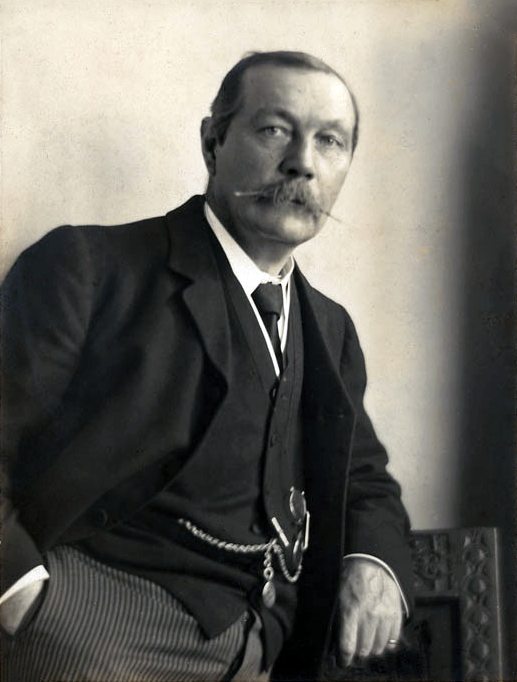
1859–1930
An Edinburgh doctor who invented Sherlock Holmes, wrote The Sign of Four in 1890, fought for wrongly convicted men, and ended his life convinced that the dead could speak and fairies could be photographed.
Conan Doyle created the most famous detective in fiction and spent much of his life trying to escape him. These five chapters follow the doctor, the commission that produced The Sign of Four, the Empire and the Boer War, the campaigns for justice, and the spiritualism that made the creator of Holmes believe in fairies.
The five chapters
- The Doctor — A troubled father, a Jesuit schooling, and Dr Joseph Bell
- The Langham Dinner — One evening, two commissions, and The Sign of Four
- Reichenbach and the Veldt — Killing Holmes, and a war in South Africa
- The Wrongly Convicted — George Edalji, Oscar Slater and the Congo
- The Coming of the Fairies — War, grief, spiritualism and Cottingley
Chapter 1 · The Doctor
A troubled father, a Jesuit schooling, and Dr Joseph Bell
1859 – 1886 · Edinburgh · Stonyhurst · Southsea
Arthur Conan Doyle was born in Edinburgh on 22 May 1859 into a large Irish Catholic family with little money. His father, Charles Altamont Doyle, was a gifted artist who suffered from alcoholism and epilepsy; he was eventually confined to institutions and died in one in 1893. His mother, Mary, whom her children called the Ma'am, held the family together and filled her son's head with stories of chivalry and heraldry.
He was sent to Jesuit boarding schools, including Stonyhurst in Lancashire, and then in 1876 to study medicine at the University of Edinburgh. There he worked as a clerk for Dr Joseph Bell, a surgeon famous for astonishing patients by telling them where they had been and what they did for a living from their hands, clothes and bearing before they spoke. Conan Doyle later said openly that Bell was the model for Sherlock Holmes's method.
To pay his way he sailed as a ship's surgeon on a whaling ship to the Arctic in 1880 and on a steamer to West Africa in 1881–82. After qualifying, he set up as a doctor in Southsea, near Portsmouth, in 1882. Patients were slow to come, and he filled his time writing stories. In 1885 he married Louisa Hawkins, the sister of a patient.
In 1886 he wrote a short novel about a consulting detective and his doctor friend. A Study in Scarlet was published in 1887 in Beeton's Christmas Annual. He sold the rights outright for twenty-five pounds.
Why this matters
Holmes's famous method of reasoning from small observed details came from the diagnostic skill of a real Edinburgh surgeon, which is why the stories feel scientific.
A troubled father, an Arctic whaler and a surgeon who read hands. What would you ask him about becoming a doctor?
Ask Conan Doyle
- “What exactly did Dr Joseph Bell do that you gave to Holmes?”
- “How did your father's illness shape the way you wrote about addiction?”
- “What did a voyage on an Arctic whaler teach a young medical student?”
- “Why did a doctor with few patients start writing detective stories?”
- “Why make your detective's companion a doctor?”
Chapter 2 · The Langham Dinner
One evening, two commissions, and The Sign of Four
1889 – 1890 · Langham Hotel · London · Southsea
On 30 August 1889 the American editor Joseph Marshall Stoddart, of Lippincott's Monthly Magazine, gave a dinner at the Langham Hotel in London. Among his guests were Oscar Wilde and the young Dr Conan Doyle. By the end of the evening both had agreed to write a short novel for the magazine. Wilde's became The Picture of Dorian Gray. Conan Doyle's became The Sign of Four, published in February 1890.
The novel opens with Holmes, bored without a case, injecting himself with cocaine while Watson disapproves — cocaine was legal and used medically at the time, but Watson already sees it as dangerous. A young governess, Mary Morstan, brings them a mystery: her father vanished years before, and since then she has received a pearl every year from an unknown sender.
The trail leads to a stolen treasure taken during the Indian rebellion of 1857 at Agra, a pact between four men, a murder in a locked room, and a chase down the Thames by steam launch. The villain, Jonathan Small, is a former soldier with a wooden leg, whose long confession at the end tells the story of the treasure.
The novel is also a product of its time and its Empire. Small's companion, Tonga, from the Andaman Islands, is described in openly racist terms, and India is seen through British imperial eyes. Students today can study how the novel shows the greed of the men who fought over the treasure while still sharing its era's prejudices. Watson, meanwhile, falls in love with Mary Morstan and they become engaged.
“When you have eliminated the impossible, whatever remains, however improbable, must be the truth.”
— The Sign of Four (1890), chapter 6 — spoken by Sherlock Holmes
Why this matters
The Sign of Four combines a detective plot with the Empire, addiction and romance, and its prejudices are part of what students must analyse rather than ignore.
A dinner with Oscar Wilde, a box of pearls and a treasure from Agra. What would you ask him about The Sign of Four?
Ask Conan Doyle
- “Why open The Sign of Four with Holmes injecting cocaine?”
- “Why did Stoddart want Oscar Wilde and you at the same dinner table?”
- “What does the Agra treasure reveal about the British Empire's greed?”
- “How do you answer readers who find Tonga's description racist?”
- “Why give Jonathan Small such a long confession at the end?”
Chapter 3 · Reichenbach and the Veldt
Killing Holmes, and a war in South Africa
1891 – 1902 · London · Reichenbach Falls · Bloemfontein
In 1891 Conan Doyle began writing Holmes short stories for the new Strand Magazine, starting with A Scandal in Bohemia, and they made him one of the most famous writers in the world. Sidney Paget's illustrations gave Holmes his image. Conan Doyle, however, considered his historical novels, such as Micah Clarke and The White Company, his real work, and grew tired of the detective. In The Final Problem (1893) he sent Holmes over the Reichenbach Falls in Switzerland in a struggle with Professor Moriarty. Readers were outraged.
That same year his wife Louisa was diagnosed with tuberculosis, and he devoted years to her care.
When the Boer War broke out in South Africa in 1899, Conan Doyle, at forty, volunteered. He served in 1900 as a doctor in a private field hospital at Bloemfontein during a typhoid epidemic that killed far more soldiers than the fighting. He wrote a history, The Great Boer War, and in 1902 a pamphlet, The War in South Africa: Its Cause and Conduct, defending Britain against international accusations of brutality. It was translated into many languages and distributed free. He was knighted later that year.
His defence has not aged well. The British policy of burning farms and holding Boer women and children, and black Africans, in concentration camps led to the deaths of tens of thousands of civilians from disease and hunger. Conan Doyle believed sincerely in the justice of Britain's cause; historians today judge the camps one of the worst episodes of the war.
He brought Holmes back in The Hound of the Baskervilles (1901–02) and then revived him properly in 1903.
Why this matters
Conan Doyle's imperial loyalties, visible in his Boer War writing, are the same assumptions that shape the view of India and the Andaman Islands in The Sign of Four.
A detective thrown off a waterfall and a typhoid hospital in South Africa. What would you ask him about these years?
Ask Conan Doyle
- “Why did you want to kill Holmes at the Reichenbach Falls?”
- “What did you see in the typhoid wards at Bloemfontein?”
- “How could you defend Britain's conduct when civilians were dying in the camps?”
- “Why did you think your historical novels mattered more than Holmes?”
- “What made you bring Holmes back after all?”
Chapter 4 · The Wrongly Convicted
George Edalji, Oscar Slater and the Congo
1906 – 1928 · Great Wyrley · Glasgow · London
Conan Doyle used his fame to fight injustice. In 1906 he read about George Edalji, a young solicitor whose father was the Parsi vicar of Great Wyrley in Staffordshire. Edalji had been convicted in 1903 of maiming horses and sending anonymous letters, on weak evidence and amid open racial prejudice, and sentenced to seven years. He had been released early but not cleared.
Conan Doyle investigated like Holmes. He met Edalji and noticed at once how he held a newspaper close to his face: Edalji had severe short sight, which made it very unlikely he could have crossed fields at night to attack animals. Conan Doyle's articles in the Daily Telegraph in 1907 caused a sensation. A government committee found Edalji innocent of the maiming, though not of the letters, and gave him no compensation. The case added to pressure that led to the creation of the Court of Criminal Appeal in England in 1907.
He then took up the case of Oscar Slater, a German Jewish immigrant convicted in 1909 of murdering an elderly woman, Marion Gilchrist, in Glasgow, on unreliable identification evidence. Slater's death sentence was commuted to life imprisonment. Conan Doyle published The Case of Oscar Slater in 1912 and campaigned for years. Slater was released in 1927 and his conviction quashed on appeal in 1928, though the two men later quarrelled over who should pay the legal costs.
In 1909 he also wrote The Crime of the Congo, supporting E. D. Morel's campaign against the brutal treatment of Congolese people under King Leopold II of Belgium.
Why this matters
The Edalji and Slater cases show Conan Doyle using the methods of Holmes on real injustices, and challenging prejudice even as he shared some of his era's assumptions.
A short-sighted solicitor and a man in prison for eighteen years. What would you ask him about fighting for justice?
Ask Conan Doyle
- “How did noticing the way Edalji read a newspaper prove his innocence?”
- “What part did racial prejudice play in George Edalji's conviction?”
- “Why did you keep fighting for Oscar Slater for so many years?”
- “How did a fiction writer persuade governments to reopen cases?”
- “How did you reconcile condemning Leopold's Congo with defending Britain's Empire?”
Chapter 5 · The Coming of the Fairies
War, grief, spiritualism and Cottingley
1906 – 1930 · Crowborough · Cottingley · London
Louisa died in 1906, and in 1907 Conan Doyle married Jean Leckie. He wrote The Lost World (1912) and more Holmes stories, but his deepest interest was moving elsewhere. He had been curious about psychical research since the 1880s. During the First World War, as millions died, he declared publicly that he believed the dead survived and could communicate with the living. In October 1918 his son Kingsley, who had been wounded on the Somme, died of pneumonia; his brother Innes died in 1919. Spiritualism became the cause of the rest of his life. He toured Britain, Australia and America lecturing about it and spent a fortune on the movement.
In 1920 he was shown photographs taken from 1917 onwards by two cousins, Elsie Wright and Frances Griffiths, in Cottingley, Yorkshire, apparently showing them with tiny dancing fairies. He believed they were genuine and published them in The Strand Magazine at Christmas 1920, followed by a book, The Coming of the Fairies (1922). Many people mocked him.
The photographs were faked. In 1983, more than fifty years after his death, the cousins admitted that the fairies were paper cut-outs, though Frances maintained that one photograph was real. Conan Doyle died believing in them.
His spiritualism also ended his friendship with the escape artist Harry Houdini, who exposed fraudulent mediums. Conan Doyle died at his home in Crowborough on 7 July 1930. Days later, spiritualists held a meeting at the Royal Albert Hall with an empty chair left for him.
Why this matters
The man who created the most rational detective in fiction was deceived by two children's photographs, a reminder that grief and hope can overcome even a trained mind.
A lost son, a séance and five photographs of fairies. What would you ask him about belief and evidence?
Ask Conan Doyle
- “How could the creator of Holmes believe the Cottingley photographs were real?”
- “How did losing Kingsley in 1918 change what you believed about death?”
- “Why did your friendship with Houdini fall apart?”
- “Would Holmes have accepted the evidence you accepted for spiritualism?”
- “Why did so many people turn to spiritualism after the First World War?”
What Conan Doyle changed
Conan Doyle created Sherlock Holmes and with him the template for the modern detective story: the brilliant investigator, the loyal narrator, and the solution reached by observation and reasoning. He used his fame to help free wrongly convicted men and to expose atrocities in the Congo. His imperial views and his belief in fairies are as much part of his story as his detective, and The Sign of Four remains a set text that asks students to read both.
A debate that continues
Historians and critics still debate whether The Sign of Four criticises the greed of the Empire or simply reflects its prejudices, and how the champion of rational detection came to believe in spirits and fairies.
Keep exploring — ask Conan Doyle
- “Is Watson more important to The Sign of Four than Holmes?”
- “How does The Sign of Four present the British Empire?”
- “Why did a man of science become a believer in spirits?”
Related lives
- Robert Louis Stevenson — Who Knew Edinburgh Had Two Towns
- Oscar Wilde — Wit · Aesthete · Poet
- Rudyard Kipling — Who Wrote Thirty-Two Lines Of Conditions
Related themes
The 19th-century novel · Detective fiction · The British Empire in literature · Victorian London
Continue on Incandio
- Talk to Conan Doyle — every question on this page is one tap from being asked, and the same page carries the Historical Brief, the achievements and the timeline
- All 280 figures · Incandio — learn every idea, teach it, then defend it