Explore Their Life · Pearson Edexcel International GCSE revision on Incandio
Robert Louis Stevenson: A Life in Five Chapters
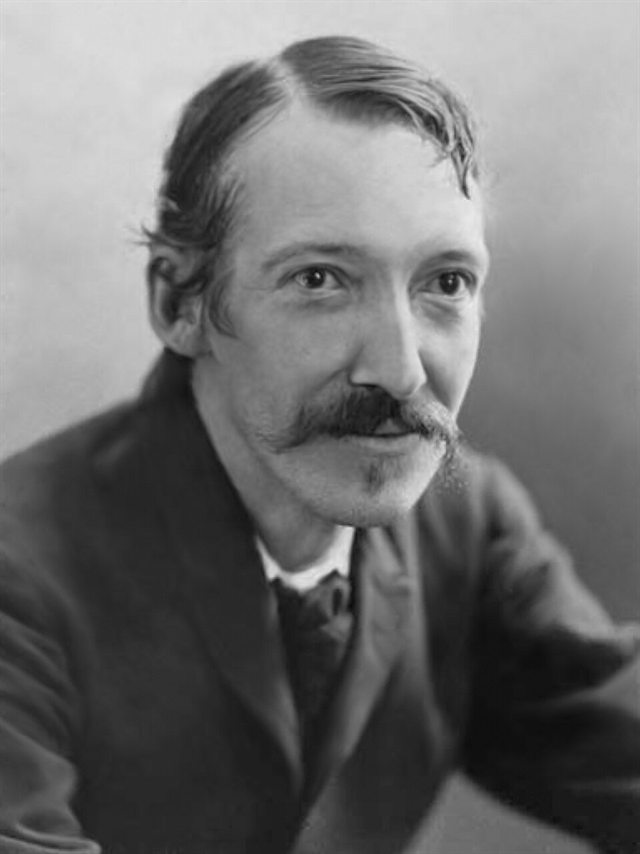
1850–1894
A sickly Edinburgh boy raised on Calvinist nightmares who rejected his father's religion, wrote Treasure Island and Jekyll and Hyde, and died in Samoa at forty-four.
Stevenson wrote the most famous story of a divided self in English. These five chapters follow the Edinburgh childhood that taught him about double lives, the rebellion against his father, the years of travel and love, the writing of Jekyll and Hyde in Bournemouth, and the Pacific exile in which he died.
The five chapters
- Two Edinburghs — A lighthouse family, a Calvinist nurse, and a city split in half
- The Velvet Coat — Engineering, law, and a quarrel with his father's God
- Fanny and the Map — France, California, and a treasure island drawn for a boy
- Skerryvore — A nightmare in Bournemouth that became Jekyll and Hyde
- Tusitala — The Pacific, Samoa, and the teller of tales
Chapter 1 · Two Edinburghs
A lighthouse family, a Calvinist nurse, and a city split in half
1850 – 1867 · Edinburgh · Heriot Row
Robert Louis Stevenson was born in Edinburgh on 13 November 1850, the only child of Thomas Stevenson, an engineer who, like his father and brothers, built lighthouses around the Scottish coast for the Northern Lighthouse Board. His mother, Margaret Balfour, was a minister's daughter. The family lived in Heriot Row in the elegant New Town.
He was a sickly child, often in bed for weeks with chest illnesses, and much of his early life was spent with his nurse, Alison Cunningham, whom he called Cummy. She was devoted to him and a strict Calvinist, and she filled his nights with stories of sin, hellfire and the Covenanters who died for their faith. He later said she gave him nightmares and also his love of stories.
Edinburgh itself was a lesson in doubleness. The New Town, with its straight Georgian streets and respectable houses, sat across a valley from the Old Town, a maze of tall tenements, closes and taverns where the poor lived crowded together. As a young man Stevenson moved between the two, dining respectably at home and slipping off to the Old Town's pubs.
In his bedroom stood a cabinet said to have been made by Deacon William Brodie, an Edinburgh cabinetmaker and town councillor who had been hanged in 1788 after it was discovered that he led a second life as a burglar. Stevenson was fascinated by Brodie and later co-wrote a play about him. The idea of a respectable man with a secret self was with him from childhood.
Why this matters
The New Town and Old Town of Edinburgh, and the story of Deacon Brodie, gave Stevenson the idea of the double life long before he wrote Jekyll and Hyde.
A Calvinist nurse, a split city and a burglar's cabinet. What would you ask him about growing up in Edinburgh?
Ask Stevenson
- “How did Edinburgh's New Town and Old Town teach you about double lives?”
- “What did Cummy's stories of sin and hellfire do to your imagination?”
- “Why did Deacon Brodie's secret life fascinate you so much?”
- “How did long childhood illnesses shape the kind of stories you loved?”
- “Why did a lighthouse engineer's son end up writing instead of building?”
Chapter 2 · The Velvet Coat
Engineering, law, and a quarrel with his father's God
1867 – 1876 · Edinburgh University · Edinburgh
Stevenson entered Edinburgh University in 1867 to study engineering, as his father expected. He had no talent or interest for it, and in 1871 his father agreed he could switch to law instead. He qualified as an advocate in 1875, put up his brass plate, and never took a case.
He spent his student years in the Old Town's taverns, wearing a shabby velvet jacket that earned him the nickname Velvet Coat, and talking about books with friends who would become editors and critics. He was trying to be a writer and to escape the respectability that his family stood for.
The crisis came in 1873. His father found papers belonging to a club Stevenson had joined that rejected the authority of the Church, and asked him directly whether he believed. Stevenson told him he did not. Thomas Stevenson was devastated and saw it as a disaster for his son's soul; his mother wept. For a time the household was almost unbearable. Stevenson wrote to a friend about the misery of having made his parents so unhappy. The rupture slowly healed, and father and son grew close again, but the argument between a strict, loving faith and a son's honest unbelief stayed in his work.
The Calvinist idea he had rejected — that human beings are naturally sinful and that the respectable may be damned — never quite left him. Jekyll and Hyde, written thirteen years later, is not a religious book, but it is a book by a man who knew what it was to hide his true self from those he loved.
Why this matters
Stevenson's break with his father's faith gave him a lasting interest in hidden selves, guilt and respectability — the moral world of Jekyll and Hyde.
A law degree never used and a father's faith rejected. What would you ask him about rebellion and respectability?
Ask Stevenson
- “What happened when you told your father you did not believe?”
- “Why qualify as an advocate and then never take a single case?”
- “Why did a lawyer like Utterson become the narrator of your strangest story?”
- “Did the Calvinism you rejected still shape how you saw human nature?”
- “What did the Old Town's taverns give a student in a velvet coat?”
Chapter 3 · Fanny and the Map
France, California, and a treasure island drawn for a boy
1876 – 1884 · Grez-sur-Loing · California · Braemar
In the late 1870s Stevenson wrote essays and travel books, including An Inland Voyage, about a canoe trip through Belgium and France, and Travels with a Donkey in the Cévennes, about a walk through the French mountains with a stubborn donkey called Modestine.
In 1876, at an artists' colony at Grez in France, he met Fanny Van de Grift Osbourne, an American ten years older than him, separated from her husband and living in France with her children. He fell in love. When she returned to California in 1879, he followed her, travelling across the Atlantic and the American continent in emigrant ships and trains that nearly killed him. They married in San Francisco in May 1880, after her divorce, and returned to Scotland, where his parents came to love her.
In 1881, on a rainy holiday at Braemar in the Highlands, Stevenson drew a map of an imaginary island to amuse his young stepson, Lloyd Osbourne. The map became Treasure Island, serialised in a boys' magazine and published as a book in 1883. Its pirate, Long John Silver, was partly modelled — as Stevenson himself told him — on his friend the poet W. E. Henley, who had lost a leg to tuberculosis. Silver is charming and murderous at once, another double figure.
But Stevenson's lungs were getting worse. He suffered haemorrhages, spent winters in health resorts, and was often forbidden to speak. He began to wonder how long he had.
Why this matters
Treasure Island made Stevenson a popular writer, and Long John Silver, both friendly and deadly, shows his interest in divided characters before Jekyll and Hyde.
A journey across a continent for love, and a map drawn on a rainy day. What would you ask him about these years?
Ask Stevenson
- “Why risk your health crossing America to follow Fanny?”
- “How did a map drawn for your stepson become a whole novel?”
- “Why is Long John Silver both likeable and dangerous?”
- “What did walking with a stubborn donkey in the Cévennes teach you about travel writing?”
- “How did constant illness change the speed at which you wrote?”
Chapter 4 · Skerryvore
A nightmare in Bournemouth that became Jekyll and Hyde
1884 – 1887 · Bournemouth · Skerryvore · London
From 1884 to 1887 Stevenson lived as an invalid in Bournemouth, on the south coast of England, in a house his father bought for the couple and which they named Skerryvore after one of the Stevenson lighthouses. He was often confined to bed. It was here that he wrote Strange Case of Dr Jekyll and Mr Hyde.
The story of how it was written comes from family accounts, mainly Lloyd Osbourne's and Fanny's, and they differ in details. According to them, Stevenson had a nightmare and Fanny woke him; he told her she had interrupted a fine bogey tale. He wrote a first draft at great speed. Fanny criticised it — reportedly for treating as a mere sensational story what should have been an allegory — and Stevenson burnt the draft and wrote a new version in a few days. How much Fanny shaped the final book is still disputed.
The novel was published by Longmans in January 1886 as a cheap paperback. It is short, told mostly through the lawyer Utterson, who investigates the link between his respectable friend Dr Jekyll and the small, repellent Mr Hyde. Only in the final chapter, Jekyll's own statement, does the reader learn that they are the same man, and that Jekyll had a concealed life of pleasures long before the potion. Hyde is not a giant monster but a younger, smaller man whom people find hard to describe.
It sold tens of thousands of copies in months, was preached about from pulpits, and became one of the first great bestsellers of its kind.
“Man is not truly one, but truly two.”
— Strange Case of Dr Jekyll and Mr Hyde (1886), 'Henry Jekyll's Full Statement of the Case' — a character's words
Why this matters
Knowing how the novel was written, and how uncertain that story is, helps students see Jekyll and Hyde as a deliberately crafted book rather than a dream copied out.
A nightmare, a burnt draft and a shilling paperback. What would you ask him about writing Jekyll and Hyde?
Ask Stevenson
- “Why keep the truth about Jekyll and Hyde hidden until the very last chapter?”
- “Why make Hyde small and hard to describe rather than a giant monster?”
- “What did Fanny object to in your first draft?”
- “Was Jekyll already living a double life before he made the potion?”
- “Why are there almost no women in the world of Utterson and his friends?”
Chapter 5 · Tusitala
The Pacific, Samoa, and the teller of tales
1887 – 1894 · Saranac Lake · Molokai · Vailima · Samoa
After his father died in 1887, Stevenson left Britain and never returned. He spent a winter in the mountains of New York State, then in 1888 hired the yacht Casco and sailed into the Pacific with Fanny, his mother and Lloyd. They visited the Marquesas, Tahiti and Hawaii, and Stevenson went to the settlement on Molokai where people with leprosy were isolated. When a Honolulu clergyman, the Reverend Dr Hyde, attacked the late Father Damien, the priest who had worked and died there, Stevenson published a furious open letter in Damien's defence in 1890.
In 1890 he bought land above Apia on the island of Upolu in Samoa and built a house called Vailima. The Samoans called him Tusitala, the teller of tales. Samoa was then being fought over by Germany, Britain and the United States, and Stevenson took the side of the Samoans, criticising the foreign officials in letters to The Times and in a book, A Footnote to History (1892). Some officials wanted him deported.
His health improved in the warm climate and he wrote steadily: The Master of Ballantrae, The Ebb-Tide, and Pacific stories that looked hard at colonial greed. He began Weir of Hermiston, a Scottish novel about a hanging judge and his son, which many critics believe would have been his masterpiece.
On 3 December 1894, while talking with Fanny, he collapsed with a brain haemorrhage and died within hours. He was forty-four. Samoans cut a path up Mount Vaea so that he could be buried at the top.
Why this matters
Stevenson's Pacific years show a writer who defended the powerless against colonial bullying, which adds depth to his lifelong interest in hidden cruelty behind respectable fronts.
A yacht, a leper settlement, and a grave carried up a mountain. What would you ask the teller of tales?
Ask Stevenson
- “Why did you defend Father Damien so fiercely against Dr Hyde?”
- “Why take the Samoans' side against three powerful empires?”
- “What did the name Tusitala mean to you?”
- “Why did Scotland keep calling you back in your writing from the other side of the world?”
- “Did you ever wish you had written something other than Jekyll and Hyde to be remembered by?”
What Stevenson changed
Stevenson gave the English language the phrase 'Jekyll and Hyde' and one of its most enduring images of the divided self. Treasure Island and Kidnapped shaped adventure fiction for a century, and his essays and Pacific writing are now valued for their humanity and their criticism of colonial power. Strange Case of Dr Jekyll and Mr Hyde remains one of the most studied novels in British schools.
A debate that continues
Critics still debate what Jekyll and Hyde is really about — hidden sexuality, addiction, Victorian class hypocrisy, fears of degeneration after Darwin, or the Calvinist sense of sin — and whether it needs one answer at all.
Keep exploring — ask Stevenson
- “Is Jekyll a victim of science or of his own hypocrisy?”
- “How does Jekyll and Hyde compare with Frankenstein as a warning about science?”
- “Why does Victorian respectability matter so much to Utterson and his friends?”
Related lives
- Arthur Conan Doyle — Who Freed The Innocent And Believed In Fairies
- Mary Shelley — Mother of Science Fiction
- Charles Dickens — The Inimitable · Chronicler of London
- Charles Darwin — Author of On the Origin of Species
Related themes
The 19th-century novel · Victorian Gothic fiction · Duality and the divided self · Victorian respectability
Continue on Incandio
- Talk to Stevenson — every question on this page is one tap from being asked, and the same page carries the Historical Brief, the achievements and the timeline
- All 280 figures · Incandio — learn every idea, teach it, then defend it