Historical figure · Pearson Edexcel International GCSE revision on Incandio
Arthur Conan Doyle
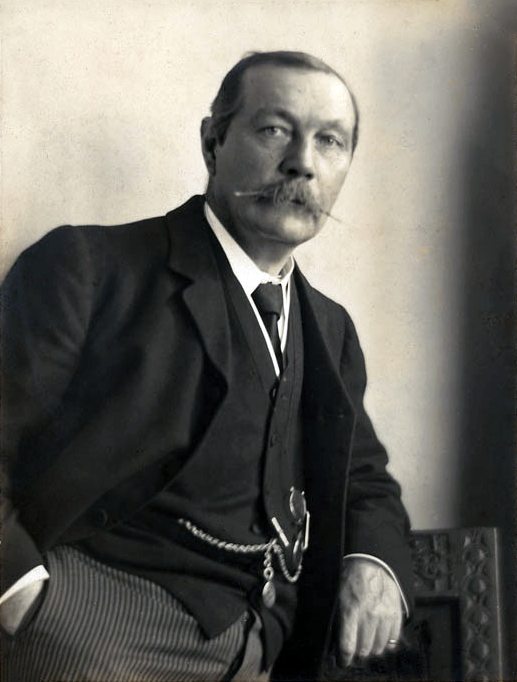
Who Freed The Innocent And Believed In Fairies · Novelist & Physician · 1859–1930
The Edinburgh-trained doctor who created Sherlock Holmes, wrote The Sign of Four in 1890, campaigned for wrongly convicted men, and became the most famous spiritualist of his age.
Defend these ideas against Conan Doyle
Incandio is a free revision platform for the Pearson Edexcel International GCSE, and on it a topic counts as mastered only once you have learned it, proved it in questions, taught it back and defended it against the person with the strongest claim on it. Arthur Conan Doyle is that person for 8 topics on the course:
- Sherlock Holmes in The Sign of Four — English Literature
- Dr Watson in The Sign of Four — English Literature
- Mary Morstan in The Sign of Four — English Literature
- Jonathan Small in The Sign of Four — English Literature
- Reason and deduction in The Sign of Four — English Literature
- Empire, race and the 1857 rebellion in The Sign of Four — English Literature
- Greed and treasure in The Sign of Four — English Literature
- Love and reason in The Sign of Four — English Literature
Who was Conan Doyle?
Conan Doyle was born in Edinburgh in 1859 to an Irish Catholic family. His father, the artist Charles Altamont Doyle, struggled with alcoholism and epilepsy and spent his last years in institutions. Educated by Jesuits, Conan Doyle studied medicine at Edinburgh, where Dr Joseph Bell's method of diagnosis by observation inspired Sherlock Holmes. After voyages as a ship's surgeon to the Arctic and West Africa he practised in Southsea. A Study in Scarlet (1887) introduced Holmes; The Sign of Four (1890) was commissioned at a dinner in London at which Oscar Wilde was also given the commission that produced The Picture of Dorian Gray. The Strand Magazine stories made Holmes world-famous; Conan Doyle killed him off in 1893 and later revived him. He served as a volunteer doctor in the Boer War, defended Britain's conduct of that war in a widely translated pamphlet, and was knighted in 1902. He campaigned successfully for George Edalji and, over many years, for Oscar Slater. After losing his son Kingsley in 1918 he devoted himself to spiritualism, and in 1920 he publicly endorsed photographs of fairies taken by two girls at Cottingley. He died on 7 July 1930.
Major achievements
- The Sign of Four (1890), the second Sherlock Holmes novel
- Sherlock Holmes — four novels and fifty-six short stories that shaped the detective story
- His investigation of the George Edalji case (1907), which helped lead to his partial exoneration
- His long campaign for Oscar Slater, whose conviction was quashed in 1928
- The Lost World (1912) and the historical novels he valued most, Micah Clarke and The White Company
Life in brief
- 1859 — Born in Edinburgh: To an Irish Catholic family in Picardy Place.
- 1881 — Qualifies in medicine: At Edinburgh, under the influence of Dr Joseph Bell.
- 1887 — A Study in Scarlet: Sherlock Holmes first appears.
- 1890 — The Sign of Four: Published in Lippincott's Monthly Magazine in February.
- 1893 — Holmes dies at Reichenbach: In The Final Problem.
- 1900 — The Boer War: Serves in a field hospital at Bloemfontein.
- 1907 — The Edalji case: His articles help win Edalji a partial pardon.
- 1920 — The Cottingley fairies: Publishes the photographs in The Strand.
Explore the life of Conan Doyle — five chapters
- The Doctor — A troubled father, a Jesuit schooling, and Dr Joseph Bell
- The Langham Dinner — One evening, two commissions, and The Sign of Four
- Reichenbach and the Veldt — Killing Holmes, and a war in South Africa
- The Wrongly Convicted — George Edalji, Oscar Slater and the Congo
- The Coming of the Fairies — War, grief, spiritualism and Cottingley
Read the five-chapter life of Arthur Conan Doyle →
Begin
- Start a conversation with Conan Doyle — a dramatised, historically grounded AI portrayal
- Read the Historical Brief
- Explore the life of Conan Doyle — five chapters
- Find your course · Meet all 280 figures