Explore Their Life · Pearson Edexcel International GCSE revision on Incandio
Arthur Eddington: A Life in Five Chapters
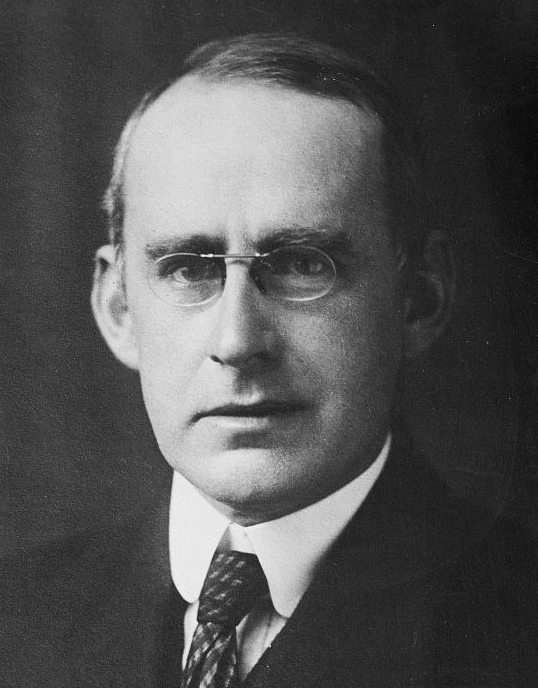
1882–1944
The Quaker who refused to fight in a war against Germany and then organised the expedition that proved a German's theory, told his critics to go and find a hotter place, and publicly humiliated a young man who was right.
Eddington built the theory of what holds a star up, proposed that stars burn hydrogen into helium five years before quantum mechanics could justify it, and tested general relativity during an eclipse. He also destroyed a young Indian physicist's confidence in public over a result that was correct. These five chapters follow all of it.
The five chapters
- A Quaker in a War — Conscientious objection, and an expedition as an alternative
- Príncipe — 29 May 1919, and a great deal of cloud
- What Holds a Star Up — Radiation pressure and the mass-luminosity relation
- Go and Find a Hotter Place — Cardiff, 1920, and the energy source of every star
- Chandrasekhar — January 1935, and a public humiliation
Chapter 1 · A Quaker in a War
Conscientious objection, and an expedition as an alternative
1882 – 1918 · Kendal · Manchester · Cambridge · Greenwich
Arthur Stanley Eddington was born at Kendal in Westmorland in December 1882, into a *Quaker* family. His father, headmaster of a Quaker school, died of typhoid when Arthur was two, and the family moved to Weston-super-Mare, where his mother raised him and his sister on very little.
He was a prodigy at mathematics, went to Owens College in Manchester at sixteen, then to Trinity College, Cambridge, and was *Senior Wrangler* in 1904 — the top mathematics student of his year, and the first person ever to achieve it in his second year.
He became Chief Assistant at the *Royal Observatory, Greenwich*, and in 1913 *Plumian Professor of Astronomy* at Cambridge, and director of its observatory from 1914.
Then the war.
As a Quaker, Eddington was a *conscientious objector* on religious grounds. Conscription came in 1916, and objectors were treated harshly: many were imprisoned, some sent to the front under military discipline, and a number died of their treatment.
Cambridge colleagues, alarmed at losing him, arranged a deferment on the grounds that his work was of national importance.
Eddington *objected to the terms*. He said publicly that if he were not deferred on grounds of national interest he would claim exemption as a *conscientious objector* anyway, and that he would not accept a deferment that concealed his position.
That is a considerable act. It risked prison, and it embarrassed the people trying to protect him.
The *Astronomer Royal*, Frank Dyson, found the solution: a deferment conditional on Eddington *leading an eclipse expedition* in 1919 to test Einstein's general relativity.
So the expedition began as a way of keeping a conscientious objector out of prison.
And Eddington's motive was explicitly *internationalist*. British scientists were largely refusing to read German work. Eddington had received Einstein's papers through the neutral Netherlands and thought the theory magnificent, and he argued that a British expedition confirming a German theory would show that science stands above national hatreds.
“We do not argue with the critic who urges that the stars are not hot enough for this process; we tell him to go and find a hotter place.”
— Arthur Eddington, address to the British Association, Cardiff (1920)
Why this matters
The 1919 eclipse expedition was arranged partly to keep a conscientious objector out of prison, and Eddington's motive was to show science standing above the war.
You have the objection and the expedition. What would you ask him?
Ask Eddington
- “Why refuse a deferment that would have protected you?”
- “What happened to conscientious objectors in 1916?”
- “Why did you want to test a German theory?”
- “How did Einstein's papers reach you at all?”
- “What did Dyson arrange, and why?”
Chapter 2 · Príncipe
29 May 1919, and a great deal of cloud
1919 · Príncipe · Sobral · London
General relativity predicts that *mass bends spacetime*, so light passing near a massive body should be *deflected*.
Newtonian gravity, treating light as particles with mass, also predicts a deflection — but only *half* as much. So the two theories give different numbers, and measuring the deflection distinguishes them.
The only body massive enough to give a measurable effect is the *Sun*, and you cannot see stars next to the Sun — except during a *total solar eclipse*.
The eclipse of 29 May 1919 was exceptionally favourable: it was long, and the Sun would be in front of the *Hyades*, a rich cluster with plenty of bright stars.
Two expeditions were sent, to reduce the risk of weather: one to *Sobral* in Brazil, one to the island of *Príncipe* off West Africa. Eddington went to Príncipe.
The method: photograph the star field around the eclipsed Sun, then photograph the *same* field months later when the Sun is elsewhere, and compare the apparent positions. Any shift is the deflection.
The conditions at Príncipe were bad. It rained heavily in the morning. The cloud began to break only shortly before totality. Eddington took sixteen plates during the roughly five minutes of totality, mostly through cloud, and *only two* were usable.
He developed them on the island and measured one on the spot.
The results were announced at a joint meeting of the Royal Society and Royal Astronomical Society on 6 November 1919, and they favoured Einstein.
It made *Einstein world-famous overnight*. The Times headline was about a revolution in science and Newtonian ideas overthrown.
The measurements have been examined critically ever since, and the honest position is this: the Príncipe plates were of poor quality and had large uncertainties; the Sobral results came from two instruments, one of which gave a Newtonian value and was set aside for reasons that were stated at the time and are defensible but were also convenient; and Eddington was not a neutral party.
Modern reanalyses generally find the discarding justified. The result has since been confirmed to far higher precision many times over. Whether the 1919 data *alone* established it is genuinely arguable.
Why this matters
The 1919 measurement was made through cloud on two usable plates, and whether that data alone established the result is still legitimately argued.
You have the rain, the two plates and the headline. What is your question?
Ask Eddington
- “Why does an eclipse let you test relativity?”
- “What is the difference between the two predictions?”
- “How bad were the conditions at Príncipe?”
- “Why was one Sobral instrument set aside?”
- “Were you a neutral party?”
Chapter 3 · What Holds a Star Up
Radiation pressure and the mass-luminosity relation
1916 – 1926 · Cambridge
Eddington's central work is on the *interiors of stars*, and the question is simple to state.
A star is an enormous quantity of gas, and gravity is pulling every part of it inward. Why does it not *collapse*?
The answer must be *pressure* pushing outward, balancing gravity at every depth. That is *hydrostatic equilibrium*.
What Eddington added — and it is his key insight — is that in a star, a large share of the outward push comes from *radiation pressure*. Light itself carries momentum, and in the enormously hot interior of a star, the flood of radiation streaming outward *pushes* on the material.
So a star is held up partly by gas pressure and partly by the pressure of its own light.
Working through this, he derived the *mass–luminosity relation*: a star's brightness depends on its *mass*, roughly as the mass cubed or a little more. A star ten times the Sun's mass is thousands of times brighter.
The surprising thing is that this relation follows from the *structure* alone, without knowing what the energy source is. Eddington derived how bright a star must be without knowing what is powering it.
He also found an upper limit — the *Eddington limit* — on how bright a star can be before radiation pressure blows its outer layers off entirely, which sets a maximum stellar mass.
*The Internal Constitution of the Stars* (1926) sets it out and is one of the founding books of astrophysics.
He had a long and public argument with *James Jeans* over stellar structure, conducted at Royal Astronomical Society meetings with considerable sharpness over many years.
Why this matters
A star is held up partly by the pressure of its own light, and the mass-luminosity relation follows from structure alone without knowing the energy source.
You have the star held open by its own radiation. What would you ask?
Ask Eddington
- “Why doesn't a star collapse under its own gravity?”
- “How can light hold something up?”
- “How can you know a star's brightness without knowing its fuel?”
- “What sets the largest a star can be?”
- “What were you and Jeans actually arguing about?”
Chapter 4 · Go and Find a Hotter Place
Cardiff, 1920, and the energy source of every star
1920 · Cardiff
The theory of stellar structure could not say *where the energy comes from*, and it was a genuine crisis.
*Gravitational contraction* — the star slowly shrinking and converting gravitational energy into heat, proposed by Kelvin and Helmholtz — gives the Sun a lifetime of a few *tens of millions* of years.
But geology and evolution both demanded *thousands of millions*. The Earth is older than the Sun could be.
So the source had to be something else, and by 1920 the only candidate with enough energy was *subatomic*.
In an address to the British Association at *Cardiff* in 1920, Eddington said what it must be.
*Francis Aston*, using mass spectrometry at Cambridge, had just measured atomic masses very precisely and found something remarkable: *four hydrogen nuclei weigh appreciably more than one helium nucleus* — about seven parts in a thousand more.
Eddington's argument: if the Sun is converting *hydrogen into helium*, that missing mass becomes *energy* by Einstein's relation. And a star that is mostly hydrogen has an enormous supply — enough for thousands of millions of years.
He went further, and it is worth quoting the substance: he said that if this is the source of a star's energy, then it seems to bring a little nearer the fulfilment of our dream of controlling this latent power for the well-being of the human race — or for its suicide.
That is 1920. Twenty-five years before Hiroshima.
The critics objected that the Sun is *not hot enough*. At the temperature of the solar interior, two positively charged nuclei repel each other far too strongly to get close enough to fuse.
Eddington's reply is the most famous sentence he wrote: we do not argue with the critic who urges that the stars are not hot enough for this process; we tell him to *go and find a hotter place*.
The critics were right on classical physics. The resolution came from *quantum tunnelling*, worked out by Gamow in 1928 — a nucleus can pass through a barrier it cannot classically surmount.
*Hans Bethe* and *Carl von Weizsäcker* worked out the actual reaction chains in 1938 and 1939.
Eddington had the right answer for five years before the physics existed to justify it.
Why this matters
Eddington identified the energy source of every star in the universe in 1920, five years before quantum mechanics existed to explain how it could work.
You have the missing mass and the hotter place. What is your question?
Ask Eddington
- “Why couldn't gravity power the Sun?”
- “What did Aston's measurements show?”
- “Why were the critics right that the Sun is too cold?”
- “What is quantum tunnelling doing in a star?”
- “Did you really foresee atomic weapons in 1920?”
Chapter 5 · Chandrasekhar
January 1935, and a public humiliation
1930 – 1944 · London · Cambridge
*Subrahmanyan Chandrasekhar* was nineteen, travelling by ship from India to Cambridge on a scholarship in 1930, when he worked out something startling.
A *white dwarf* — the dense remnant left when a star like the Sun exhausts its fuel — is held up not by heat but by *electron degeneracy pressure*, a quantum effect arising from the Pauli exclusion principle.
Chandrasekhar included *special relativity*, which nobody had, and found that as a white dwarf becomes more massive the electrons approach the speed of light — and beyond a *critical mass*, around 1.4 times the Sun's, degeneracy pressure *cannot* support it.
Above that mass, nothing known could stop the collapse.
He worked it out over the following years at Cambridge and presented it at the *Royal Astronomical Society* on 11 January 1935. He was twenty-four.
Eddington — who had encouraged him, discussed the work with him, and had visited him in the days before — rose immediately afterwards and *demolished it in public*, calling the result a *reductio ad absurdum*, saying there should be a law of nature to prevent a star behaving in this absurd way, and dismissing the relativistic treatment as illegitimate.
Chandrasekhar had no warning and no chance to reply properly.
Eddington was the most eminent astrophysicist in Britain. The effect on a young Indian researcher in 1935 was devastating. Chandrasekhar wrote that he felt his career was finished, and that colleagues privately told him he was right while declining to say so publicly.
He left the field, moved to the University of Chicago in 1937, and worked on other problems for decades.
Eddington never conceded. He attacked the result repeatedly until his death.
Chandrasekhar was right. The *Chandrasekhar limit* is fundamental to modern astrophysics: it determines which stars end as white dwarfs and which collapse further into *neutron stars* or *black holes*, and it governs the type Ia supernovae used to measure the expansion of the universe.
Chandrasekhar received the *Nobel Prize in 1983*, forty-eight years later. He always spoke of Eddington with generosity, and said his personal relations with him remained good.
Eddington's later years went into *Fundamental Theory*, an attempt to derive the constants of nature from pure reason. It is generally regarded as a failure.
He died at Cambridge in November 1944, aged sixty-one, of cancer.
Why this matters
Eddington publicly destroyed a correct result by a twenty-four-year-old and never conceded, and the limit he ridiculed determines which stars become black holes.
You have the meeting, the young man and the limit. What would you ask?
Ask Eddington
- “What did Chandrasekhar actually find?”
- “Why did you attack it in public without warning him?”
- “What did the attack cost him?”
- “Why could you not accept gravitational collapse?”
- “How should an eminent scientist disagree with a young one?”
What Eddington changed
Eddington's stellar models are the foundation of astrophysics, and his 1920 proposal identified the energy source of every star in the universe five years before quantum mechanics existed to justify it. The 1919 eclipse expedition made Einstein world-famous and gave general relativity its first observational confirmation.
A debate that continues
The 1919 eclipse data were of poor quality and one Sobral instrument was set aside on grounds that were stated but convenient; and Eddington's public destruction of Chandrasekhar's correct 1935 result, which he never conceded, is one of the worst-conducted disputes in modern science.
Keep exploring — ask Eddington
- “What would you say to Chandrasekhar now?”
- “Was the 1919 data good enough?”
- “What should stop a star collapsing?”
Related lives
- Albert Einstein — Nobel Laureate · Author of Relativity
- Cecilia Payne — Who Read What The Stars Are Made Of
- Ejnar Hertzsprung — Who Found Giants Among The Dwarfs
- Lord Kelvin — Who Found The Bottom Of The Scale
Related themes
Stars and their structure · General relativity · Nuclear fusion
Continue on Incandio
- Talk to Eddington — every question on this page is one tap from being asked, and the same page carries the Historical Brief, the achievements and the timeline
- All 280 figures · Incandio — learn every idea, teach it, then defend it