Explore Their Life · Pearson Edexcel International GCSE revision on Incandio
Maimonides: A Life in Five Chapters
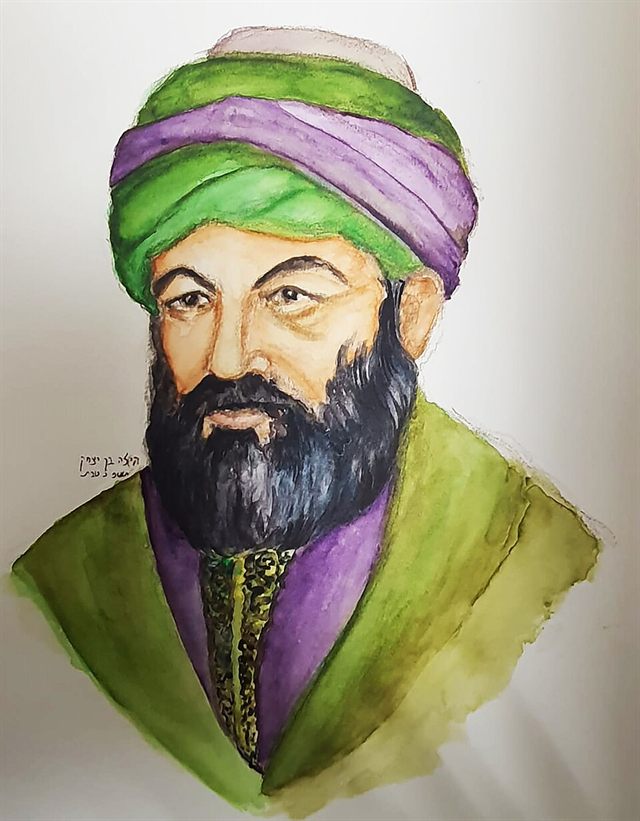
1138–1204
A boy driven out of Córdoba who became physician to a sultan's court, wrote down the whole of Jewish law so anybody could find it, and then argued that nearly everything people say about God is false.
Maimonides is the most demanding figure in medieval Jewish thought and the most practical: a working doctor who codified a legal tradition by night and then wrote a book designed to unsettle its most educated readers. These five chapters follow the exile, the loss at sea, the law code, the Guide, and the argument it started.
The five chapters
- Out of Córdoba — A family of judges on the road for a decade
- The Loss at Sea — A brother, the family's money, and a grief written down
- The Whole of the Law, in Order — A code that made scholars unnecessary, and annoyed them
- The Guide for the Perplexed — What can honestly be said about God
- The Argument That Followed — Banned, defended, and still consulted
Chapter 1 · Out of Córdoba
A family of judges on the road for a decade
1138 – 1166 · Córdoba · Fez · Acre · Fustat
Moses ben Maimon was born at Córdoba in 1138 into a family of judges. Córdoba was then among the great cities of the world, and the Jewish community there had held a settled and productive place in it for generations.
That ended. The Almohad conquest of the city in 1148 brought a regime that would not tolerate the arrangement, and the family left. What followed was roughly a decade of moving: through southern Iberia, then to Fez in Morocco, then briefly to Acre, and finally to Fustat, near Cairo, where they settled. Maimonides was studying and writing throughout, which is remarkable given the circumstances and which he never presents as remarkable.
It is worth resisting the temptation to romanticise this. It was a family losing a home, a position and a city, and moving repeatedly between places where the terms of Jewish life were uncertain. His later insistence on writing law that a reader could actually find an answer in is not unconnected to having watched communities cut off from their scholars.
In Egypt he found a Jewish community that was substantial, mixed and argumentative, and he entered its life quickly. He was eventually recognised as its head.
Why this matters
The practicality of Maimonides's greatest work follows directly from a childhood spent among communities that had lost access to the people who could answer their questions.
You have the conquest and the decade of moving. What would you ask?
Ask Maimonides
- “What did leaving Córdoba cost your family?”
- “How did you keep studying while moving that often?”
- “What was the Jewish community in Egypt like when you arrived?”
- “Did the years in Fez change what you thought a scholar was for?”
- “What does a community without scholars actually lose?”
Chapter 2 · The Loss at Sea
A brother, the family's money, and a grief written down
c. 1177 · Fustat · The Indian Ocean
The household in Egypt was supported by trade. Maimonides did not earn; his younger brother David travelled with precious stones, and the arrangement freed the elder brother to study and write. It was a deliberate family decision and it worked.
David drowned in the Indian Ocean, with the family's capital aboard. Maimonides wrote about it years afterwards in a letter, and what he wrote is unusual for the period and unusual for him. He says he was ill for about a year — fever, inflammation, a state near despair — and that afterwards the grief did not lift. He says that whenever he comes across his brother's handwriting his heart turns over. He states plainly that this was the greatest calamity of his life.
The practical consequence changed everything about his working life. With the household's income gone, he turned to medicine as a profession, and became a physician in the household of al-Fadil, the vizier of Saladin's administration. He describes the resulting day in another letter: riding to the court in the morning, attending there, returning to Fustat in the afternoon to find the antechamber full of patients, seeing them until night, and being too exhausted to speak by the end of it.
Everything he wrote after this was written in those conditions.
“Teach thy tongue to say 'I do not know', and thou shalt progress.”
— Attributed to Maimonides in the medieval Jewish tradition
Why this matters
The Guide for the Perplexed and much of the legal work were produced by a man doing a demanding full-time job, after a bereavement he described as permanent — which is worth knowing before calling any of it abstract.
You have the brother, the money and the medical practice. What would you ask?
Ask Maimonides
- “What did David's death change about your working life?”
- “What was a day at the court and the clinic actually like?”
- “Why write about your grief in a letter rather than keep it private?”
- “Did being a physician change how you thought about the body and the soul?”
- “How do you write a book that long while seeing patients until night?”
Chapter 3 · The Whole of the Law, in Order
A code that made scholars unnecessary, and annoyed them
c. 1170 – 1180 · Fustat
The Mishneh Torah, finished about 1180, sets out the entire body of Jewish law in fourteen books of ordered Hebrew. It covers everything, including laws that could not be practised at the time. It is arranged by subject. A reader with a question can look it up.
That last sentence is the controversial part. The traditional way of establishing a point of law was to follow the argument through the Talmud — the debates, the objections, the competing authorities, the reasoning by which a conclusion had been reached. Maimonides gives the conclusion. He does not name his sources and he does not rehearse the argument.
His reason was practical and he stated it: communities were scattered, scholars were not everywhere, and a person who needed to know what to do could not always follow a Talmudic argument to find out. The code makes the law available.
Rabbis in Provence and Baghdad objected, and their objection was not petty. Strip out the reasoning, they said, and you produce a generation that knows the ruling and cannot argue it — and a ruling nobody can argue is a ruling nobody can correct. Rabbi Abraham ben David of Posquières wrote critical glosses that are printed alongside the text to this day, which is a fair outcome: the argument was preserved by being attached to the book that had removed it.
The Hebrew is the other achievement. It is clear, unornamented and completely consistent, and it was a considerable feat to write law that way in a language that had not been used for the purpose.
Why this matters
The dispute over the Mishneh Torah is a live question about any subject: does making an answer easy to find help a learner, or remove the thing that would have made them able to think?
You have the code and the objection to it. What would you ask?
Ask Maimonides
- “Why leave out the reasoning and give only the ruling?”
- “Were the rabbis who objected right about what would be lost?”
- “Why write the whole thing in Hebrew?”
- “Why include laws that nobody could practise?”
- “What does a person actually need when they have a question of law?”
Chapter 4 · The Guide for the Perplexed
What can honestly be said about God
c. 1185 – 1190 · Fustat
The Guide is addressed to one reader: Joseph ben Judah, a pupil who knew both philosophy and Torah and could not see how they fitted together. That is the perplexity of the title. It is not doubt and it is not unbelief; it is the specific discomfort of holding two things that will not sit still beside each other.
The argument at the centre is austere and Maimonides does not soften it. When people say God is powerful, or wise, or good, they take a word whose meaning comes from creatures and apply it to something that is not a creature — and in doing so they make God a kind of thing among things, which is exactly what they meant to deny. Every positive attribute imports something false.
What is left is denial. God is not a body. God is not in a place. God is not subject to change. Each of these removes an error rather than adding a description, and Maimonides argues that a person who has removed many errors stands closer than one who has accumulated many descriptions. The uncomfortable consequence, which he accepts, is that a simple believer with a long list of divine attributes may be further from the truth than they think.
The book handles biblical passages that describe God with hands, or a face, or anger, and argues consistently that these are not to be taken literally, because taking them literally would make God corporeal, which is the one thing he holds no Jew may believe.
He knew what he was doing. The Guide is written obliquely, with its most difficult material distributed rather than concentrated, on the stated grounds that some truths harm a reader who is not ready for them.
Why this matters
The Guide is the sharpest available test of whether a statement about God is doing real work, and it is the reason a Religious Studies learner should be careful about what an attribute of God actually claims.
You have the argument and the reader it was written for. What would you ask?
Ask Maimonides
- “What goes wrong when somebody says God is good?”
- “Is a simple believer worse off than a philosopher?”
- “What do you do with a verse that gives God a hand?”
- “Why write the book obliquely rather than plainly?”
- “What was Joseph's perplexity exactly?”
Chapter 5 · The Argument That Followed
Banned, defended, and still consulted
1204 – present · Fustat · Provence · Tiberias
Maimonides died in December 1204 and was buried at Tiberias. The argument about him began almost at once and ran for a century.
The charge was that the Guide made philosophy the judge of revelation and encouraged readers to explain away whatever they found difficult. In the 1230s the controversy became bitter enough that some communities banned the study of the book, and at one point copies were burned — an episode that later horrified both sides. His defenders, including his son Abraham, argued that he had saved the faith of readers who would otherwise have lost it.
Both positions have something. His method does give demonstration real authority over the plain sense of a text. It also demonstrably held people who could not otherwise have stayed.
What survived is unusual in its spread. The Mishneh Torah is consulted as a legal authority to this day. The Thirteen Principles, drawn from his commentary on the Mishnah, are sung in synagogues by people who could not name their author. And the Guide is still argued over, which is what he would probably have wanted, having written a book designed to be difficult.
He was also, throughout, a working doctor whose medical writings were translated and used for centuries. It is a strange combination and it was not strange to him.
Why this matters
The reception of Maimonides is the clearest case in Jewish thought of a question every religious tradition faces: how much authority may argument have over the plain sense of a text?
You have the ban, the defence and what survived. What would you ask?
Ask Maimonides
- “Were the people who banned the Guide entirely wrong?”
- “How much authority should an argument have over a text?”
- “Which of your books did you expect to last?”
- “What would you say to somebody who recites your principles and has read nothing else?”
- “Was being a physician a distraction from the writing?”
What Maimonides changed
Maimonides did two incompatible-looking things extremely well: he made a vast legal tradition usable by ordinary people, and he wrote a book arguing that most ordinary talk about God is mistaken. On Religious Studies he is the opponent for any point where a learner has to say what a claim about God actually claims, and he is uncomfortable to argue with because he agrees that the honest answer is smaller than the comfortable one.
A debate that continues
Whether the Guide rescued readers who would otherwise have lost their faith, or taught a habit of explaining away whatever is difficult, was fought over for a century after his death and has never been settled.
Keep exploring — ask Maimonides
- “Can you say anything true about God in ordinary words?”
- “Does making an answer easy to find make a person less able to think?”
- “Should a difficult truth be kept from a reader who is not ready for it?”
Related lives
- Thomas Aquinas — Who Would Not Let Faith Fear Reason
- Ibn Rushd — Who Answered The Incoherence
- Augustine of Hippo — Who Wrote Down What He Had Been
Related themes
Ultimate reality · Religious language · Faith and reason
Continue on Incandio
- Talk to Maimonides — every question on this page is one tap from being asked, and the same page carries the Historical Brief, the achievements and the timeline
- All 280 figures · Incandio — learn every idea, teach it, then defend it