Explore Their Life · Pearson Edexcel International GCSE revision on Incandio
Douglas Haig: A Life in Five Chapters
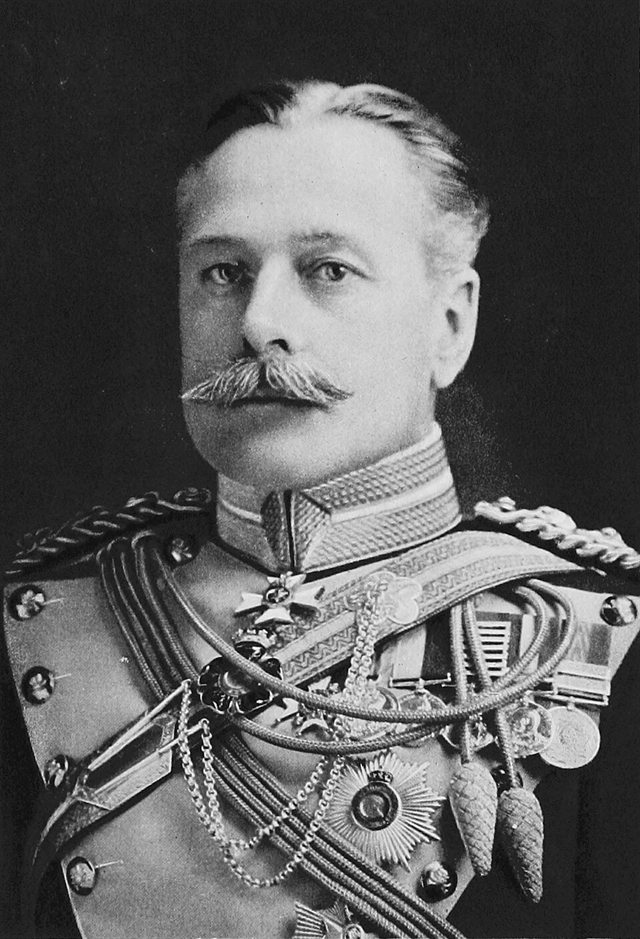
1861–1928
The commander of the bloodiest battles in British history, who also commanded the most successful campaign in it, and whose reputation was destroyed by a Prime Minister's memoirs, a book about donkeys and a sitcom.
No British figure of the twentieth century has been argued about more violently. These five chapters follow the whisky family's youngest son, the army reformer, the Somme, the Hundred Days that ended the war, and the ninety years of argument since.
The five chapters
- The Youngest of Eleven — A distiller's son who passed out first from Sandhurst
- The Army He Helped Build — The Haldane reforms, and the part nobody mentions
- The Somme — The first day, and the four months after it
- The Hundred Days — The most successful campaign in British military history
- The Poppy, and the Donkeys — Ten years for the veterans, and ninety years of ridicule
Chapter 1 · The Youngest of Eleven
A distiller's son who passed out first from Sandhurst
1861 – 1905 · Edinburgh · Oxford · Sandhurst · Omdurman · South Africa
Douglas Haig was born in Edinburgh in 1861, the youngest of eleven children of John Haig, whose family made whisky. Money, therefore, and not the landed background usually assumed of a British general. His mother, whom he was devoted to, died when he was eighteen.
He went to Clifton College and to Brasenose College, Oxford, where he rode, played polo and left without taking a degree — he had not kept the required terms. He then went to Sandhurst and passed out first in his year, which is the first sign of something the whole career shows: he was serious, methodical and driven in a way his Oxford contemporaries had not seen.
He was commissioned into the cavalry, and served under Kitchener in the Sudan, including at Omdurman in 1898, and through the South African War from 1899 under John French. South Africa was formative for the whole generation: it exposed a British army that was badly trained, badly staffed and organised for colonial policing rather than for European war.
Haig came out of it convinced that the army needed a general staff, a proper reserve and a system for training officers, and he spent the following decade getting them.
Why this matters
Haig's formation was the South African War, which showed the British Army to be organisationally unfit, and his response was reform rather than tactics.
A whisky family, a first place at Sandhurst and a colonial war. What would you ask him?
Ask Haig
- “What did leaving Oxford without a degree do to your ambitions?”
- “What did South Africa reveal about the British Army?”
- “Why did you take the cavalry rather than a technical arm?”
- “What did you learn from Kitchener in the Sudan?”
- “Did coming from trade rather than land matter in the officer corps?”
Chapter 2 · The Army He Helped Build
The Haldane reforms, and the part nobody mentions
1906 – 1915 · The War Office · Aldershot · Mons · Loos
From 1906 Haig worked at the War Office under Richard Haldane, the Secretary of State for War, on the reforms that produced the British Expeditionary Force of 1914 — a small professional army organised in divisions with its own staff, transport and artillery, capable of being sent to a continental war at short notice — and the Territorial Force behind it.
This is the least-known part of his career and it is arguably the most consequential. The army that held at Mons and on the Marne in 1914 existed in that form because of work done in an office between 1906 and 1909, and Haig did a great deal of it.
When war came he commanded I Corps, then the First Army. At Neuve Chapelle in 1915 the British broke into the German line and could not exploit it. At Loos in September 1915 he was ordered to attack over ground he had reported as unsuitable, was refused control of the reserves, and watched them arrive too late; the failure destroyed Sir John French's position and Haig — who had corresponded privately with the King about French's fitness — replaced him as Commander-in-Chief in December 1915.
That correspondence is a real charge against his character. He wanted the command, he communicated with the King about his superior, and he got it.
Why this matters
Haig helped design the army of 1914 in an office, and he obtained the supreme command partly by writing to the King about the man who held it.
A reformer at the War Office who wrote to the King. What would you ask him?
Ask Haig
- “What did the Haldane reforms actually change?”
- “Why did you write to the King about Sir John French?”
- “What went wrong at Loos?”
- “Could the BEF of 1914 have been made any larger?”
- “What did Neuve Chapelle teach you about breaking a line?”
Chapter 3 · The Somme
The first day, and the four months after it
July – November 1916 · Picardy · Albert · Bapaume
The Somme was not Haig's plan. It was a joint offensive agreed with the French, on ground chosen because it was where the two armies met, and by the time it opened the French contribution had been reduced by Verdun, where the French Army was being destroyed and where relief was the offensive's most urgent purpose.
On 1 July 1916 the British Army suffered something in the order of 57,000 casualties, of whom roughly a third were killed — the worst day in its history. The week-long bombardment had not cut the wire on much of the front, a large proportion of the shells were shrapnel rather than high explosive and many were defective, and the German dugouts were deeper than expected.
The battle continued until November and gained about six miles. Tanks were used for the first time in September, in numbers too small and too unreliable to be decisive, which is a decision Haig has been criticised for ever since — using a new weapon before it was ready and forfeiting surprise.
What is argued about is not the cost but the purpose. Haig's defenders point out that the German army was also being destroyed there, that Verdun was relieved, and that the British Army learned the artillery and infantry methods it used in 1918 on the Somme and at Passchendaele. His critics answer that this is a defence of attrition rather than of generalship, and that a commander who could not find a better method than exchanging casualties at that rate has not been defended at all.
Passchendaele in 1917 raised every one of the same questions in worse conditions.
Why this matters
The Somme's first day is the worst in British military history, and the argument about it is whether attrition was a strategy or the absence of one.
Fifty-seven thousand casualties in a day, and four more months. What would you ask him?
Ask Haig
- “Why did the bombardment fail to cut the wire?”
- “How much did Verdun decide the timing and the place?”
- “Why use tanks in September 1916 when so few were ready?”
- “Is attrition a strategy or an admission that you have none?”
- “Why continue Passchendaele into November 1917?”
Chapter 4 · The Hundred Days
The most successful campaign in British military history
March – November 1918 · The Somme · Amiens · The Hindenburg Line
In March 1918 the German spring offensive broke through the British Fifth Army and advanced further than any army had in three years. On 11 April, with the situation critical, Haig issued a special order of the day telling his troops that with their backs to the wall and believing in the justice of their cause, each must fight on to the end. It is one of the few things he wrote that is still quoted, and it was issued in a genuine emergency.
The offensive was held. And from 8 August 1918, beginning at Amiens, the British and Dominion armies under Haig conducted the Hundred Days — a sequence of attacks that broke the Hindenburg Line and drove the German army back to the armistice in three months.
The methods were not the methods of 1916. Predicted artillery fire without a ranging bombardment, so that surprise was preserved; sound-ranging and flash-spotting to locate German guns; tanks in numbers and used with infantry; aircraft for ground attack and observation; a bite-and-hold approach rather than an attempt at a single breakthrough. In the last three months the BEF took something in the order of 188,000 prisoners — more than the French, Americans and Belgians combined.
This is the part of Haig's record that popular memory has no place for at all. The army that broke the German line in 1918 was the same army, commanded by the same man, that had walked into the wire in 1916, and any account of him has to explain both.
Why this matters
The British Army's most successful campaign was fought under Haig in 1918, using methods it did not have in 1916 — and popular memory contains only the earlier half.
The line broken in a hundred days. What would you ask him?
Ask Haig
- “What was different about the artillery in 1918?”
- “Did the army learn, or did you?”
- “What was the order of 11 April 1918 for?”
- “Why is 1918 so much less remembered than 1916?”
- “Could the Hundred Days have happened in 1916?”
Chapter 5 · The Poppy, and the Donkeys
Ten years for the veterans, and ninety years of ridicule
1919 – now · London · Bemersyde
Haig spent the last ten years of his life on the welfare of ex-servicemen. He was central to the amalgamation that created the British Legion in 1921 and to the Officers' Association, and he refused honours until the government made provision for disabled veterans. The Earl Haig Fund — the poppy appeal — carried his name for decades. When he died in 1928 the crowds at his funeral were enormous, and they were largely made of the men who had served under him.
The reputation began to collapse almost immediately afterwards. Lloyd George's War Memoirs, published between 1933 and 1936, are a sustained attack by a Prime Minister who had wanted to remove him and could not, and they set the template. Haig's own diaries, published in edited form, did not help: he had typed them up afterwards with additions, which made him look calculating and gave his critics a document to quote.
The modern picture was made after 1960. Alan Clark's The Donkeys in 1961 popularised the phrase lions led by donkeys and attributed it to a German exchange that no historian has been able to source. Oh! What a Lovely War followed in 1963, and Blackadder Goes Forth in 1989 fixed it for a generation of British schoolchildren.
Since the 1960s military historians — Terraine, Sheffield, Harris and others — have argued that the picture is wrong in fact even where the criticisms are fair, and the argument between the popular memory and the professional literature is now itself part of the topic. What is not in dispute is that a great many men died under his command, and that he commanded the army that won.
Why this matters
The most familiar version of Haig comes from a rival's memoirs, an unsourced phrase and two pieces of satire, which is why he is the standing test case for how popular history is made.
A poppy fund and a sitcom. What would you ask him?
Ask Haig
- “Why spend your last ten years on ex-servicemen's welfare?”
- “Why did you edit your own diaries afterwards?”
- “What would you say to Lloyd George's memoirs?”
- “Does it matter that nobody can source 'lions led by donkeys'?”
- “How should a commander be judged — by the cost or by the outcome?”
What Haig changed
Haig commanded the British Army through the Somme and Passchendaele and through the Hundred Days, and any assessment has to hold both. He helped design the expeditionary force of 1914, presided over the worst day in British military history, and led the campaign that broke the German army in 1918. He then spent a decade on the welfare of the men who had served under him, and was posthumously turned into the emblem of incompetent slaughter by a rival's memoirs and two pieces of satire.
A debate that continues
Was the British Army's transformation between 1916 and 1918 a learning curve Haig presided over and enabled, or a change that happened despite him? The professional literature and the popular memory give opposite answers.
Keep exploring — ask Haig
- “Can a general be judged separately from the casualties of his command?”
- “Why does popular memory keep 1916 and forget 1918?”
- “How much of what we believe about the First World War comes from comedy?”
Related lives
- David Lloyd George — The Cottage-Bred Solicitor Who Ran An Empire
- Wilfred Owen — Who Would Not Write A Consolation
- Winston Churchill — Prime Minister of Great Britain
Related themes
The Western Front · Attrition and the learning curve · How reputations are made
Continue on Incandio
- Talk to Haig — every question on this page is one tap from being asked, and the same page carries the Historical Brief, the achievements and the timeline
- All 280 figures · Incandio — learn every idea, teach it, then defend it