Explore Their Life · Pearson Edexcel International GCSE revision on Incandio
Margaret Thatcher: A Life in Five Chapters
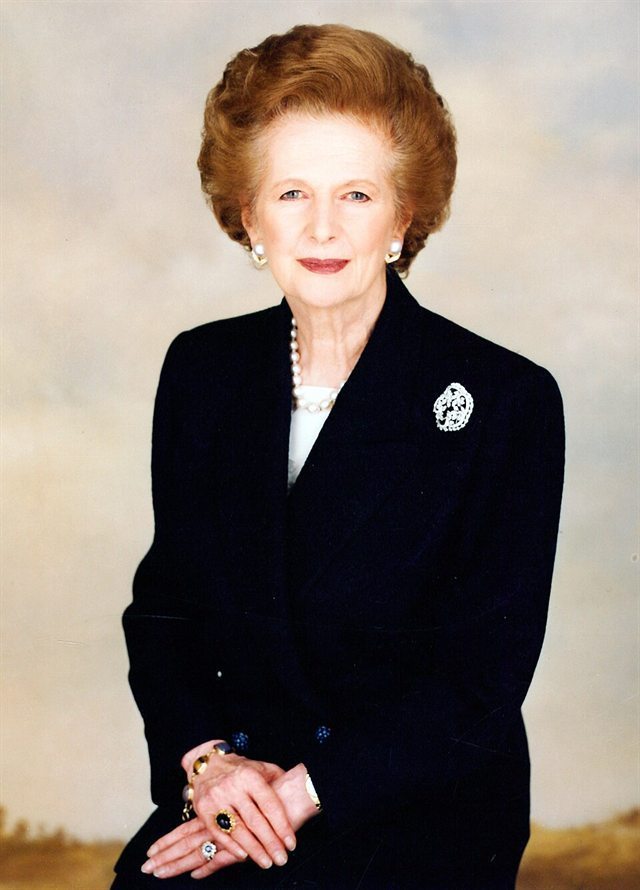
1925–2013
A grocer's daughter and research chemist who became Britain's first woman prime minister, and reshaped the country so thoroughly that the argument about her has never stopped.
Thatcher is the most divisive British political figure of the last century: revered for reversing national decline, blamed for destroying industrial communities. Both views draw on the same eleven years. These five chapters set out what she did, why she believed it was necessary, and what it cost — without pretending the verdict is settled.
The five chapters
- Above the Shop in Grantham — A Methodist upbringing and a chemistry degree
- Milk Snatcher to Party Leader — An unexpected challenge in 1975
- The Medicine and the Cost — Inflation, unemployment and the miners' strike
- The Falklands, the Cold War and South Africa — Abroad, where her judgement ran both ways
- The Poll Tax and the Fall — Removed by her own party
Chapter 1 · Above the Shop in Grantham
A Methodist upbringing and a chemistry degree
1925 – 1959 · Grantham · Oxford · Dartford
Margaret Hilda Roberts was born on 13 October 1925 above her father's grocer's shop in Grantham, Lincolnshire. Alfred Roberts was a Methodist lay preacher, an alderman and eventually mayor, and his daughter absorbed a specific creed: live within your means, work hard, take responsibility, and distrust anything got for nothing. She quoted him for the rest of her life. Her mother appears far less in her account, a silence biographers have noticed.
She won a place at Somerville College, Oxford, to read chemistry — an unusual subject for a woman in 1943 — and worked for a time in the laboratory of the crystallographer Dorothy Hodgkin. She then spent four years as an industrial research chemist, working on plastics and on food emulsifiers. The popular claim that she invented soft ice cream overstates a team effort, but the training was real: she thought in terms of evidence, method and stated results, and colleagues in politics noticed she mastered detail more thoroughly than most.
She was already political, chairing the Oxford University Conservative Association, and fought Dartford twice in 1950 and 1951 — losing both times but cutting the majority and gaining attention as the youngest woman candidate in the country. She married Denis Thatcher, a businessman whose money made her career financially possible, in 1951, had twins in 1953, and qualified as a barrister specialising in tax the same year.
She entered Parliament for Finchley in 1959.
Why this matters
Thatcher's scientific training and provincial nonconformist upbringing gave her a style unlike the patrician Conservatives who dominated her party: evidential, moralistic and impatient with consensus.
You have met the chemist before the politician. What would you ask her?
Ask Thatcher
- “What did your father actually teach you about money and duty?”
- “How did studying chemistry change the way you argued?”
- “What obstacles did you face as a woman seeking a seat in the 1950s?”
- “How did having twins affect your political ambitions?”
- “Why do you say so much less about your mother?”
Chapter 2 · Milk Snatcher to Party Leader
An unexpected challenge in 1975
1970 – 1979 · Westminster
As Education Secretary from 1970, Thatcher ended free milk for children over seven to protect the schools building budget. The tabloids named her Milk Snatcher and she later said the episode taught her she had incurred maximum political odium for minimum political benefit. Less remembered is that she approved more comprehensive schools than any other education secretary and expanded nursery provision.
The Conservative government of Edward Heath collapsed in 1974 after a miners' strike and a three-day week. In the aftermath Thatcher associated herself with Keith Joseph's argument that post-war Conservatism had accepted too much of the socialist settlement, and that inflation, not unemployment, was the enemy that government could actually control.
When Joseph disqualified himself with an ill-judged speech, she stood against Heath herself in 1975. Almost nobody expected her to win. She beat him on the first ballot and took the leadership — the first woman to lead a major British party.
Her years in opposition were spent building an argument. Monetarist economics, free markets, reduced union power, lower direct taxation and a robust anti-Soviet foreign policy — the last of which earned her the nickname the Iron Lady from a Soviet newspaper, which she immediately adopted as a compliment.
The Labour government's collapse during the strike-bound Winter of Discontent in 1978–79 handed her the election. She entered Downing Street on 4 May 1979.
Why this matters
Thatcher's leadership victory in 1975 marked a deliberate break with the post-war consensus that both main parties had shared since 1945 — a change of political direction, not just of personnel.
You have watched an outsider take a party. What would you ask her?
Ask Thatcher
- “What did the school milk row teach you about politics?”
- “Why did you think the post-war consensus had failed?”
- “How did you win a leadership contest nobody expected you to win?”
- “Why accept 'Iron Lady' as a compliment?”
- “How much did the Winter of Discontent decide the 1979 election?”
Chapter 3 · The Medicine and the Cost
Inflation, unemployment and the miners' strike
1979 – 1987 · Downing Street · Yorkshire · Nottinghamshire
Thatcher's first term was economically brutal. Interest rates and spending controls aimed at inflation, which fell from over twenty per cent in 1980 to around four per cent by 1983. Unemployment rose above three million, and much of Britain's manufacturing base closed. In 1981, 364 economists signed a letter arguing her policy had no basis in economic theory; she told her party conference that the lady was not for turning.
Privatisation was the second pillar, and it was genuinely new. British Telecom in 1984, British Gas in 1986, British Airways, water and electricity were sold to the public, with advertising campaigns encouraging first-time share ownership. The Right to Buy scheme let council tenants purchase their homes at a large discount, creating over a million new homeowners — and, because councils were restricted from spending the receipts on replacements, contributing to a long-term shortage of social housing. The Big Bang of 1986 deregulated the City and made London a global financial centre.
The miners' strike of 1984–85 was the decisive confrontation. Thatcher's government, having stockpiled coal, faced a National Union of Mineworkers led by Arthur Scargill, who called a national strike without a national ballot — a decision that split the union. The dispute lasted a year, involved violent clashes such as Orgreave, and ended in the miners' defeat. Pit closures followed, and communities built entirely around coal lost their economic reason to exist; some have never recovered. Supporters argue that uneconomic pits were closing anyway and that union power over elected governments had to end. Both things can be true, and the human cost is not disputed.
Why this matters
The economic transformation of the 1980s ended Britain's industrial economy and created its service and finance economy — the single most consequential domestic change in post-war British history.
You have the economic programme and its consequences. What would you ask her?
Ask Thatcher
- “Was mass unemployment a price worth paying to beat inflation?”
- “What did Right to Buy do to social housing in the long run?”
- “Did the miners have to be defeated so completely?”
- “What was privatisation actually meant to achieve?”
- “Why did you refuse to change course in 1981?”
Chapter 4 · The Falklands, the Cold War and South Africa
Abroad, where her judgement ran both ways
1982 – 1990 · The Falklands · Moscow · Brighton
In April 1982 Argentina's military junta invaded the Falkland Islands. Thatcher assembled a task force and sent it 8,000 miles. The islands were retaken in ten weeks; around 900 people died, including 323 aboard the Argentine cruiser *General Belgrano*, sunk outside the declared exclusion zone in a decision that remains contested. Victory transformed her standing and contributed to a landslide in 1983; it also helped bring down the junta and restore Argentine democracy.
On the Cold War she was hawkish and then unexpectedly pragmatic. She accepted American cruise missiles at Greenham Common, where a women's peace camp protested for nineteen years. In 1984 she met Mikhail Gorbachev before he became Soviet leader and concluded publicly that this was a man she could do business with — a judgement she pressed on Reagan, and one that helped open the diplomacy which ended the Cold War.
Ireland ran through the decade darkly. Ten republican prisoners died on hunger strike in 1981 after she refused political status. In October 1984 the IRA bombed the Grand Hotel in Brighton during the Conservative conference, killing five people and nearly killing her; she opened the conference on time that morning. In 1985 she signed the Anglo-Irish Agreement giving Dublin a consultative role in Northern Ireland, which unionists bitterly opposed.
On South Africa her record is hard to defend. She opposed comprehensive economic sanctions against the apartheid regime, arguing they would hurt Black South Africans most, and in 1987 described the ANC as a typical terrorist organisation. She did press P. W. Botha privately to release Nelson Mandela. Mandela, after his release, was gracious about her while noting their disagreement.
Why this matters
Thatcher's foreign record shows the same conviction producing opposite results: the early recognition of Gorbachev helped end the Cold War, while her stance on sanctions put Britain at odds with most of the world on apartheid.
You have the world stage. What would you ask her?
Ask Thatcher
- “How do you justify the sinking of the Belgrano?”
- “What made you decide Gorbachev was different?”
- “Why did you oppose sanctions against apartheid South Africa?”
- “Would you handle the 1981 hunger strikes the same way again?”
- “Why open the conference the morning after the Brighton bomb?”
Chapter 5 · The Poll Tax and the Fall
Removed by her own party
1988 – 1990 and after · Scotland · London · Westminster
The community charge, universally called the poll tax, replaced property-based local rates with a flat charge per adult. A duke and a cleaner in the same town would pay the same. Introduced in Scotland in 1989 and England and Wales in 1990, it was seen as plainly unfair, produced mass non-payment, and culminated in a riot in Trafalgar Square in March 1990.
Europe divided her party. Her Bruges speech of 1988 rejected what she called a European super-state, and her later refusal to contemplate closer integration alienated senior colleagues. In November 1990 her long-serving deputy Geoffrey Howe resigned and delivered a resignation speech comparing serving under her to being sent out to bat with a broken bat. Michael Heseltine challenged her; she led the first ballot but not decisively, and her Cabinet told her one by one that she would lose. She resigned on 28 November 1990, in tears in the car leaving Downing Street.
Section 28, her government's 1988 prohibition on local authorities 'promoting' homosexuality, remained law until 2003 and is remembered by LGBT Britons as one of the most damaging measures of the period.
She died on 8 April 2013. The reaction demonstrated the split: a ceremonial funeral at St Paul's attended by heads of state, and street parties in former mining towns.
Her deepest legacy may be that her successors accepted her settlement. Tony Blair's Labour governments retained privatisation, the union legislation and much of the tax framework. When a politician's opponents keep her policies, the argument about whether she was right is not over — but the argument about whether she changed things is.
Why this matters
Thatcher's fall shows a British prime minister removed not by voters but by her own party — and her policy settlement outlasted her by decades, which is the strongest evidence of her impact.
You have the fall and the long aftermath. What would you ask her?
Ask Thatcher
- “Why did you push the poll tax when the warnings were so clear?”
- “What did you fear about closer European integration?”
- “How does it feel to be removed by your own colleagues?”
- “What do you say to people harmed by Section 28?”
- “Does it prove you right that your opponents kept your policies?”
What Thatcher changed
Thatcher ended the post-war economic consensus in Britain: privatisation, restricted union power, mass home ownership and a deregulated financial sector all survived her by decades and were adopted by her opponents. Internationally, her early engagement with Gorbachev contributed to the diplomacy that ended the Cold War, and her example changed assumptions about who could lead a British party.
A debate that continues
The argument about Thatcher is unresolved and unusually raw: whether she rescued a failing economy at a necessary cost, or whether the destruction of industrial communities, the shortfall in social housing and the deregulation that preceded later financial crises outweigh the gains.
Keep exploring — ask Thatcher
- “What did being the only woman in the room actually change?”
- “Which of your decisions caused harm you did not anticipate?”
- “How do you answer people whose towns never recovered?”
Related lives
- Winston Churchill — Prime Minister of Great Britain
- Nelson Mandela — Madiba · Father of the Nation
- Emmeline Pankhurst — Deeds, Not Words
- Lee Kuan Yew — Founding Father of Singapore
Related themes
Post-war British politics · Privatisation and the market economy · The end of the Cold War
Continue on Incandio
- Talk to Thatcher — every question on this page is one tap from being asked, and the same page carries the Historical Brief, the achievements and the timeline
- All 280 figures · Incandio — learn every idea, teach it, then defend it