Explore Their Life · Pearson Edexcel International GCSE revision on Incandio
Florence Nightingale: A Life in Five Chapters
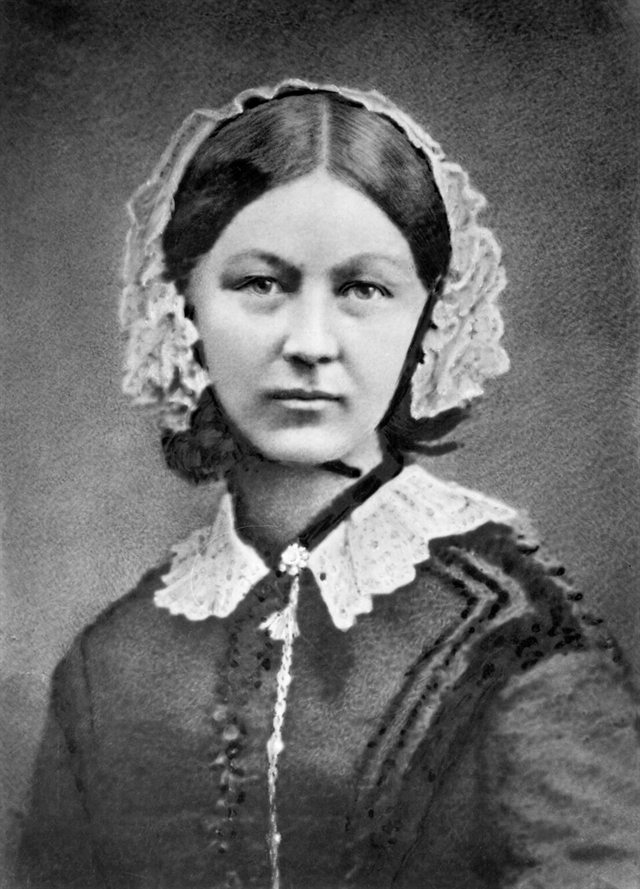
1820–1910
The reformer remembered as a lamp-carrying nurse, who was in fact a formidable statistician — and who used graphs to force an army to clean its hospitals.
Nightingale's real achievement was not comforting the wounded but proving, with data, that most of them died from preventable causes. She then spent fifty years, largely from a sickbed, using that evidence to reform army medicine, hospital design and nursing itself. These five chapters follow the argument as well as the lamp.
The five chapters
- The Daughter Who Would Not Marry — Wealth, mathematics, and sixteen years of refusal
- Scutari — What actually killed the soldiers
- The Rose Diagram — Winning an argument with a picture
- Fifty Years From a Sickbed — Chronic illness, and reform by correspondence
- The Lamp and the Ledger — What the icon leaves out
Chapter 1 · The Daughter Who Would Not Marry
Wealth, mathematics, and sixteen years of refusal
1820 – 1853 · Florence · Embley Park · Kaiserswerth
Florence Nightingale was born on 12 May 1820 in Florence, and named after the city, into a wealthy English family with reforming Unitarian connections. Her father, unusually, educated his daughters himself in Greek, Latin, philosophy, history and mathematics — the last of which she pressed to study further and eventually got a tutor for.
On 7 February 1837, aged sixteen, she recorded that God had spoken to her and called her to His service. She did not know for years what the service was.
When she concluded it was nursing, the family objected violently. Hospitals of the period were places the poor went to die, and nurses were widely assumed to be drunk or worse; for a woman of her class it was unthinkable. Her mother and sister opposed her for years, and the conflict was bitter.
She was courted for nine years by Richard Monckton Milnes, a poet and politician she liked and admired. She refused him, writing that she had a moral and active nature that would not be satisfied by his life, and that she would be starved to death by it.
In 1851, aged thirty-one, she finally obtained permission to spend three months at Kaiserswerth in Germany, a Protestant institution training deaconesses in nursing — the only formal training she ever received.
In 1853 she took an unpaid post running the Institute for the Care of Sick Gentlewomen in Harley Street, and reorganised it — piped hot water, a lift for meals, a bell system so patients could summon help — within a year.
Why this matters
Nightingale's mathematical education, unusual for a woman of her class, is what made her later work possible: she could analyse mortality data that professional doctors could not.
You have met the young woman fighting her family. What would you ask her?
Ask Florence
- “Why did your family object to nursing so strongly?”
- “What did you mean when you described a call?”
- “Why did you refuse Richard Monckton Milnes?”
- “How did you get permission to train at Kaiserswerth?”
- “What did you change at the Harley Street institute?”
Chapter 2 · Scutari
What actually killed the soldiers
1854 – 1856 · Scutari · Crimea
*The Times* reported in 1854 that British wounded in the Crimea were receiving worse care than the French. Sidney Herbert, the Secretary at War and a family friend, asked Nightingale to lead a party of nurses. She arrived at the Barrack Hospital at Scutari, near Constantinople, in November 1854 with thirty-eight women.
The conditions were catastrophic. The building sat on a broken sewer; the water supply was contaminated; there was no ventilation; men lay in their uniforms on floors covered in filth, with rats and lice. There were almost no basins, towels or soap.
She organised relentlessly — supplies, laundry, kitchens, record-keeping — and worked twenty-hour days, walking the wards at night with a lamp, which produced the image that made her famous. A *Times* correspondent described her as a ministering angel, and Longfellow's 1857 poem fixed the Lady with the Lamp in public memory.
The uncomfortable fact, which Nightingale herself established afterwards, is that mortality at Scutari rose during her first months and was worse than at other hospitals. She initially believed the problem was inadequate food and supplies. In March 1855 a government Sanitary Commission arrived, flushed out the sewers, removed a dead horse from the water supply and improved ventilation. Death rates then fell sharply.
She faced the evidence honestly. Her later analysis concluded that the great majority of deaths — she calculated around sixteen thousand of eighteen thousand — were caused not by wounds but by preventable disease: typhus, cholera, dysentery, spread by filth. That conclusion, drawn against her own earlier belief, became her life's work.
Why this matters
Nightingale's willingness to publish evidence that mortality rose under her own management is a striking case of a reformer following the data against her own reputation.
You have Scutari as it actually was. What would you ask her?
Ask Florence
- “What did you find when you arrived at Scutari?”
- “Why did mortality rise in your first months?”
- “What did the Sanitary Commission change?”
- “How did you come to change your mind about the cause?”
- “What did the lamp actually mean to the men?”
Chapter 3 · The Rose Diagram
Winning an argument with a picture
1856 – 1860 · London
Nightingale returned in 1856 a national heroine, and used the position immediately. She secured a private audience with Queen Victoria and pressed for a Royal Commission on the health of the army.
Women could not serve on it, so she wrote the evidence. Her contribution ran to over eight hundred pages of analysis, published in 1858, setting out mortality rates in army barracks in peacetime as well as war. Her finding was startling: soldiers in barracks in England died at nearly twice the rate of civilian men of the same age. Barracks were killing men who were not at war at all.
She knew that a table of figures would not move a committee, so she designed a picture. Her polar area diagram — often called the rose diagram or coxcomb — divides a circle into twelve wedges, one per month, with the area of each showing deaths, and colours distinguishing deaths from wounds, from preventable disease, and from other causes.
The blue area representing preventable disease overwhelms the rest at a glance. Nobody needed to read a table to see it.
It is among the earliest deliberate uses of statistical graphics for persuasion rather than record, and it worked: an Army Medical School was founded, barracks and hospitals were rebuilt with proper ventilation and drainage, and army mortality in peacetime fell substantially.
In 1858 she became the first woman elected a fellow of the Royal Statistical Society. She corresponded with the leading statisticians of the age and campaigned, unsuccessfully, for uniform hospital statistics so that institutions could be compared.
“To understand God's thoughts we must study statistics, for these are the measure of His purpose.”
— Attributed to Florence Nightingale, quoted by Karl Pearson in his life of Francis Galton, 1924
Why this matters
Nightingale's polar area diagram is a founding example of data visualisation used to change policy — the technique now standard in public health communication.
You have the statistics. What would you ask her?
Ask Florence
- “Why did soldiers in English barracks die faster than civilians?”
- “How does your rose diagram work?”
- “Why draw a picture instead of presenting a table?”
- “What changed as a result of the Royal Commission?”
- “Why did you want standard hospital statistics?”
Chapter 4 · Fifty Years From a Sickbed
Chronic illness, and reform by correspondence
1857 – 1900 · London · India
From 1857 Nightingale was chronically ill, and from around 1860 she was largely confined to her room, often bedridden, for decades. The most widely accepted diagnosis is brucellosis, a bacterial infection probably contracted in the Crimea, which causes recurring fever, joint pain and severe fatigue; depression and exhaustion very likely compounded it.
She turned the confinement into a method. She summoned ministers, generals and officials to her bedside one at a time, briefed them thoroughly, and followed up in writing. She produced an estimated fourteen thousand letters and around two hundred books, reports and pamphlets.
*Notes on Nursing* (1859) was written for ordinary women caring for family at home, and sold widely. Its principles — fresh air, light, warmth, cleanliness, quiet, proper diet, and careful observation of the patient — read as obvious now because she established them.
In 1860 the Nightingale Training School opened at St Thomas' Hospital, funded by a public subscription raised in her honour. It made nursing a trained profession with entry standards, records and a career, and its graduates founded schools across the world.
She also worked extensively on India, analysing mortality among British troops and then among the wider population, and campaigning on sanitation, irrigation and famine — without ever going there.
One episode should be noted. Mary Seacole, a Jamaican-born woman with considerable practical experience of treating cholera and yellow fever, applied to join Nightingale's nurses, was turned down, funded her own passage and ran the British Hotel near Balaclava, where she treated soldiers close to the front. Nightingale wrote dismissively of her in a private letter years afterwards. Seacole's contribution has been properly recognised only recently, and the two women's work should be understood as separate achievements rather than a competition.
Why this matters
Nightingale's Training School converted nursing from casual work into a trained profession with standards and records — the model on which modern nursing worldwide is built.
You have fifty years of work from one room. What would you ask her?
Ask Florence
- “How did you run reform campaigns from your bed?”
- “What was Notes on Nursing written for?”
- “What did the Training School change about nursing?”
- “Why did you turn down Mary Seacole?”
- “How did you work on India without going there?”
Chapter 5 · The Lamp and the Ledger
What the icon leaves out
1900 – 1910 and after
Nightingale lived to ninety, blind in her final years and increasingly withdrawn. In 1907 she became the first woman appointed to the Order of Merit. She died on 13 August 1910 and, following her instructions, declined a national funeral and burial in Westminster Abbey; she was buried in a Hampshire churchyard under a stone marked only with her initials and dates.
Her public image — the gentle lady with the lamp — is not false, but it is a small part of the story and, in a way she would have disliked, it has crowded out the rest. The lamp suggests comfort; her actual instrument was arithmetic. She was, by the assessment of modern statisticians, one of the most effective users of data for public persuasion in the nineteenth century.
Her reputation has also been examined more critically in recent decades. Historians have noted her early misdiagnosis of the Scutari crisis, her sometimes autocratic control of the nursing profession she created, her resistance to germ theory for longer than the evidence warranted, her imperial assumptions about India, and her treatment of Mary Seacole. None of this overturns the achievement; all of it makes her a more useful subject than a saint.
International Nurses Day falls on her birthday, and the Nightingale Pledge, written after her death, is still taken by nursing graduates in some countries. Hospital design, ward ventilation, infection control and the collection of health statistics all bear her mark.
What she demonstrated, in the end, is that compassion without evidence changes very little, and that the way to save lives at scale is to count carefully, publish, and refuse to stop asking.
Why this matters
Nightingale is the standard example of evidence-based reform: her lasting achievement came from counting deaths and publishing the results, not from bedside care alone.
You have the lamp and the ledger together. What would you ask her?
Ask Florence
- “How do you feel about being remembered for the lamp?”
- “Why did you refuse a national funeral?”
- “Why were you slow to accept germ theory?”
- “Did you control the nursing profession too tightly?”
- “What should a reformer do first — care or count?”
What Florence changed
Nightingale professionalised nursing through the training school at St Thomas', reformed army and civilian hospital sanitation on the basis of mortality statistics, and pioneered the use of statistical graphics to change public policy. Modern hospital ventilation, infection control and routine health statistics all descend from her work.
A debate that continues
Historians now examine her initial misdiagnosis of the Scutari crisis, her prolonged resistance to germ theory, her autocratic control of nursing and her dismissal of Mary Seacole — while continuing to regard her statistical reform work as her most important achievement.
Keep exploring — ask Florence
- “How do you persuade a government that does not want to be persuaded?”
- “What did you learn from being wrong about Scutari?”
- “What would you count first in a hospital today?”
Related lives
- Louis Pasteur — Father of Germ Theory
- Queen Victoria — Queen & Empress of India
- Alexander Fleming — Discoverer of Penicillin
Related themes
Public health and sanitation · Statistics and data visualisation · The Crimean War
Where Florence appears in your course
Florence Nightingale has a genuine claim on 3 lessons of the Pearson Edexcel International GCSE science course built into Incandio:
- A Balanced Diet — Biology: At Scutari, Nightingale rebuilt the hospital kitchens as deliberately as the wards, and she recorded the outcomes month by month in numbers nobody could argue with. She was making the argument this lesson makes — that a body which is not supplied properly cannot repair itself — at a time when diet was considered a comfort rather than a medical treatment.
- The Thorax and Ventilation — Biology: Nightingale made ventilation the first rule of nursing — windows open in every weather, air changed constantly, wards designed around the movement of air — and she backed it with mortality figures rather than opinion. She was wrong about why bad air was dangerous, since she rejected germ theory, but she was right that it was, and the wards she designed saved lives.
- Water Pollution and Eutrophication — Biology: Half of statement 4.16 is about pathogens in sewage causing disease, and Nightingale is the person who forced that connection into public policy. At Scutari she found that far more soldiers were dying of infectious disease than of wounds, and she proved it with data rather than assertion — inventing a diagram to display the causes of death month by month so that ministers who would not read a table could not miss the point. Her argument was about drains, water supply and ventilation, and it changed British hospitals permanently.
Debate Florence in the Agora
Reading is the start. On Incandio an idea counts as mastered only once you have argued it against the person with the strongest claim on it, in structured rounds marked against published descriptors.
- The Diagram That Moved a Government — “Nightingale's greatest contribution to public health was statistical, not nursing.”
Continue on Incandio
- Talk to Florence — every question on this page is one tap from being asked, and the same page carries the Historical Brief, the achievements and the timeline
- All 280 figures · Incandio — learn every idea, teach it, then defend it