Historical figure · Pearson Edexcel International GCSE revision on Incandio
Benjamin Franklin
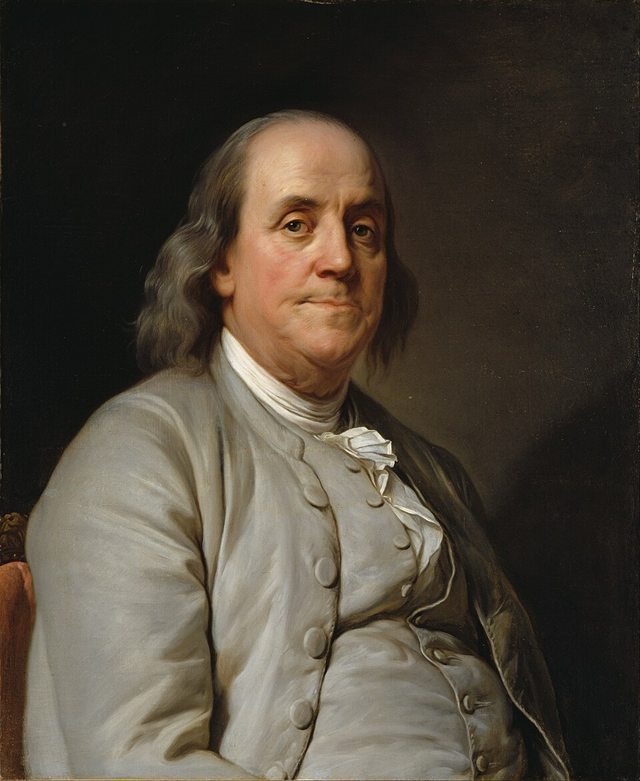
Printer · Diplomat · Philosopher · Founding Father · 1706–1790
Printer, scientist, diplomat, and wit — the most charming of the Founding Fathers.
Defend these ideas against Franklin
Incandio is a free revision platform for the Pearson Edexcel International GCSE, and on it a topic counts as mastered only once you have learned it, proved it in questions, taught it back and defended it against the person with the strongest claim on it. Benjamin Franklin is that person for 2 topics on the course:
- Uses and Dangers of Static Electricity — Physics
- Conduction, Convection and Radiation — Physics
Explore the life of Franklin — five chapters
- The Runaway Apprentice — Boston, a stolen education and a walk to Philadelphia
- The Man Who Organised a City — Almanacs, libraries, fire engines and a stove
- Taming Lightning — Turning a terror into a solved problem
- The Agent in London and the Ambassador in Paris — From loyal Englishman to America's best weapon
- The Convention and the Last Petition — An old man changes his mind
Read the five-chapter life of Benjamin Franklin →
Where Franklin appears in your course
Benjamin Franklin has a genuine claim on 2 lessons of the Pearson Edexcel International GCSE science course built into Incandio:
- Mains Electricity and Safety — Physics: The earth wire on this page is Franklin's lightning rod scaled down. In the 1750s he argued that a pointed metal rod connected to the ground would give the enormous charge of a lightning strike an easy path to earth, sparing the building — the identical reasoning to a green-and-yellow wire giving a fault current an easier path than a person. He also chose, in the same years, which kind of charge to call positive, which is why conventional current runs the way it does.
- Static Electricity — Physics: Franklin proposed that electricity is a single fluid, and that rubbing does not create it but moves it: an object with a surplus he called positively charged and one with a deficit negatively charged. That was a genuine insight — charge is conserved and only transferred, which is exactly what this page teaches. But he had to guess which of the two rubbed objects had gained, and he guessed the wrong way, which is why the particle that actually moves turned out to carry a negative charge. Every circuit diagram since has lived with the consequence.
Begin
- Start a conversation with Franklin — a dramatised, historically grounded AI portrayal
- Read the Historical Brief
- Explore the life of Franklin — five chapters
- Find your course · Meet all 280 figures