Pearson Edexcel International GCSE in Physics · 4PH1 · Free · no account needed
Static Electricity
Why rubbing two things together charges them both — and why only one kind of particle is ever responsible.
Topic 2 · Electricity — one of 9 lessons in this topic, and one of 65 in Physics.
This lesson ends with Charles-Augustin de Coulomb. Learn Static Electricity, teach it, then defend it against Charles-Augustin de Coulomb.
The 2 definitions this lesson teaches, word for word — every Physics definition.
- Electrostatic charging
- The transfer of electrons from one insulating object to another, usually by friction, leaving one negatively charged and the other equally positively charged.
- The law of electrostatic force
- Like charges repel and unlike charges attract. The force acts at a distance and becomes stronger as the charged objects are brought closer together.
One of the 17 Physics required practicals.
What this lesson covers in the specification
Incandio is aligned to this specification. It is not published by, endorsed by or affiliated with Pearson, and it reproduces none of Pearson's wording — the statement numbers are given so you can check every lesson against your own copy.
- 2.22 — Identify common electrical conductors and insulators (bold P statement — Paper 2 only)
- 2.23 — Practical: investigate how insulating materials can be charged by friction (bold P statement — Paper 2 only) (required practical)
- 2.24 — How electrostatic charges are produced by the loss and gain of electrons (bold P statement — Paper 2 only)
- 2.25 — Attraction between unlike charges and repulsion between like charges (bold P statement — Paper 2 only)
1 · Understand it
No exam language yet. The only question this section answers is: do I actually understand what is happening?
Every material contains equal numbers of protons and electrons, so ordinarily it is neutral. The protons sit locked inside nuclei and cannot go anywhere at all. The electrons, on the outside of each atom, sometimes can. That asymmetry is the whole of static electricity: whenever anything becomes charged, it is because ELECTRONS have moved, and nothing else ever does.
Follow the consequence carefully, because it is the point most answers get wrong. If an object becomes NEGATIVELY charged, it has GAINED electrons. If it becomes POSITIVELY charged, it has LOST electrons — it has not gained anything. A positive charge is an absence. Writing that a rod 'gained protons' or 'gained positive charges' describes something that does not happen, and it is the most reliably penalised sentence in this topic.
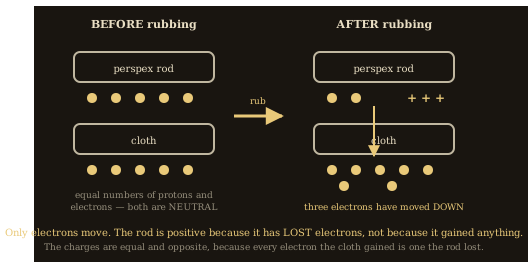
Charging by friction, one step at a time
- Both objects start NEUTRAL, with equal numbers of protons and electrons.
- They are rubbed together. FRICTION transfers some electrons from one surface to the other; which way they go depends on the two materials.
- The object that GAINED electrons now has more electrons than protons, so it is NEGATIVELY charged.
- The object that LOST electrons now has fewer electrons than protons, so it is POSITIVELY charged.
- The two charges are EQUAL IN SIZE and OPPOSITE, because every electron one gained is one the other lost. Charge is conserved.
- This only works for INSULATORS. On a conductor the charge would immediately spread out and flow away to earth through your hand.
That last point is statement 2.22 doing real work rather than being a list to memorise. A CONDUCTOR contains charges that are free to move — the delocalised electrons of a metal, or the ions in a solution — so any charge placed on it spreads over the surface and leaks away. An INSULATOR has no free charges, so electrons transferred onto it stay where they were put. This is why you can charge a plastic comb or a perspex rod by rubbing it, and why rubbing a metal rod held in your hand achieves nothing whatever.
Metals are the conductors you will be asked for — copper, aluminium, steel, and graphite, which is the one non-metal that conducts. Insulators are plastics, rubber, glass, dry wood, perspex, polythene and dry air. Water is worth a note: pure water is a poor conductor, but ordinary water contains dissolved ions and conducts well enough to be dangerous, which is why electricity and wet hands do not mix.
Think of it like shuffling across a carpet with your hands full
Imagine carrying a stack of loose papers while walking across a room, and some blow off onto the floor as you go. You end up short of papers and the floor ends up with extra ones — and nobody made any papers or destroyed any. If you are wearing gloves that grip, the papers you are left holding stay put. If your hands were wet and slippery, they would slide off immediately and you would end up with a normal-looking stack again. The papers are the electrons, the gripping gloves are an insulator, and the slippery hands are a conductor connected to earth. Nothing is created; something is redistributed, and whether it stays redistributed depends on the material.
Charged objects then exert forces on one another, and the rule is short: LIKE CHARGES REPEL, UNLIKE CHARGES ATTRACT. Two negatively charged rods push apart, two positive ones push apart, and a positive and a negative attract. These forces act at a distance, with nothing in between, and they get stronger as the objects get closer.
There is a third case that looks like an exception and is not: a charged object attracts UNCHARGED objects too, which is why a rubbed balloon sticks to a wall and a charged rod picks up small pieces of paper. The charged object repels like charges within the neutral object to its far side and attracts unlike charges to its near side. The near side is now slightly opposite in charge and closer, so the attraction beats the repulsion and the whole thing is pulled in. The neutral object is still neutral overall — the charge inside it has merely shifted.
2 · Grade 9 Notes
A different job from the section above. You have already understood it; this is the precise set of things to LEARN — definitions to reproduce word for word, processes in order, equations with units, and the answers that score full marks.
Learn this definition · Electrostatic charging
The transfer of electrons from one insulating object to another, usually by friction, leaving one negatively charged and the other equally positively charged.
Statement 2.24 — the rule, and the sentence that loses the mark
- ONLY ELECTRONS MOVE. Protons are held in nuclei and never transfer between objects
- GAINED electrons → NEGATIVELY charged
- LOST electrons → POSITIVELY charged. A positive charge is an ABSENCE of electrons, not an arrival of anything
- The two objects always end up with EQUAL AND OPPOSITE charges, because charge is conserved
- NEVER write 'gained protons' or 'gained positive charge' — protons do not move between objects
Statement 2.22 — conductors and insulators
| Conductor | Insulator | |
|---|---|---|
| Charges inside | free to move — delocalised electrons, or ions in solution | not free to move; they stay where they are |
| Examples | copper, aluminium, steel, graphite, salt solution | plastic, rubber, glass, perspex, polythene, dry wood, dry air |
| Can it be charged by rubbing? | not while it is held — the charge spreads and leaks to earth | yes — the transferred electrons stay where they were put |
| What it is used for | wires, contacts and earthing paths | cable coverings, plug casings and handles |
Required practical 2.23 — charging insulating materials by friction
- Suspend a polythene rod horizontally in a paper stirrup hung from a thread, so that it can turn freely.
- Rub a second polythene rod with a dry woollen cloth and bring it near one end of the suspended rod, without touching it.
- Observe the direction in which the suspended rod turns, and record whether it was attracted or repelled.
- Repeat with a perspex rod rubbed with the same cloth, brought near the same charged polythene rod.
- Repeat each observation at least twice to check that the result is consistent.
- Conclude from the pattern: two rods of the same material rubbed the same way repel, and rods of different materials attract.
Variables
Independent (changed) — The material of the rod brought near the suspended rod
Dependent (measured) — Whether the suspended rod is attracted or repelled
| Control variable | Why it must be held constant |
|---|---|
| The suspended rod | a different rod may carry a different charge |
| The rubbing cloth | a different material transfers electrons the other way |
| Number of rubbing strokes | more rubbing transfers more electrons |
| Humidity of the air | damp air lets the charge leak away |
Sources of error
| Type | What goes wrong | What to do |
|---|---|---|
| Systematic | Damp air or damp hands let charge leak away, so every result is weaker than it should be. | Work on a dry day with dry, clean apparatus. |
| Judgement | A small movement of the suspended rod is hard to read as attraction or repulsion. | Watch the first movement only, before it swings back. |
| Random | Draughts move the suspended rod independently of any electrostatic force. | Shield the apparatus from air currents. |
Learn this definition · The law of electrostatic force
Like charges repel and unlike charges attract. The force acts at a distance and becomes stronger as the charged objects are brought closer together.
Explaining why a charged rod attracts an uncharged object
- The charged rod repels the like charges within the neutral object, pushing them to its far side.
- It attracts the unlike charges within the object, drawing them to its near side.
- The near side is therefore oppositely charged to the rod, and is closer to it than the far side.
- Because the force is stronger at shorter distances, the attraction of the near side outweighs the repulsion of the far side.
- The object is pulled towards the rod, even though it is still neutral overall.
Model answer [4 marks]
A polythene rod is rubbed with a dry cloth and becomes negatively charged. Explain what has happened to the rod and to the cloth. [4]
Friction between the rod and the cloth has transferred electrons from the cloth to the rod. The rod now has more electrons than protons, so it has a negative charge. The cloth has lost the same number of electrons, so it now has fewer electrons than protons and carries an equal positive charge. No protons have moved and no charge has been created — the charges are equal and opposite because the electrons the rod gained are exactly those the cloth lost.
Model answer [3 marks]
Explain why a metal rod held in the hand cannot be charged by rubbing it. [3]
A metal is a conductor, so it contains electrons that are free to move through it. Any charge transferred to it by rubbing does not stay where it was put but spreads out over the whole rod. Because the rod is held in the hand, and a person is a reasonable conductor connected to earth, that charge then flows away to earth, so the rod does not remain charged.
Not this: A positively charged object has gained protons, or gained positive charges.
This: Protons are held inside nuclei and never move between objects. A positive charge means electrons have been LOST, so there are now fewer electrons than protons. Positive charge is an absence, not an arrival.
Mark-losing trap. Only ELECTRONS move. Never write that protons or positive charges have transferred.
Mark-losing trap. Positive = LOST electrons. Negative = GAINED electrons. Say which, every time.
Mark-losing trap. The two objects end up with EQUAL AND OPPOSITE charges, because charge is conserved.
Mark-losing trap. Only INSULATORS can be charged by rubbing while held — a conductor leaks the charge to earth.
3 · Prove it — the five questions
The five questions climb Grade 6 → Grade 7 → Grade 8 → Grade 9 → Grade 9 challenge, and are marked inside Incandio on your own device, by rule, with an authored diagnosis of the mistake you actually made. The mark schemes stay in the app so that the practice is worth doing; the questions themselves are here.
- Grade 6 · State [1 mark] — A perspex rod becomes positively charged when it is rubbed with a cloth. What has happened to the rod?
- Grade 7 · State [2 marks] — Two polythene rods are each rubbed with the same cloth and brought near each other. What happens, and why?
- Grade 8 · Explain [5 marks] — A polythene rod is rubbed with a dry cloth and becomes negatively charged. Select every statement that belongs in a full-mark explanation of what has happened to both the rod and the cloth.
- Grade 9 · Explain [5 marks] — A charged plastic rod is held near small pieces of uncharged paper, and the paper is attracted to it. Select every statement that belongs in a full-mark explanation.
- 9+ · Analyse [6 marks] — A student rubs a copper rod with a cloth while holding it in their hand, tests it, and finds no charge. They conclude: 'Copper cannot be charged.' Select every statement that belongs in a full-mark analysis.
The people behind this science
Two ways into the same idea — the one who decided which charge to call positive, and chose wrongly, and the one who proved charge is only ever moved, never made. Inside Incandio each of them answers knowing exactly which lesson you have just finished.
Benjamin Franklin — the one who decided which charge to call positive, and chose wrongly
Franklin proposed that electricity is a single fluid, and that rubbing does not create it but moves it: an object with a surplus he called positively charged and one with a deficit negatively charged. That was a genuine insight — charge is conserved and only transferred, which is exactly what this page teaches. But he had to guess which of the two rubbed objects had gained, and he guessed the wrong way, which is why the particle that actually moves turned out to carry a negative charge. Every circuit diagram since has lived with the consequence.
- “What made you think electricity was moved rather than created?”
- “How did you choose which kind of charge to call positive?”
- “What did you mean by calling electricity a single fluid?”
- “How would you have felt about the electron being found to be negative?”
- “Why do two rods rubbed the same way push each other apart?”
Michael Faraday — the one who proved charge is only ever moved, never made
In 1843 Faraday lowered a charged ball into a metal ice pail connected to a detector and found that the charge induced on the outside of the pail exactly matched the charge on the ball — and that once the ball touched the inside, all of its charge transferred to the outer surface, leaving the ball with none at all. That is the conservation of charge demonstrated directly, and it also shows that charge on a conductor lives entirely on its outside, which is the principle behind the shielding on the next page.
- “What did the ice-pail experiment actually show?”
- “Why does charge on a conductor sit on the outside surface?”
- “How can you prove that no charge is created when things are rubbed?”
- “Why does a charged object attract something that is not charged at all?”
- “What is happening in the space between two charged objects?”
Think you understand it?
Reading is the start. On Incandio a topic counts as mastered only once you have taught it and defended it — the two things a revision guide cannot ask of you.
Incandio this topic → Prove it. Teach it. Defend it. What does “Incandio it” mean?
- Prove it — five questions on Static Electricity, marked on the spot, that tell you what was missing rather than just what was wrong.
- Teach it — Explain Static Electricity in your own words to Ember, an AI pupil who does not have it yet and asks the awkward question. Understanding is credited; wording is not required.
- Defend it — Argue Static Electricity against Charles-Augustin de Coulomb — three rounds, marked against descriptors you can read before you begin.
- Then the exam — read all 12 authored exam-style questions on this unit, each with its command word and its tariff, then have them marked on Incandio with the mistake you actually made named.
Completely free. No subscriptions, no paywalls, no account needed to start.
Carry on through the course
- Previous lesson: Mains Electricity and Safety
- Next lesson: Uses and Dangers of Static Electricity
- Charge and Current — What is actually moving in a wire, how fast it is really going, and why the arrows on every circuit diagram point the wrong way.
- Resistance and Ohm's Law — What slows the electrons down, the one equation that ties the whole topic together, and when it stops being true.
- Series and Parallel Circuits — Two ways of joining components, and why every building in the world is wired one of them.
- Current–Voltage Graphs, LDRs and Thermistors — The shapes four components make on a graph, and two resistors that deliberately refuse to stay the same.
- Voltage as Energy per Charge — What a volt actually is — and why knowing that turns three separate equations into one idea.
- All of Physics · Physics key terms · required practicals · equations · Incandio Science · The 4PH1 specification