Explore Their Life · Pearson Edexcel International GCSE revision on Incandio
Benjamin Franklin: A Life in Five Chapters
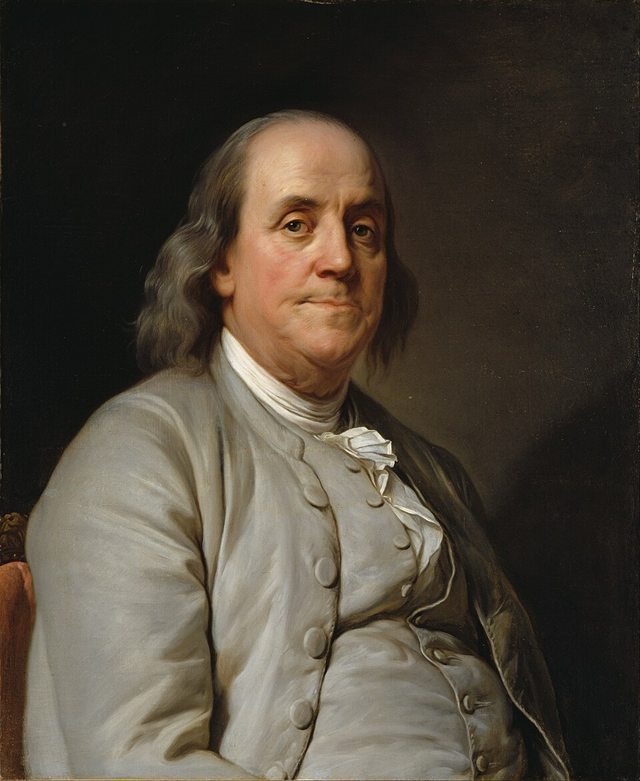
1706–1790
A candlemaker's son who made himself a printer, a scientist, a diplomat and, at eighty-one, one of the architects of the United States.
Franklin had no formal education after the age of ten. He became the most famous American in the world by being useful: inventing, organising, experimenting, negotiating and writing better than almost anyone alive. These five chapters follow a life of deliberate self-improvement — including a late and incomplete reckoning with slavery.
The five chapters
- The Runaway Apprentice — Boston, a stolen education and a walk to Philadelphia
- The Man Who Organised a City — Almanacs, libraries, fire engines and a stove
- Taming Lightning — Turning a terror into a solved problem
- The Agent in London and the Ambassador in Paris — From loyal Englishman to America's best weapon
- The Convention and the Last Petition — An old man changes his mind
Chapter 1 · The Runaway Apprentice
Boston, a stolen education and a walk to Philadelphia
1706 – 1730 · Boston · Philadelphia · London
Benjamin Franklin was born in Boston on 17 January 1706, the fifteenth of his father's seventeen children. Josiah Franklin made candles and soap and could afford only two years of schooling for a son with no inheritance coming. At twelve Benjamin was apprenticed to his older brother James, a printer — the luckiest bad job in American history, because a print shop was a room full of books.
He educated himself with a method he later described in detail: taking essays from *The Spectator*, rewriting them from memory, then comparing his version with the original to find his own weaknesses. At sixteen, forbidden to write for James's newspaper, he slid letters under the door signed 'Silence Dogood', a middle-aged widow whose sharp opinions on marriage, education and religious hypocrisy delighted Boston. James printed fourteen of them before discovering his brother was the author.
The apprenticeship ended in quarrels and, in 1723, Franklin ran away — a breach of contract that made him, technically, a fugitive. He arrived in Philadelphia at seventeen with almost nothing, was talked into a trip to London by a governor whose promised letters of credit never existed, worked as a printer there for eighteen months, and came home wiser about trusting powerful men.
By 1729 he owned the *Pennsylvania Gazette*. In 1730 he entered a common-law marriage with Deborah Read, whom he had first met on his first day in the city.
Why this matters
Franklin's self-education became a template for the American idea that a person's origins need not fix their future — an idea he actively promoted through his own published account of it.
You have met the runaway who taught himself to write. What would you ask him about those early years?
Ask Franklin
- “How exactly did you teach yourself to write well without a teacher?”
- “Why did you invent Silence Dogood instead of writing under your own name?”
- “Was running away from your apprenticeship a betrayal of your brother?”
- “What did being stranded in London at eighteen teach you?”
- “Why did printing turn out to be the ideal trade for you?”
Chapter 2 · The Man Who Organised a City
Almanacs, libraries, fire engines and a stove
1727 – 1752 · Philadelphia
Franklin's genius was for institutions. In 1727 he formed the Junto, a club of tradesmen who met weekly to debate and to help each other improve. Out of it came a chain of practical inventions in civic life: America's first subscription library in 1731, a volunteer fire company in 1736, a fire insurance scheme, a city police watch, a hospital in 1751, an academy that became the University of Pennsylvania, and the American Philosophical Society.
*Poor Richard's Almanack*, published annually from 1732, made him rich. Beneath the weather forecasts and tide tables ran the proverbs on thrift and industry that shaped how Americans talked about work for two centuries. It sold around ten thousand copies a year in a small colonial market.
He never patented an invention. The Franklin stove, designed to heat a room with less fuel, the flexible urinary catheter he made for his brother, bifocal spectacles and the glass armonica were all given away freely, on the principle — which he stated plainly — that since we benefit constantly from others' inventions, we should be glad to serve others with our own.
By 1748, aged forty-two, he had made enough money to retire from business and hand the shop to a partner. He did not retire to rest. He retired, as he put it, to have time for study and experiment — and turned to the strangest force known to science.
Why this matters
Franklin's civic inventions show a distinctive idea of citizenship: that ordinary people, organised voluntarily, could supply the public services a distant government would not.
You have seen a city rebuilt by clubs and subscriptions. What would you ask him about it?
Ask Franklin
- “Why did you refuse to patent any of your inventions?”
- “What was the Junto actually for?”
- “Did you really live by the maxims in Poor Richard's Almanack?”
- “Why start a subscription library rather than simply buy your own books?”
- “What made you decide to stop making money at forty-two?”
Chapter 3 · Taming Lightning
Turning a terror into a solved problem
1746 – 1760 · Philadelphia · London · Paris
Electricity in the 1740s was a parlour amusement — sparks, shocks and tricks. Franklin studied it systematically and produced the theory that reorganised the field: electricity is a single fluid, not two, and objects carry an excess or a deficiency of it. He coined the terms still in use — positive and negative charge, conductor, battery, condenser — and formulated the conservation of charge.
His boldest proposal was that lightning was the same phenomenon on an enormous scale. He designed an experiment using a sentry box and a tall iron rod to draw charge from a storm cloud, published it in 1751, and French experimenters carried it out successfully at Marly in May 1752. The famous kite experiment is Franklin's own later account, written up by Joseph Priestley in 1767; some historians question its details, and the version in which he casually risks electrocution is certainly dramatised.
The result was not a curiosity but a life-saving device. The lightning rod, mounted above a building and earthed, gave the charge a safe path and stopped churches and powder magazines from burning. It was among the first times a scientific theory had visibly protected ordinary people, and it made Franklin famous across Europe. The Royal Society awarded him its Copley Medal in 1753.
He applied the same curiosity elsewhere, charting the Gulf Stream to explain why some Atlantic crossings ran faster than others, and studying storm paths, ship design and the common cold.
Why this matters
The lightning rod was the first widely adopted technology derived from a scientific theory of electricity — proof that understanding nature could directly reduce human suffering.
You have seen lightning turned into a solved engineering problem. What would you ask him about the science?
Ask Franklin
- “How did you work out that lightning and laboratory sparks were the same thing?”
- “How much of the kite story is accurate?”
- “Why did some clergy object to lightning rods?”
- “Where did the words 'positive' and 'negative' charge come from?”
- “What did mapping the Gulf Stream change for sailors?”
Chapter 4 · The Agent in London and the Ambassador in Paris
From loyal Englishman to America's best weapon
1757 – 1785 · London · Philadelphia · Passy
Franklin spent most of the years between 1757 and 1775 in London, representing Pennsylvania and then several colonies. He wanted reconciliation, arguing for years that Britain and America could share one empire on equal terms; his testimony to Parliament in 1766 helped get the Stamp Act repealed.
His conversion was public and humiliating. In January 1774, after he leaked private letters showing a royal governor urging that colonial liberties be curtailed, he was summoned to the Privy Council chamber known as the Cockpit and denounced for nearly an hour while the assembled gentlemen laughed. He stood silent throughout. He returned to America in 1775 committed to independence — a break that also destroyed his relationship with his son William, the loyalist governor of New Jersey, whom he never forgave.
At seventy, he sailed for France as the new republic's envoy. There he performed America brilliantly: plain brown coat, fur cap, no wig, the rustic philosopher of the New World among powdered aristocrats. Behind the performance he ran a demanding negotiation, and in 1778 secured the treaty of alliance that brought French money, troops and — decisively — the navy that trapped Cornwallis at Yorktown.
In 1783 he was one of the negotiators of the Treaty of Paris, which recognised American independence on generous terms.
Why this matters
The French alliance was the single most important diplomatic achievement of the Revolution, and it rested on Franklin's ability to make a rebellion look respectable to a monarchy.
You have watched a loyal subject become a revolutionary diplomat. What would you ask him?
Ask Franklin
- “What did the humiliation in the Cockpit change in you?”
- “Could Britain and America really have stayed one empire?”
- “Why did you dress as a backwoods philosopher at the French court?”
- “How did you persuade a monarchy to bankroll a republican revolution?”
- “Was breaking with your son William worth the cost?”
Chapter 5 · The Convention and the Last Petition
An old man changes his mind
1785 – 1790 and after · Philadelphia
Franklin returned home in 1785 and, at eighty-one, sat as the oldest delegate to the Constitutional Convention. He spoke rarely and was often carried in a sedan chair, but his interventions mattered: he pushed for compromise when the small and large states deadlocked, and at the close he asked delegates who still had doubts to doubt a little of their own infallibility and sign.
His final campaign was against slavery — a cause he came to late, having earlier enslaved household servants himself and carried advertisements for slave sales in his newspaper. His views shifted over decades, influenced partly by visiting a Philadelphia school for Black children and concluding that the assumption of inferior capacity was false. In 1787 he accepted the presidency of the Pennsylvania Abolition Society, and in February 1790 he signed its petition asking Congress to end the slave trade and to consider emancipation. Congress refused to act, holding that the Constitution barred it from touching the trade before 1808. Franklin's last published piece, weeks before his death, was a satire in which a fictional North African official defends the enslavement of Christians using exactly the arguments American slaveholders used — a demolition by mirror.
He died on 17 April 1790, aged eighty-four. About twenty thousand people are reported to have attended the funeral. His *Autobiography*, unfinished, became one of the most widely read books of self-improvement ever written.
Why this matters
Franklin's late abolitionism is important precisely because it was late: it shows that people in his own century could and did change their minds about slavery, which weakens the excuse that no one knew better.
You have reached the end of a very long life of usefulness. What would you ask him last?
Ask Franklin
- “What changed your mind about slavery after you had participated in it?”
- “Why did you ask the delegates to doubt their own certainty?”
- “What were you trying to prove with your final satire about enslaved Christians?”
- “Which parts of your Autobiography left things out on purpose?”
- “Of everything you made, what do you think served people best?”
What Franklin changed
Franklin is the only person who signed the Declaration of Independence, the Treaty of Alliance with France, the Treaty of Paris and the Constitution. Alongside that, his theory of electrical charge, the lightning rod, and the model of voluntary civic institutions — libraries, fire companies, hospitals, learned societies — shaped both science and everyday life on two continents.
A debate that continues
Historians debate how much Franklin's folksy public persona was an accurate self-portrait and how much a calculated tool, and how to weigh his decades of complicity in slavery against his final years of abolitionist work.
Keep exploring — ask Franklin
- “How did being a printer shape the way you argued in politics?”
- “What did you get wrong that you later had to unlearn?”
- “Which of your public institutions are you proudest of?”
Related lives
- George Washington — Commander-in-Chief · First President
- Thomas Jefferson — Author of the Declaration · Third President
- Voltaire — Philosophe · Voice of the Enlightenment
Related themes
The American Revolution · The Enlightenment · Early electrical science
Where Franklin appears in your course
Benjamin Franklin has a genuine claim on 2 lessons of the Pearson Edexcel International GCSE science course built into Incandio:
- Mains Electricity and Safety — Physics: The earth wire on this page is Franklin's lightning rod scaled down. In the 1750s he argued that a pointed metal rod connected to the ground would give the enormous charge of a lightning strike an easy path to earth, sparing the building — the identical reasoning to a green-and-yellow wire giving a fault current an easier path than a person. He also chose, in the same years, which kind of charge to call positive, which is why conventional current runs the way it does.
- Static Electricity — Physics: Franklin proposed that electricity is a single fluid, and that rubbing does not create it but moves it: an object with a surplus he called positively charged and one with a deficit negatively charged. That was a genuine insight — charge is conserved and only transferred, which is exactly what this page teaches. But he had to guess which of the two rubbed objects had gained, and he guessed the wrong way, which is why the particle that actually moves turned out to carry a negative charge. Every circuit diagram since has lived with the consequence.
Continue on Incandio
- Talk to Franklin — every question on this page is one tap from being asked, and the same page carries the Historical Brief, the achievements and the timeline
- All 280 figures · Incandio — learn every idea, teach it, then defend it