Historical figure · Pearson Edexcel International GCSE revision on Incandio
Joseph Priestley
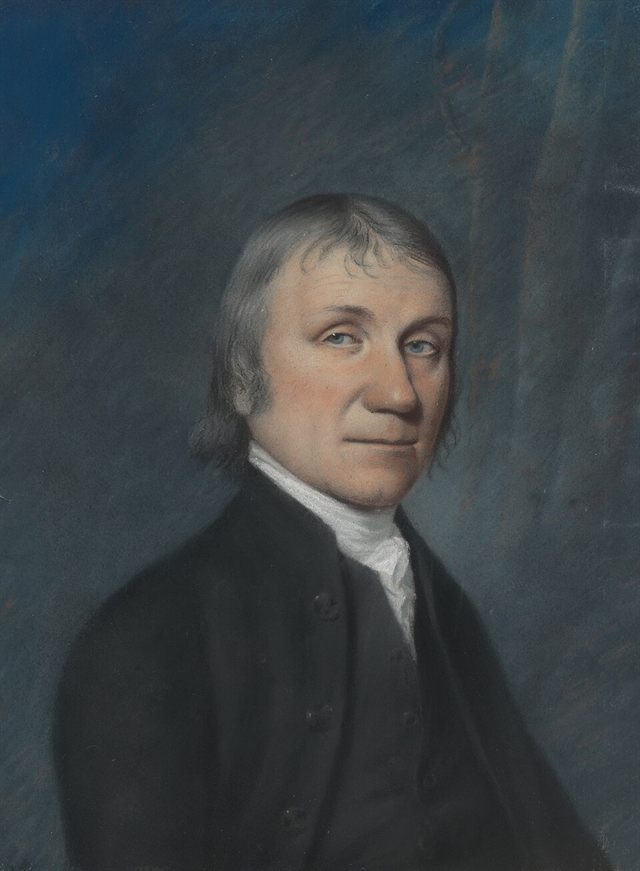
Discoverer of Dephlogisticated Air · Chemist & Dissenting Minister · 1733–1804
The Dissenting minister who isolated oxygen, discovered that a plant can restore air a candle has spoiled, and refused to the end the theory that explained them both.
Defend these ideas against Priestley
Incandio is a free revision platform for the Pearson Edexcel International GCSE, and on it a topic counts as mastered only once you have learned it, proved it in questions, taught it back and defended it against the person with the strongest claim on it. Joseph Priestley is that person for 5 topics on the course:
- Photosynthesis — Biology
- Global Warming and Deforestation — Biology
- The Gases in the Air — Chemistry
- The Reactions of Acids — Chemistry
- Tests for Gases, and for Water — Chemistry
Who was Priestley?
Joseph Priestley was born near Leeds in 1733 and spent his life as a Dissenting minister, schoolmaster and controversialist, with natural philosophy as a hobby he could not put down. Living next to a brewery in Leeds, he became interested in the heavy air lying over the fermenting vats, and from playing with it produced carbonated water, for which the Royal Society gave him its Copley Medal and nobody gave him any money. He went on to isolate an extraordinary series of new gases — ammonia, sulphur dioxide, nitrous oxide, hydrogen chloride, carbon monoxide — and on 1 August 1774, focusing a burning lens on red calx of mercury, obtained an air in which a candle burned with startling brightness and a mouse lived far longer than it should. He called it dephlogisticated air; Lavoisier, to whom Priestley described it over dinner in Paris that autumn, understood it better and named it oxygen. Three years earlier Priestley had put a sprig of mint into a jar of air a candle had spoiled and found, days later, that a candle would burn in it again. He could not make the result repeat reliably and never learned why. A Unitarian who denied the Trinity and defended the American and French revolutions, he had his house, library and laboratory burned by a Birmingham mob in July 1791, and emigrated to Pennsylvania in 1794.
Major achievements
- Isolated oxygen — his 'dephlogisticated air' — on 1 August 1774
- Discovered that a plant can restore air spoiled by a candle or a mouse
- Isolated ammonia, sulphur dioxide, nitrous oxide, hydrogen chloride and carbon monoxide
- Invented carbonated water, and won the Copley Medal for it
- Wrote the standard history of electricity, at Franklin's urging
Life in brief
- 1733 — Born near Leeds: Into a Dissenting family of cloth-dressers.
- 1767 — History of Electricity: Written at Franklin's encouragement.
- 1772 — Carbonated water and the Copley Medal: From the airs above a brewery vat.
- 1771 — The mint in the spoiled jar: A plant restores air a candle has ruined.
- 1774 — Dephlogisticated air: 1 August — a burning lens on red calx of mercury.
- 1780 — Moves to Birmingham: And joins the Lunar Society.
- 1791 — House burned by a mob: Library and laboratory destroyed in the Birmingham riots.
- 1794 — Emigrates to Pennsylvania: Where he died in 1804, still defending phlogiston.
Explore the life of Priestley — five chapters
- Barred From the Universities — A Dissenting academy, and an education better than Oxford's
- The Air Over the Brewery Vats — Carbonated water, and a career in gases
- The Mint in the Spoiled Jar — 1771, and a result he could not repeat
- 1 August 1774 — Discovering oxygen and calling it something else
- The Mob at the Door — July 1791, and a life burned in a night
Read the five-chapter life of Joseph Priestley →
Where Priestley appears in your course
Joseph Priestley has a genuine claim on 8 lessons of the Pearson Edexcel International GCSE science course built into Incandio. Six of them:
- Photosynthesis — Biology: Every claim on this page rests on plants doing something to the air, and Priestley supplied the first evidence that they do. In 1771 he burned a candle in a sealed jar until it went out, put a sprig of mint into the spoiled air, and found days later that a candle would burn in it again. He had no idea what had happened — he thought in terms of phlogiston to the end of his life and rejected Lavoisier's explanation of his own discovery. What he had was the observation that a plant restores something a flame destroys, which is where this entire subject begins.
- Seeds and Germination — Biology: The claim on this page that a germinating seed consumes oxygen and releases carbon dioxide can be demonstrated with Priestley's own apparatus and nothing else. He was the first to show that a living thing in a sealed jar changes the air in it — a mouse or a candle spoils it, a growing plant in the right conditions restores it. He also never managed to make the plant experiment work reliably, and the reason is on this page: he had not separated light from darkness, and a plant in the dark behaves exactly like the mouse.
- The Carbon and Nitrogen Cycles — Biology: The carbon cycle claims that plants take carbon dioxide out of the air while everything else puts it back, and Priestley produced the first evidence that any such exchange occurs. In 1771 he burned a candle in a sealed jar until it went out, put a sprig of mint into the spoiled air, and found days later that a candle would burn in it again. He had demonstrated one complete loop of the cycle in a single jar — something removing what something else had added — without any idea what the substance involved actually was.
- The Gases in the Air — Chemistry: Priestley isolated the gas in 1774, before Lavoisier, by focusing sunlight onto mercury oxide with a burning lens. A candle burned in it with a remarkably vigorous flame, and a mouse lived in a sealed portion far longer than in ordinary air. He tried breathing it himself and reported that his chest felt peculiarly light and easy. But he interpreted it through the phlogiston theory and called it dephlogisticated air — air with room to absorb more phlogiston — and he defended that account for the rest of his life, long after Lavoisier's explanation had prevailed.
- The Reactions of Acids — Chemistry: The acid–carbonate reaction on this page is where carbonated water came from. Priestley lived next door to a brewery in Leeds and became interested in the layer of gas sitting above the fermenting vats. He found he could dissolve that gas in water under pressure and produce a pleasantly sharp drink, and published the method in 1772 without patenting it. He also identified the gas as the same one produced when acid is poured on chalk. It is a rare case of a school reaction whose commercial consequence is on every supermarket shelf.
- Tests for Gases, and for Water — Chemistry: Several of the gases on this page were first prepared and characterised by Priestley, who isolated around a dozen including oxygen, ammonia and hydrogen chloride. His method was essentially to make a gas and then see what it did — to a candle, to a mouse, to a plant, to himself. That is exactly the logic of a gas test, arrived at before there was any theory to guide it. He is the right person to ask how you begin to describe something invisible, and how he decided which properties were worth recording.
Begin
- Start a conversation with Priestley — a dramatised, historically grounded AI portrayal
- Read the Historical Brief
- Explore the life of Priestley — five chapters
- Find your course · Meet all 280 figures