Explore Their Life · Pearson Edexcel International GCSE revision on Incandio
Joseph Priestley: A Life in Five Chapters
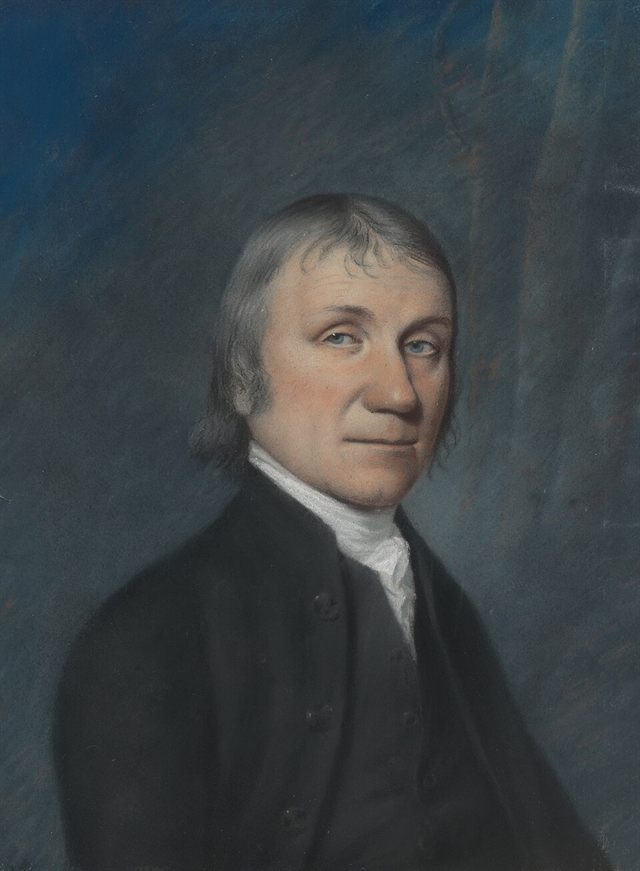
1733–1804
A Dissenting minister who isolated the gas that keeps everything alive, could not accept what it was, defended the wrong theory to his death, and had his house and laboratory burned by a mob for his politics.
Priestley discovered oxygen and the phenomenon that would become photosynthesis, and understood neither. He was a Unitarian who denied the Trinity, defended the French Revolution, and was driven out of England. These five chapters follow a man whose theory could not carry his own discoveries — and who published everything anyway.
The five chapters
- Barred From the Universities — A Dissenting academy, and an education better than Oxford's
- The Air Over the Brewery Vats — Carbonated water, and a career in gases
- The Mint in the Spoiled Jar — 1771, and a result he could not repeat
- 1 August 1774 — Discovering oxygen and calling it something else
- The Mob at the Door — July 1791, and a life burned in a night
Chapter 1 · Barred From the Universities
A Dissenting academy, and an education better than Oxford's
1733 – 1767 · Birstall · Daventry · Needham Market · Warrington
Joseph Priestley was born near Leeds in March 1733 into a family of cloth-dressers, and brought up after his mother's death by an aunt who took in Dissenting ministers.
As a Dissenter — a Protestant outside the Church of England — he was barred from Oxford and Cambridge, which required subscription to the Thirty-Nine Articles. He went instead to the Dissenting academy at Daventry.
This was not a lesser education. The Dissenting academies, precisely because they were outside the establishment, taught modern subjects the ancient universities did not: contemporary history, modern languages, mathematics, natural philosophy, and above all a method of teaching by *disputation*, in which students were required to argue both sides of a question. Priestley said it made him unable to hold a position without knowing the case against it.
He became a minister, taught, and by 1761 was tutor in languages and literature at Warrington Academy, one of the best of them.
He stammered badly, which was a real handicap for a preacher and which he never fully overcame.
His theology moved steadily away from orthodoxy. He became a Unitarian: denying the Trinity, denying the divinity of Christ, denying original sin. In eighteenth-century England this was legally precarious and socially disqualifying, and he wrote about it constantly and without discretion.
His governing conviction was that free inquiry in religion and free inquiry in nature are the same activity, and that authority is the enemy of truth in a church exactly as in a laboratory.
“In completing one discovery we never fail to get an imperfect knowledge of others.”
— Joseph Priestley, Experiments and Observations on Different Kinds of Air (1775)
Why this matters
Priestley's exclusion from the universities placed him in a Dissenting academy with a better modern curriculum, and his conviction that free inquiry in religion and nature are one activity runs through everything he did.
You have the barred universities and the academy instead. What would you ask?
Ask Priestley
- “What did a Dissenting academy teach that Oxford would not?”
- “What does it do to you to argue both sides of everything?”
- “Are free inquiry in religion and in nature really the same thing?”
- “What did it cost to deny the Trinity in print?”
- “How did you preach with a stammer?”
Chapter 2 · The Air Over the Brewery Vats
Carbonated water, and a career in gases
1767 – 1773 · Leeds
In 1767 Priestley took a ministry at Mill Hill Chapel in Leeds, and his house happened to be next to a brewery.
Above a vat of fermenting beer sits a layer of dense gas — carbon dioxide, then called *fixed air* — which does not mix quickly with the air above it. Priestley could stand at the vat and experiment on it directly, and did.
He found it would extinguish a lit taper. He found smoke poured into it would spread out along its surface, making the invisible layer visible. And he found that if he poured water back and forth between two vessels above the vat, the water absorbed the gas and became pleasantly sharp to the taste.
He had made carbonated water. He published the method in 1772, gave it away, and made nothing from it; Johann Jacob Schweppe commercialised the process a decade later and founded a company that still exists. The Royal Society gave Priestley its Copley Medal.
The brewery got him started, and he then built the technique that made his career: the *pneumatic trough*, collecting gases over water — and, crucially, over *mercury*, which allowed him to collect gases that dissolve in water and would otherwise be lost.
With it he isolated an extraordinary series of new substances: ammonia, sulphur dioxide, nitrous oxide, hydrogen chloride, silicon tetrafluoride, nitrogen dioxide, and carbon monoxide.
Before Priestley, most chemists still treated air as a single element. He established that it is a category — that there are *many* different airs, with different properties.
Why this matters
Collecting gases over mercury rather than water let Priestley isolate the many soluble gases nobody else could catch, and turned 'air' from one substance into a category.
You have the brewery and the trough. What is your question?
Ask Priestley
- “Why does collecting gas over mercury change what you can catch?”
- “How did you make carbonated water?”
- “Why give the method away rather than sell it?”
- “What convinced you there was more than one kind of air?”
- “How do you tell one invisible gas from another?”
Chapter 3 · The Mint in the Spoiled Jar
1771, and a result he could not repeat
1771 – 1772 · Leeds
Priestley burned a candle in a closed vessel until it went out. The air was now *spoiled*: it would not support another flame, and a mouse placed in it died quickly.
He then put a sprig of mint into such a jar and left it standing for some days. When he tested the air again, a candle would burn in it.
The plant had restored the air.
This was the first evidence that plants and animals do opposite things to the atmosphere, and it is the founding observation of what became photosynthesis. He extended it: a mouse could live in air a plant had restored. He drew the large conclusion, and it is correct — that the vegetable creation repairs the injury the animal creation does to the air, and that this is how the atmosphere is kept fit to breathe.
The Royal Society gave him the Copley Medal for it in 1773.
And then it would not repeat. Sometimes the plant restored the air; sometimes nothing happened; sometimes it got worse. Priestley could not make it work reliably, and neither could anybody else who tried. By the late 1770s the result was under a cloud.
The missing condition was *light*. Priestley's jars stood in whatever illumination his window happened to give, and he did not record it. Jan Ingenhousz identified it in 1779, and also found the other half — that plants respire in darkness, spoiling the air as an animal does.
Priestley had the phenomenon and did not have the conditions.
Why this matters
Priestley's plant experiment is the founding observation of photosynthesis, and it failed to replicate because he was not controlling the one variable that mattered.
You have the mint, the candle and the inconsistency. What would you ask?
Ask Priestley
- “What did you conclude from the mint in the jar?”
- “Why would the experiment not repeat?”
- “How did you feel when Ingenhousz found the condition?”
- “Should you have published a result you could not repeat?”
- “What made you think plants and animals were opposites?”
Chapter 4 · 1 August 1774
Discovering oxygen and calling it something else
1774 – 1800 · Calne · Paris
By 1774 Priestley was librarian and companion to Lord Shelburne at Calne in Wiltshire, a position that gave him a salary, a laboratory and time.
On 1 August 1774 he used a large burning lens to focus sunlight on *red calx of mercury* — mercuric oxide — in a vessel inverted over mercury. A gas came off.
He tested it. A candle burned in it with a startling, vivid brightness. A mouse placed in it lived far longer than in the same volume of ordinary air. And he breathed some himself, reporting that his breast felt peculiarly light and easy for some time afterwards, and speculating that it might in time become a fashionable luxury — a joke that turned out to be a fair description of the oxygen bar.
He had oxygen.
He called it *dephlogisticated air*. Phlogiston theory held that burning releases a substance, phlogiston, into the air, and that air becomes saturated and can absorb no more. So an air that supported combustion unusually well must be air with the phlogiston *removed* — hence the name.
In October 1774 Priestley was in Paris with Shelburne and described the preparation over dinner to Antoine Lavoisier. Lavoisier repeated it, understood it as a *component of ordinary air that combines with burning substances*, and named it oxygen.
Priestley never accepted it. He argued against the oxygen theory for the rest of his life and published a defence of phlogiston in 1800, when essentially every other chemist in Europe had abandoned it.
Why this matters
Priestley isolated oxygen and described its properties accurately, and his theory made it impossible for him to see what he had.
You have the burning lens and the wrong name. What is your question?
Ask Priestley
- “What did the candle look like in the new air?”
- “Why call it dephlogisticated air?”
- “What did you tell Lavoisier over that dinner?”
- “Why defend phlogiston when everyone else had given it up?”
- “What would it have taken to change your mind?”
Chapter 5 · The Mob at the Door
July 1791, and a life burned in a night
1780 – 1804 · Birmingham · London · Northumberland, Pennsylvania
Priestley moved to Birmingham in 1780 and joined the Lunar Society — Matthew Boulton, James Watt, Josiah Wedgwood, Erasmus Darwin — which met monthly at full moon so members could see their way home.
He also went on writing. He defended the American Revolution. He defended the French Revolution enthusiastically after 1789. He campaigned for the repeal of the Test and Corporation Acts, which excluded Dissenters from public office. And he continued to publish attacks on the doctrines of the established Church.
On 14 July 1791 a dinner was held in Birmingham to mark the second anniversary of the fall of the Bastille. Priestley did not attend. A mob gathered, encouraged by local magistrates who did nothing to stop it, and went looking for Dissenters, shouting for Church and King.
They burned his meeting house. Then they went to his home at Fair Hill and burned that: the house, his library, his manuscripts, and his laboratory with all its instruments. He and his wife escaped shortly before the mob arrived. The rioting continued for three days and destroyed four Dissenting chapels and around twenty-seven houses.
He never recovered the manuscripts. He moved to London and found himself socially frozen out; the Royal Society, of which he was a Fellow, was cold.
In 1794 he emigrated to the United States, settling at Northumberland, Pennsylvania, where his sons had gone. He was welcomed by Jefferson and Adams, declined a chair of chemistry at Philadelphia, built a laboratory, and kept working.
He died there in February 1804, aged seventy, still defending phlogiston.
Why this matters
Priestley's laboratory, library and manuscripts were destroyed by a mob for his political and religious views — a concrete instance of politics ending a scientific career.
You have the burned house and the emigration. What would you ask him?
Ask Priestley
- “What did you lose in the Birmingham riots?”
- “Did the magistrates want the mob to find you?”
- “Was defending the French Revolution worth what it cost?”
- “What was the Lunar Society like?”
- “Would you write any of it more carefully?”
What Priestley changed
Priestley found the gas that respiration and combustion depend on, and the phenomenon that became photosynthesis, without understanding either. He isolated more new gases than anyone before him, invented carbonated water, and established that air is a category rather than a single substance. He is the standing example of a discoverer whose theory could not carry his own discovery.
A debate that continues
Scheele prepared oxygen before Priestley and Lavoisier explained it after him, so credit for the discovery is genuinely divided three ways; and Priestley's refusal to abandon phlogiston, published as late as 1800, is variously read as intellectual courage or obstinacy.
Keep exploring — ask Priestley
- “Which of your airs are you proudest of?”
- “When should a scientist abandon a theory?”
- “What would you have written if you had been more careful?”
Related lives
- Antoine Lavoisier — Father of Modern Chemistry
- Carl Wilhelm Scheele — Who Found Seven Acids and Named None
- Jan Ingenhousz — The One Who Found the Light
- Benjamin Franklin — Printer · Diplomat · Philosopher
Related themes
Oxygen and combustion · Photosynthesis · Gases and their properties
Where Priestley appears in your course
Joseph Priestley has a genuine claim on 8 lessons of the Pearson Edexcel International GCSE science course built into Incandio. Six of them:
- Photosynthesis — Biology: Every claim on this page rests on plants doing something to the air, and Priestley supplied the first evidence that they do. In 1771 he burned a candle in a sealed jar until it went out, put a sprig of mint into the spoiled air, and found days later that a candle would burn in it again. He had no idea what had happened — he thought in terms of phlogiston to the end of his life and rejected Lavoisier's explanation of his own discovery. What he had was the observation that a plant restores something a flame destroys, which is where this entire subject begins.
- Seeds and Germination — Biology: The claim on this page that a germinating seed consumes oxygen and releases carbon dioxide can be demonstrated with Priestley's own apparatus and nothing else. He was the first to show that a living thing in a sealed jar changes the air in it — a mouse or a candle spoils it, a growing plant in the right conditions restores it. He also never managed to make the plant experiment work reliably, and the reason is on this page: he had not separated light from darkness, and a plant in the dark behaves exactly like the mouse.
- The Carbon and Nitrogen Cycles — Biology: The carbon cycle claims that plants take carbon dioxide out of the air while everything else puts it back, and Priestley produced the first evidence that any such exchange occurs. In 1771 he burned a candle in a sealed jar until it went out, put a sprig of mint into the spoiled air, and found days later that a candle would burn in it again. He had demonstrated one complete loop of the cycle in a single jar — something removing what something else had added — without any idea what the substance involved actually was.
- The Gases in the Air — Chemistry: Priestley isolated the gas in 1774, before Lavoisier, by focusing sunlight onto mercury oxide with a burning lens. A candle burned in it with a remarkably vigorous flame, and a mouse lived in a sealed portion far longer than in ordinary air. He tried breathing it himself and reported that his chest felt peculiarly light and easy. But he interpreted it through the phlogiston theory and called it dephlogisticated air — air with room to absorb more phlogiston — and he defended that account for the rest of his life, long after Lavoisier's explanation had prevailed.
- The Reactions of Acids — Chemistry: The acid–carbonate reaction on this page is where carbonated water came from. Priestley lived next door to a brewery in Leeds and became interested in the layer of gas sitting above the fermenting vats. He found he could dissolve that gas in water under pressure and produce a pleasantly sharp drink, and published the method in 1772 without patenting it. He also identified the gas as the same one produced when acid is poured on chalk. It is a rare case of a school reaction whose commercial consequence is on every supermarket shelf.
- Tests for Gases, and for Water — Chemistry: Several of the gases on this page were first prepared and characterised by Priestley, who isolated around a dozen including oxygen, ammonia and hydrogen chloride. His method was essentially to make a gas and then see what it did — to a candle, to a mouse, to a plant, to himself. That is exactly the logic of a gas test, arrived at before there was any theory to guide it. He is the right person to ask how you begin to describe something invisible, and how he decided which properties were worth recording.
Continue on Incandio
- Talk to Priestley — every question on this page is one tap from being asked, and the same page carries the Historical Brief, the achievements and the timeline
- All 280 figures · Incandio — learn every idea, teach it, then defend it