Pearson Edexcel International GCSE in Biology · 4BI1 · Free · no account needed
The Carbon and Nitrogen Cycles
The same atoms, used again and again — and the four bacteria that do the work nothing else can.
On the specification this is stages of the carbon cycle — 4BI1 statements 4.10 · 4.11.
Topic 4 · Ecology and the environment — one of 8 lessons in this topic, and one of 68 in Biology.
This lesson ends with Antoine Lavoisier. Learn the Carbon and Nitrogen Cycles, teach it, then defend it against Antoine Lavoisier.
What this lesson covers in the specification
Incandio is aligned to this specification. It is not published by, endorsed by or affiliated with Pearson, and it reproduces none of Pearson's wording — the statement numbers are given so you can check every lesson against your own copy.
- 4.10 — The stages of the carbon cycle: respiration, photosynthesis, decomposition, combustion
- 4.11 — The stages of the nitrogen cycle and the roles of the bacteria involved (bold B statement — Paper 2 only)
Specification section 4(c) Cycles within ecosystems — also taught in Energy Transfer Along a Food Chain.
1 · Understand it
No exam language yet. The only question this section answers is: do I actually understand what is happening?
Energy arrives from the Sun, passes along a food chain and leaves as heat, so it has to be constantly resupplied. Matter cannot work that way — the Earth receives almost no new atoms — so every carbon and nitrogen atom in you has been used before, many times, by other organisms. The two cycles on this page are how that happens.
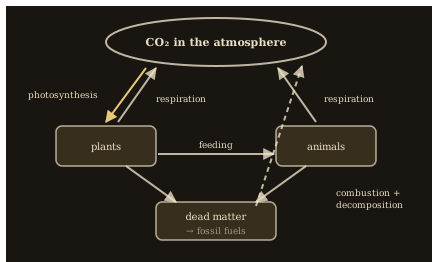
The carbon cycle — four processes, and which way each moves the carbon
- PHOTOSYNTHESIS takes carbon dioxide OUT of the atmosphere and locks the carbon into glucose, and then into all the other compounds of the plant. It is the only process on this list that removes carbon from the air.
- RESPIRATION puts it back. Every organism — plant, animal, bacterium, fungus — respires and releases carbon dioxide into the atmosphere.
- DECOMPOSITION puts it back. When an organism dies, decomposers feed on its remains and respire, releasing the carbon it contained as carbon dioxide.
- COMBUSTION puts it back. Burning wood or fossil fuels oxidises the carbon they contain and releases it as carbon dioxide.
- So one process in, three processes out — and the balance between them is why the next lesson on greenhouse gases exists.
Fossil fuels are worth a sentence of their own, because they are what makes the modern imbalance possible. Coal, oil and gas are the remains of organisms that died in conditions where decomposers could not work — waterlogged, airless ground — so their carbon was never released and instead sat underground for hundreds of millions of years. Burning them returns in a few centuries the carbon that the cycle took an era to remove.
Think of it like a library with one desk that takes books in
Books are returned to the library constantly, by many different readers, through several return slots. Only one desk sends them back out again. As long as the desk works at the same rate as the slots, the shelves stay at a steady level. Speed up the returns — open a vault of books that had been sealed away for centuries and pour them in — and the shelves fill up, even though nobody has created a single new book. That is the carbon cycle with fossil fuels added, and it explains why the problem is a rate problem rather than a quantity problem.
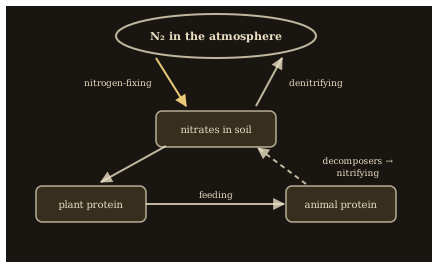
Now nitrogen, and the first thing to understand is why it needs a cycle this complicated. Nearly four fifths of the atmosphere is nitrogen gas — it is everywhere, and no plant or animal can use any of it. The two atoms in N₂ are held together so tightly that almost nothing can separate them. So although organisms are surrounded by nitrogen, they can only obtain it in combined forms, and getting it into those forms is what the bacteria are for.
The nitrogen cycle — the four bacteria, and exactly what each one does
- NITROGEN-FIXING BACTERIA convert nitrogen gas from the air into nitrogen compounds. Some live free in the soil; others live in nodules on the roots of legumes such as peas, beans and clover, which is why those plants enrich the soil rather than depleting it.
- DECOMPOSERS (bacteria and fungi) break down the proteins in dead organisms and in urea and faeces, releasing AMMONIUM COMPOUNDS into the soil.
- NITRIFYING BACTERIA convert those ammonium compounds into NITRATES. This is the form plants absorb, so nitrifying bacteria are the step that makes the soil's nitrogen useful.
- PLANTS absorb nitrates through their roots by ACTIVE TRANSPORT and use them to make amino acids and then proteins. Animals obtain their nitrogen by eating plants or other animals.
- DENITRIFYING BACTERIA convert nitrates back into nitrogen gas, returning it to the atmosphere. They thrive in waterlogged soils with little oxygen — which is why waterlogged fields are poor for crops and why farmers plough to aerate the soil.
Notice which bacterium is the farmer's enemy and which are the farmer's allies. Nitrogen-fixing and nitrifying bacteria both increase the nitrates available; denitrifying bacteria remove them. That single fact explains three ordinary farming practices at once: ploughing and draining fields to keep the soil aerated and denitrifying bacteria suppressed, planting a legume crop in rotation to let its root nodules fix nitrogen, and spreading manure so that decomposers can release its nitrogen into the soil.
Two precisions worth carrying into the exam. Lightning also fixes nitrogen, providing enough energy to combine it with oxygen, but the amount is small beside what the bacteria do. And plants absorb NITRATES, not nitrogen and not protein — an answer saying plants take in nitrogen from the air is describing something no plant can do without help.
2 · Grade 9 Notes
A different job from the section above. You have already understood it; this is the precise set of things to LEARN — definitions to reproduce word for word, processes in order, equations with units, and the answers that score full marks.
Statement 4.10 — the four processes of the carbon cycle, and the direction of each
- Photosynthesis
- Removes carbon dioxide FROM the atmosphere, fixing the carbon into glucose and then into other plant compounds. The only process that takes carbon out.
- Respiration
- Returns carbon dioxide TO the atmosphere. Carried out by every living organism, continuously.
- Decomposition
- Returns carbon dioxide TO the atmosphere. Decomposers feed on dead organisms and waste and respire, releasing the carbon they contained.
- Combustion
- Returns carbon dioxide TO the atmosphere. Burning wood or fossil fuels oxidises the carbon they contain.
- Fossil fuels
- Formed from organisms that died where decomposers could not act, so their carbon was locked away for hundreds of millions of years. Burning them returns it rapidly.
Statement 4.11 — the four bacteria, in the words that score
- Nitrogen-fixing bacteria
- Convert nitrogen GAS from the air into nitrogen compounds. Found free in the soil and in root nodules of legumes such as peas, beans and clover.
- Decomposers
- Break down proteins in dead organisms, urea and faeces, releasing AMMONIUM COMPOUNDS into the soil.
- Nitrifying bacteria
- Convert ammonium compounds into NITRATES — the form plants can absorb.
- Denitrifying bacteria
- Convert nitrates back into nitrogen GAS, returning it to the atmosphere. They thrive in waterlogged, poorly aerated soil.
- How plants obtain nitrogen
- They absorb NITRATES through their roots by active transport, and use them to make amino acids and then proteins.
The nitrogen cycle in order — the sequence to write
- Nitrogen gas in the air is converted to nitrogen compounds by nitrogen-fixing bacteria, in the soil or in root nodules of legumes.
- Plants absorb nitrates from the soil by active transport and use them to make amino acids and proteins.
- Animals obtain nitrogen compounds by eating plants or other animals.
- Dead organisms, urea and faeces are broken down by decomposers, releasing ammonium compounds into the soil.
- Nitrifying bacteria convert ammonium compounds into nitrates, which plants can absorb again.
- Denitrifying bacteria convert nitrates back into nitrogen gas, returning it to the atmosphere.
Why farmers do what they do — the cycle applied
- PLOUGHING and DRAINING aerate the soil, which suppresses the activity of denitrifying bacteria and so keeps the nitrate concentration high — denitrifying bacteria thrive where there is little oxygen
- Aerating the soil also raises the activity of nitrifying bacteria and decomposers, which need oxygen for respiration, so more nitrates are produced
- Growing a LEGUME in rotation adds nitrogen compounds to the soil, because of the nitrogen-fixing bacteria in its root nodules
- Spreading MANURE supplies material for decomposers to break down, releasing ammonium compounds
- Adding FERTILISER supplies nitrates directly, bypassing the biological steps entirely
The two cycles compared — the point of having them at all
A. MATTER IS RECYCLED: the same carbon and nitrogen atoms pass round the cycles repeatedly, because the Earth receives almost no new atoms.
B. ENERGY IS NOT: it enters as sunlight, flows along the food chain and leaves as heat, so it must be constantly resupplied by the Sun.
Not this: Plants absorb nitrogen from the air to make their proteins.
This: No plant can use nitrogen gas. Plants absorb NITRATES from the soil through their roots by active transport, and nitrogen gas is only made available by nitrogen-fixing bacteria.
Model answer [3 marks]
Describe how carbon is returned to the atmosphere. [3]
Respiration by all living organisms releases carbon dioxide into the atmosphere. When organisms die, decomposers feed on their remains and respire, releasing the carbon they contained as carbon dioxide. Combustion of wood and fossil fuels also oxidises the carbon they contain and releases it as carbon dioxide.
Model answer [4 marks]
Explain the roles of nitrifying and denitrifying bacteria in the nitrogen cycle. [4]
Nitrifying bacteria convert ammonium compounds in the soil into nitrates. This matters because nitrates are the form of nitrogen that plants can absorb through their roots. Denitrifying bacteria do the opposite: they convert nitrates back into nitrogen gas, which is returned to the atmosphere. This reduces the nitrates available to plants, and denitrifying bacteria are most active in waterlogged soils where there is little oxygen.
Model answer [3 marks]
Explain why a farmer might plant a crop of clover in a field for one season instead of a cereal crop. [3]
Clover is a legume, and nitrogen-fixing bacteria live in nodules on its roots. These bacteria convert nitrogen gas from the air into nitrogen compounds, which increases the nitrogen available in the soil. When the clover is ploughed in or decomposes, decomposers release those compounds, so the soil is more fertile for the next crop without fertiliser having to be added.
Mark-losing trap. Photosynthesis is the ONLY process that removes carbon dioxide from the air. The other three all return it.
Mark-losing trap. Plants absorb NITRATES, not nitrogen gas and not protein. No plant can use N₂ directly.
Mark-losing trap. Nitrifying makes nitrates; DEnitrifying destroys them. The 'de-' means undoing, exactly as it sounds.
Mark-losing trap. Denitrifying bacteria thrive in WATERLOGGED soil with little oxygen. That is why ploughing and draining help.
Mark-losing trap. Decomposers release AMMONIUM compounds. It takes nitrifying bacteria to turn those into the nitrates plants can use.
3 · Prove it — the five questions
The five questions climb Grade 6 → Grade 7 → Grade 8 → Grade 9 → Grade 9 challenge, and are marked inside Incandio on your own device, by rule, with an authored diagnosis of the mistake you actually made. The mark schemes stay in the app so that the practice is worth doing; the questions themselves are here.
- Grade 6 · Identify [1 mark] — Which process removes carbon dioxide from the atmosphere?
- Grade 7 · State [1 mark] — In what form do plants absorb nitrogen from the soil?
- Grade 8 · Describe [5 marks] — Describe how nitrogen from the air becomes protein in an animal. Select every statement that belongs in a full-mark answer.
- Grade 9 · Calculate [4 marks] — A field of 2.5 hectares is planted with clover, whose root nodules fix nitrogen at 180 kg per hectare per year. A cereal crop grown afterwards removes 320 kg of nitrogen from the field in total. Calculate how much nitrogen the farmer must add as fertiliser to replace what the cereal removes.
- 9+ · Analyse [5 marks] — A field is left waterlogged through a wet winter. In the spring the farmer finds that crops grow poorly, and soil tests show a much lower nitrate concentration than in a neighbouring well-drained field. Select every statement that belongs in a full-mark explanation.
The people behind this science
Two ways into the same idea — the one who first showed the air is being recycled, and the one who proved matter is never lost. Inside Incandio each of them answers knowing exactly which lesson you have just finished.
Joseph Priestley — the one who first showed the air is being recycled
The carbon cycle claims that plants take carbon dioxide out of the air while everything else puts it back, and Priestley produced the first evidence that any such exchange occurs. In 1771 he burned a candle in a sealed jar until it went out, put a sprig of mint into the spoiled air, and found days later that a candle would burn in it again. He had demonstrated one complete loop of the cycle in a single jar — something removing what something else had added — without any idea what the substance involved actually was.
- “What had the candle done to the air in the jar?”
- “How did you know the mint had put something back?”
- “What did you think was being exchanged?”
- “Why did the experiment sometimes fail?”
- “Does it trouble you that you never worked out the explanation?”
Antoine Lavoisier — the one who proved matter is never lost
A cycle only makes sense if matter is conserved — if atoms could vanish there would be nothing to go round. Lavoisier established that by weighing everything, before and after, in sealed vessels: the total mass never changes, however violently a reaction proceeds. That principle is why every carbon atom in the atmosphere has to be somewhere afterwards, and why burning fossil fuels must add to the total in the air rather than simply making it disappear.
- “How did you show that nothing is lost when something burns?”
- “Why does it matter that the vessel is sealed?”
- “Where does the carbon in a burning log actually go?”
- “What did people believe before you weighed things?”
Think you understand it?
Reading is the start. On Incandio a topic counts as mastered only once you have taught it and defended it — the two things a revision guide cannot ask of you.
Incandio this topic → Prove it. Teach it. Defend it. What does “Incandio it” mean?
- Prove it — five questions on the Carbon and Nitrogen Cycles, marked on the spot, that tell you what was missing rather than just what was wrong.
- Teach it — Explain the Carbon and Nitrogen Cycles in your own words to Ember, an AI pupil who does not have it yet and asks the awkward question. Understanding is credited; wording is not required.
- Defend it — Argue the Carbon and Nitrogen Cycles against Antoine Lavoisier — three rounds, marked against descriptors you can read before you begin.
- Then the exam — read all 10 authored exam-style questions on this unit, each with its command word and its tariff, then have them marked on Incandio with the mistake you actually made named.
Completely free. No subscriptions, no paywalls, no account needed to start.
Carry on through the course
- Previous lesson: Energy Transfer Along a Food Chain
- Next lesson: Air Pollution and the Greenhouse Gases
- Populations, Ecosystems and Sampling with Quadrats — Four nested words for where organisms live — and how to count a population you could never count in full.
- Biodiversity, Distribution and Limiting Factors — Why organisms are where they are and not somewhere else — and how to measure the variety of life in a place rather than just its quantity.
- Food Chains, Webs and Pyramids — Who eats whom, drawn three different ways — and why only one of the three can come out upside down.
- Energy Transfer Along a Food Chain — About nine tenths of the energy disappears at every step. Here is exactly where it goes — and what that means for how the world is fed.
- Air Pollution and the Greenhouse Gases — Two entirely different problems that both begin with burning — one that poisons what it touches, and one that changes the energy balance of the planet.
- All of Biology · Biology key terms · required practicals · Incandio Science · The 4BI1 specification