Explore Their Life · Pearson Edexcel International GCSE revision on Incandio
Thomas Aquinas: A Life in Five Chapters
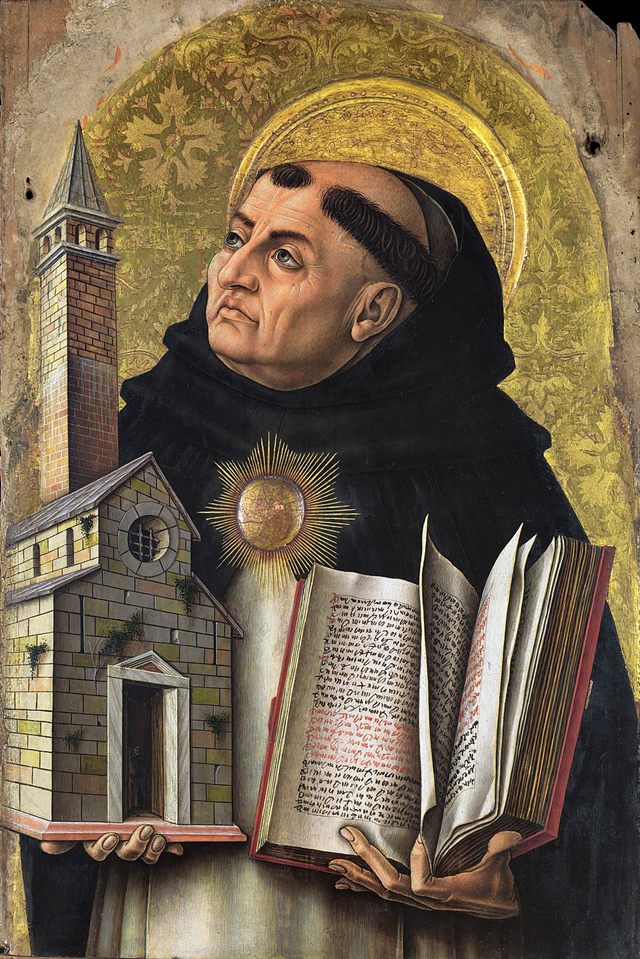
1225–1274
A nobleman's son whose family imprisoned him for a year to stop him becoming a beggar, who then spent his life proving that faith has nothing to fear from argument — and stopped writing three months before he died.
Aquinas is the reason Western Christianity did not have to choose between reason and revelation, and the shape of his writing — every question opening with the case against his own answer — is a lesson before it is a doctrine. These five chapters follow the abduction, the teacher, the method, the great unfinished book, and the silence at the end.
The five chapters
- The Year in the Castle — A family who wanted an abbot and got a friar
- The Dumb Ox — Cologne, Albert, and a new Aristotle
- Objections First — A form of writing that hands the other side the opening
- The Summa — Written for beginners, and never finished
- Straw — Three months of not writing
Chapter 1 · The Year in the Castle
A family who wanted an abbot and got a friar
c. 1225 – 1245 · Roccasecca · Monte Cassino · Naples
Thomas was born about 1225 at Roccasecca, a castle between Rome and Naples, into a family of the minor nobility with a plan. He was sent as a boy to the great abbey of Monte Cassino, a few miles away, in the expectation that he would eventually be its abbot — a position of wealth, land and considerable influence, and a normal use for a younger son.
At Naples, studying at the university, he met the Dominicans instead. The order was about thirty years old. Its members preached, studied and begged for their living, and for a family like his it was roughly the worst available outcome: the abbacy given up for a life of deliberate poverty in an order nobody's cousin had heard of.
His brothers intercepted him on the road and took him back to the family castle, where he was held for about a year. The accounts of what was tried during that year vary and some of them are certainly embellished; what is not in doubt is that he was detained, that the family's object was to change his mind, and that it did not work. He was eventually allowed to leave and rejoined the order.
This is worth knowing before anything else about him, because the settled, orderly, unheated prose gives an impression of a man to whom nothing ever happened. He made one enormous decision very young, at a real cost, and never revisited it.
Why this matters
The calm of Aquinas's writing sits on top of a decision his own family used force to prevent, which is a useful corrective to reading him as merely systematic.
You have the abbacy, the friars and the year in the castle. What would you ask?
Ask Aquinas
- “What did your family lose when you joined the Dominicans?”
- “What was the year at Roccasecca actually like?”
- “Why an order that begged, rather than an abbey that owned?”
- “Did you ever come close to giving in?”
- “What did Naples show you that Monte Cassino would not have?”
Chapter 2 · The Dumb Ox
Cologne, Albert, and a new Aristotle
1245 – 1256 · Paris · Cologne
Thomas studied at Paris and then at Cologne under Albert the Great, one of the very few people in Europe then working systematically through the newly available Aristotle. He was large, and he was silent in company, and the other students called him the dumb ox. Albert is reported to have told them that this ox would one day bellow so loudly that the whole world would hear him.
The intellectual situation is the thing to understand. Almost the whole of Aristotle had been unavailable in Latin for centuries and was arriving in translation, much of it through Arabic and with the commentaries of Ibn Sina and Ibn Rushd attached. It was a complete, powerful, non-Christian account of the natural world, of causation, of the soul, of ethics — and it disagreed with received Christian positions in several places. Some in Paris wanted it banned. Some wanted it accepted wholesale, including the parts that could not be reconciled.
Aquinas took a third position and spent his life defending it: truth is one. A conclusion reached by argument and a truth received by revelation come from the same source and therefore cannot really conflict, so where they appear to, somebody has misunderstood something — and the work is to find out which.
That is not a compromise. It is a claim with teeth, because it means a religious position can be wrong about a matter of fact, and it means an argument cannot be answered by an assertion.
Why this matters
The recovery of Aristotle was the intellectual crisis of the thirteenth century, and Aquinas's answer to it — truth is one — is still the cleanest statement of how faith and reason can be held together.
You have the new Aristotle and the fight over him. What would you ask?
Ask Aquinas
- “Why did the arrival of Aristotle frighten people?”
- “What did Albert see in you that the other students did not?”
- “If truth is one, can a religious position be factually wrong?”
- “What did the Arabic commentators give you?”
- “Were the people who wanted Aristotle banned entirely wrong?”
Chapter 3 · Objections First
A form of writing that hands the other side the opening
1256 – 1265 · Paris · Orvieto · Rome
The most useful thing about Aquinas for a student is not any single conclusion; it is the shape of the writing.
Every question in the Summa opens with objections — the case AGAINST the answer he is going to give, stated as strongly as he can manage, usually three or four of them, each with its own supporting argument. Only then comes a brief statement on the other side, then his own answer, and then a reply to each objection in turn, individually.
Two consequences follow, and both matter. The first is that a reader meets the opposing case before they meet his, in its best form, and often finds it convincing. The second is that he cannot dodge: having stated an objection at full strength, he has to answer that objection rather than a weaker cousin of it.
It is also a teaching form. It came out of the disputed question, the medieval university exercise in which a master took a position, students attacked it, and the master answered. The written version preserves the argument rather than the result.
He worked at extraordinary speed, dictating to several secretaries — the reports of him keeping three or four busy at once are probably exaggerated and certainly point at something real. He also produced commentaries on Aristotle, on scripture, on Boethius, alongside the theological work.
Why this matters
Putting the strongest objection first is the habit every Religious Studies mark scheme rewards and most candidates omit, and Aquinas is where it can be seen done at length.
You have the form and where it came from. What would you ask?
Ask Aquinas
- “Why give the objections the opening of every question?”
- “Has an objection you wrote ever seemed better than your answer?”
- “What was a disputed question like in the room?”
- “How did you actually write so much?”
- “Why answer each objection separately rather than all at once?”
Chapter 4 · The Summa
Written for beginners, and never finished
1265 – 1273 · Rome · Paris · Naples
The Summa Theologiae was begun in 1265 and described by its author as a work for beginners. It runs to several thousand pages.
Its scope is the whole of Christian theology arranged as a single argument, from God, through creation and human action, to the person of Christ and the sacraments. Along the way it contains the material a Religious Studies course most often meets: five arguments moving from features of the world to God; an account of law in which a rule not ordered to the common good is not really law at all; an account of human action built around what a person is for; and a treatment of evil which follows Augustine in denying that it is a thing.
The part usually skipped is the most characteristic. Aquinas holds that grace does not destroy nature but completes it — that becoming what a religion asks does not require becoming less of what a human being naturally is. Almost everything else in his system is downstream of that.
He was not writing in peace. Positions close to his were being disputed at Paris throughout, and three years after his death a list of condemned propositions issued there included some that touched him. He was formally cleared decades later, and centuries after that his work was made the standard framework for Catholic theology — an outcome he had no way of foreseeing and no share in arranging.
Why this matters
The Summa is the most complete attempt anybody has made to set out a religion as a single connected argument, and its unfinished state is part of what it teaches.
You have the great book and its scale. What would you ask?
Ask Aquinas
- “In what sense is the Summa a book for beginners?”
- “What does it mean that grace completes nature rather than replacing it?”
- “When is a law not really a law?”
- “Which of the five ways do you think is strongest?”
- “What was being disputed at Paris while you wrote?”
Chapter 5 · Straw
Three months of not writing
1273 – 1274 · Naples · Fossanova
On 6 December 1273, at Naples, something happened to Aquinas during Mass. He did not describe it. What is recorded is that he stopped writing, and that the Summa breaks off in the middle of the treatment of the sacraments and was never resumed.
Reginald of Piperno, his secretary and companion of many years, pressed him to continue. The reply that has come down is that everything he had written seemed to him like straw, compared to what he had seen. He would not say more.
Historians have proposed explanations — a stroke, exhaustion after decades of enormous output, a mystical experience — and the honest position is that the evidence does not settle it. What is not in dispute is the behaviour: a man who had written at extraordinary speed for twenty years stopped completely and gave a reason nobody could examine.
In January 1274 he set out for the Council of Lyon, at the pope's summons. He was unwell on the road, struck his head on a fallen branch, and stopped at the Cistercian abbey of Fossanova, where he died on 7 March. He was about forty-nine.
The end is worth sitting with rather than resolving. The most systematic writer in the Western tradition finished by declining to systematise something, and left the largest work in it unfinished on purpose.
Why this matters
Aquinas's silence is the standing reminder inside his own life that a system, however complete, is an account of something rather than the thing itself.
You have the silence and the unfinished book. What would you ask?
Ask Aquinas
- “Why does everything you wrote seem like straw?”
- “What did Reginald say when you would not continue?”
- “Is a system ever the same thing as what it describes?”
- “Would you have finished it if you had been given time?”
- “What would you tell a student who reads only your conclusions?”
What Aquinas changed
Aquinas made it possible for a religious tradition to take an argument seriously without treating it as an attack, and gave Western thought a vocabulary — nature and grace, law and the common good, the distinction of senses — it still uses. For a Religious Studies learner his method is worth more than his conclusions: state the objection first, at full strength, and answer that one.
A debate that continues
Whether his synthesis genuinely holds reason and revelation together, or quietly subordinates one to the other, has been argued since the Paris condemnations of 1277 and is argued still.
Keep exploring — ask Aquinas
- “Can a religious claim be shown to be factually wrong?”
- “Is stating the other side properly a courtesy or a method?”
- “What is a system of thought actually for?”
Related lives
- Augustine of Hippo — Who Wrote Down What He Had Been
- Aristotle — The Philosopher · Founder of the Lyceum
- Ibn Rushd — Who Answered The Incoherence
Related themes
Faith and reason · Natural law · Arguments about God
Continue on Incandio
- Talk to Aquinas — every question on this page is one tap from being asked, and the same page carries the Historical Brief, the achievements and the timeline
- All 280 figures · Incandio — learn every idea, teach it, then defend it