Pearson Edexcel International GCSE in Biology · 4BI1 · Free · no account needed
Mitosis and Meiosis
Two kinds of cell division solving two opposite problems — one that must copy exactly, and one that must not.
Topic 3 · Reproduction and inheritance — one of 15 lessons in this topic, and one of 68 in Biology.
This lesson ends with Theodor Schwann. Learn Mitosis and Meiosis, teach it, then defend it against Theodor Schwann.
The 2 definitions this lesson teaches, word for word — every Biology definition.
- Mitosis
- A type of cell division in which one cell divides once to produce two cells, each diploid and genetically identical to the parent cell and to each other.
- Meiosis
- A type of cell division in which one cell divides twice to produce four haploid gametes, each genetically different from the others and from the parent cell.
What this lesson covers in the specification
Incandio is aligned to this specification. It is not published by, endorsed by or affiliated with Pearson, and it reproduces none of Pearson's wording — the statement numbers are given so you can check every lesson against your own copy.
- 3.28 — Mitosis produces two cells with identical sets of chromosomes
- 3.29 — Mitosis occurs during growth, repair, cloning and asexual reproduction
- 3.30 — Meiosis produces four genetically different haploid gametes
- 3.32 — The human diploid number is 46 and the haploid number is 23
Specification section 3(b) Inheritance — also taught in DNA, Genes and Chromosomes, Protein Synthesis, Alleles, Genotype and Phenotype, Monohybrid Inheritance and Probability.
1 · Understand it
No exam language yet. The only question this section answers is: do I actually understand what is happening?
A body has two entirely different problems to solve with cell division, and they pull in opposite directions. When you grow, or heal a cut, or replace worn-out skin, you need new cells that are EXACTLY like the ones already there — a liver cell must produce liver cells with the identical genetic instructions, or the tissue stops working. But when you make gametes, you need cells that are deliberately NOT identical, and that carry only half the usual number of chromosomes so that fertilisation restores the full set rather than doubling it.
No single process can do both, so there are two. MITOSIS copies exactly. MEIOSIS halves and varies. Almost every mistake on this topic comes from learning them as two similar lists rather than as two solutions to two incompatible requirements.
The numbers first, because everything else depends on them
- A human body cell contains 46 chromosomes, arranged in 23 PAIRS. A cell with the full set in pairs is DIPLOID, and 46 is the human diploid number.
- A human gamete contains 23 chromosomes — one of each pair, not 23 pairs. A cell with a single set is HAPLOID, and 23 is the human haploid number.
- At fertilisation a haploid sperm (23) fuses with a haploid egg (23), giving a diploid zygote with 46.
- That is why gametes must be haploid: if they carried 46 each, every generation would double the number, and the second generation would have 184 chromosomes per cell.
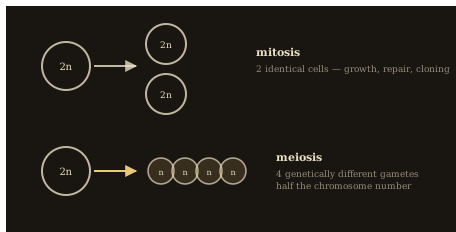
MITOSIS — the copying division
- Before division, each chromosome is COPIED, so the cell briefly contains two identical copies of every chromosome.
- The cell divides ONCE, and the copies are separated so that one of each goes to each new cell.
- The result is TWO cells, each DIPLOID with 46 chromosomes, and each genetically IDENTICAL to the parent cell and to each other.
- It is used wherever an exact copy is what is wanted: GROWTH, REPAIR of damaged tissue, replacement of worn-out cells, ASEXUAL REPRODUCTION, and cloning — including the runners and cuttings from the earlier lesson.
MEIOSIS — the halving-and-shuffling division
- The chromosomes are copied once, as before — but then the cell divides TWICE rather than once.
- In the first division the PAIRS are separated, so each new cell receives one chromosome of each pair rather than both.
- In the second division the copies are separated, as in mitosis.
- The result is FOUR cells, each HAPLOID with 23 chromosomes, and each genetically DIFFERENT from the others and from the parent cell.
- It happens only in the making of GAMETES — in the testes and the ovaries.
Where does the variation in meiosis come from? From which chromosome of each pair ends up in which cell. You have 23 pairs, one of each pair originally from your mother and one from your father, and when the pairs separate, each pair does so independently of all the others. A gamete might get your mother's chromosome 1 and your father's chromosome 2, or the reverse, or any of the other combinations — and with 23 pairs there are over eight million possible combinations from that shuffling alone, before fertilisation adds a second parent's worth on top.
Think of it like a photocopier and a card shuffle
A photocopier has one job and one measure of success: the copy must be indistinguishable from the original, and a machine that introduced small creative differences would be broken. That is mitosis. Now think of dealing hands from a shuffled deck — the whole point is that each hand is different, and dealing the same hand every time would defeat the purpose. That is meiosis. Nobody would design one machine to do both jobs, and evolution did not either.
One precision that costs marks constantly: meiosis produces cells that are genetically different from EACH OTHER, not merely different from the parent. Mitosis produces two cells identical to the parent and to each other. When a question asks you to compare, it wants both halves of that — the number of cells, and the relationship between them.
It is also worth being clear about where each occurs, because it is a common one-mark question with a trap in it. Meiosis happens ONLY in the reproductive organs, and only for making gametes. Everything else in the body — every cell of every tissue, including the cells of the testes and ovaries that are not becoming gametes — divides by mitosis. So the testes do both, and saying 'meiosis happens in the testes' is right, while 'the testes only do meiosis' is not.
2 · Grade 9 Notes
A different job from the section above. You have already understood it; this is the precise set of things to LEARN — definitions to reproduce word for word, processes in order, equations with units, and the answers that score full marks.
Learn this definition · Mitosis
A type of cell division in which one cell divides once to produce two cells, each diploid and genetically identical to the parent cell and to each other.
Learn this definition · Meiosis
A type of cell division in which one cell divides twice to produce four haploid gametes, each genetically different from the others and from the parent cell.
Statement 3.32 — the numbers, and the words for them
- Diploid
- Having the full number of chromosomes, arranged in pairs. In humans this is 46 — 23 pairs. All body cells are diploid.
- Haploid
- Having a single set of chromosomes, one of each pair. In humans this is 23. Gametes are haploid.
- Human diploid number
- 46.
- Human haploid number
- 23.
- Why gametes must be haploid
- So that fertilisation restores the diploid number rather than doubling it every generation.
Mitosis against meiosis — the table nearly every question on this topic comes from
| Mitosis | Meiosis | |
|---|---|---|
| Number of divisions | one | two |
| Number of cells produced | two | four |
| Chromosome number in the products | diploid — 46 in humans, the same as the parent cell | haploid — 23 in humans, half that of the parent cell |
| Genetic relationship of the products | identical to the parent cell and to each other | genetically different from the parent cell and from each other |
| Where it occurs | throughout the body, in all tissues | only in the reproductive organs, to make gametes |
| What it is for | growth, repair, replacement of cells, asexual reproduction and cloning | producing gametes for sexual reproduction, and generating variation |
Statement 3.29 — where mitosis is used, with an example of each
- GROWTH — an organism increasing its number of cells as it develops
- REPAIR — replacing cells destroyed by a wound or injury
- REPLACEMENT — renewing cells that wear out, such as skin and the lining of the gut
- ASEXUAL REPRODUCTION — producing offspring from one parent, as in bacteria dividing or a strawberry runner
- CLONING — including cuttings taken from a plant, which is why the new plants are genetically identical
Why meiosis produces four different cells — the sequence to write
- The chromosomes are copied once.
- In the first division the pairs of chromosomes are separated, so each cell receives one chromosome of each pair.
- Which chromosome of each pair goes to which cell is independent for every pair, so the combinations differ.
- In the second division the copies are separated, giving four cells in total.
- Each of the four is haploid, and each has a different combination of chromosomes — so the gametes are genetically different from one another.
The distinction to hold — what the products are LIKE
A. MITOSIS: two cells, identical to the parent AND to each other. The whole point is that nothing changes.
B. MEIOSIS: four cells, half the chromosome number, and different from the parent AND from each other. The whole point is that something does.
Not this: Meiosis happens in the testes and ovaries, so those organs do not use mitosis.
This: They use both. Meiosis makes the gametes; mitosis makes and maintains every other cell in those organs, exactly as it does everywhere else in the body.
Model answer [4 marks]
Give four differences between mitosis and meiosis. [4]
Mitosis involves one division and meiosis involves two. Mitosis produces two cells and meiosis produces four. The cells produced by mitosis are diploid, with 46 chromosomes in humans, while those produced by meiosis are haploid, with 23. The cells produced by mitosis are genetically identical to the parent cell and to each other, while those produced by meiosis are genetically different from the parent cell and from one another.
Model answer [4 marks]
Explain why gametes must be produced by meiosis rather than by mitosis. [4]
Meiosis halves the chromosome number, so each gamete is haploid with 23 chromosomes rather than 46. At fertilisation two haploid gametes fuse, restoring the diploid number of 46 in the zygote. If gametes were produced by mitosis they would be diploid, and fertilisation would double the chromosome number in every generation. Meiosis also produces gametes that are genetically different from one another, which is the source of variation in the offspring.
Model answer [3 marks]
Explain why the cells produced by meiosis are genetically different from one another. [3]
In the first division the pairs of chromosomes are separated, so each cell receives one chromosome from each pair. Which chromosome of each pair a cell receives is independent for every pair, so different cells end up with different combinations. With 23 pairs there is an enormous number of possible combinations, so the four cells produced are genetically different.
Mark-losing trap. Meiosis products differ from EACH OTHER, not just from the parent. Say both.
Mark-losing trap. Haploid is 23 CHROMOSOMES, not 23 pairs. A gamete has one of each pair.
Mark-losing trap. Mitosis is used for growth, repair, replacement, asexual reproduction and cloning — learn the whole list.
Mark-losing trap. Meiosis makes GAMETES only. Every other dividing cell in the body, including in the ovaries and testes, uses mitosis.
Mark-losing trap. Mitosis: one division, two cells. Meiosis: two divisions, four cells. Getting these numbers the wrong way round unravels the whole answer.
3 · Prove it — the five questions
The five questions climb Grade 6 → Grade 7 → Grade 8 → Grade 9 → Grade 9 challenge, and are marked inside Incandio on your own device, by rule, with an authored diagnosis of the mistake you actually made. The mark schemes stay in the app so that the practice is worth doing; the questions themselves are here.
- Grade 6 · State [1 mark] — How many chromosomes are there in a human gamete?
- Grade 7 · Identify [2 marks] — A gardener takes a cutting from a plant, and the cutting grows roots and becomes a new plant. Which type of cell division has produced the new plant's cells, and how do you know?
- Grade 8 · Compare [5 marks] — Compare mitosis and meiosis. Select every statement that belongs in a full-mark comparison.
- Grade 9 · Calculate [4 marks] — A cell from a plant species has a diploid number of 24. One such cell in the ovary undergoes meiosis. Calculate the total number of chromosomes present across all the cells produced.
- 9+ · Analyse [5 marks] — A drug prevents the SECOND division of meiosis from occurring, while leaving the first division and everything before it unaffected. Predict and explain what the resulting gametes would be like, and what would happen if one were involved in fertilisation. Select every statement that belongs in a full-mark answer.
The people behind this science
Two ways into the same idea — the one who first watched cells building a body, and the one whose ratios predicted this division before it was seen. Inside Incandio each of them answers knowing exactly which lesson you have just finished.
Marcello Malpighi — the one who first watched cells building a body
Growth by mitosis is the process Malpighi was watching without knowing it. He opened chick eggs at intervals across successive days and drew what the lens showed, tracing an embryo from a structureless start to a body with a beating heart and blood vessels. The prevailing view was that the embryo already existed fully formed and merely enlarged; his day-by-day drawings showed structures appearing that had not been there before, which is what a body dividing and multiplying its cells actually looks like from outside.
- “What did you see on the first day, and what by the fourth?”
- “Did the embryo look assembled, or already present and growing larger?”
- “How could something appear that had not been there before?”
- “What did you most want a better lens for?”
Gregor Mendel — the one whose ratios predicted this division before it was seen
Mendel's ratios only work if each parent's two factors separate cleanly when gametes are made, so that a gamete carries one and not both. He deduced that from counting peas, decades before anyone watched chromosome pairs being pulled apart down a microscope. The first division of meiosis on this page is the physical event his arithmetic required, and the match between the two — a mathematical prediction and a visible mechanism found independently — is one of the most satisfying moments in the history of biology.
- “Why did your results require the two factors to separate?”
- “What would the ratios have looked like if both factors went into every gamete?”
- “How does a plant end up with one factor from each parent rather than two?”
- “Would it have helped you to see it happening?”
Think you understand it?
Reading is the start. On Incandio a topic counts as mastered only once you have taught it and defended it — the two things a revision guide cannot ask of you.
Incandio this topic → Prove it. Teach it. Defend it. What does “Incandio it” mean?
- Prove it — five questions on Mitosis and Meiosis, marked on the spot, that tell you what was missing rather than just what was wrong.
- Teach it — Explain Mitosis and Meiosis in your own words to Ember, an AI pupil who does not have it yet and asks the awkward question. Understanding is credited; wording is not required.
- Defend it — Argue Mitosis and Meiosis against Theodor Schwann — three rounds, marked against descriptors you can read before you begin.
- Then the exam — read all 9 authored exam-style questions on this unit, each with its command word and its tariff, then have them marked on Incandio with the mistake you actually made named.
Completely free. No subscriptions, no paywalls, no account needed to start.
Carry on through the course
- Previous lesson: Pedigrees and Sex Determination
- Next lesson: Variation and Mutation
- Sexual and Asexual Reproduction — Two ways to make a new organism — one produces copies, the other produces something that has never existed before. Why any species would want both.
- Flowers, Pollination and Fertilisation — Two completely different solutions to one problem — a plant that cannot move has to get its male gamete to another plant's female gamete.
- Seeds and Germination — What a seed needs to start growing, what it lives on before it has a single leaf — and why light is not on the list.
- The Human Reproductive Systems — Two systems built around the same problem — making gametes and bringing them together — and the hormones that switch them on.
- The Menstrual Cycle — Four hormones, two organs and one repeating question — should the uterus lining be built up, held, or let go?
- All of Biology · Biology key terms · required practicals · Incandio Science · The 4BI1 specification