Explore Their Life · Pearson Edexcel International GCSE revision on Incandio
Woodrow Wilson: A Life in Five Chapters
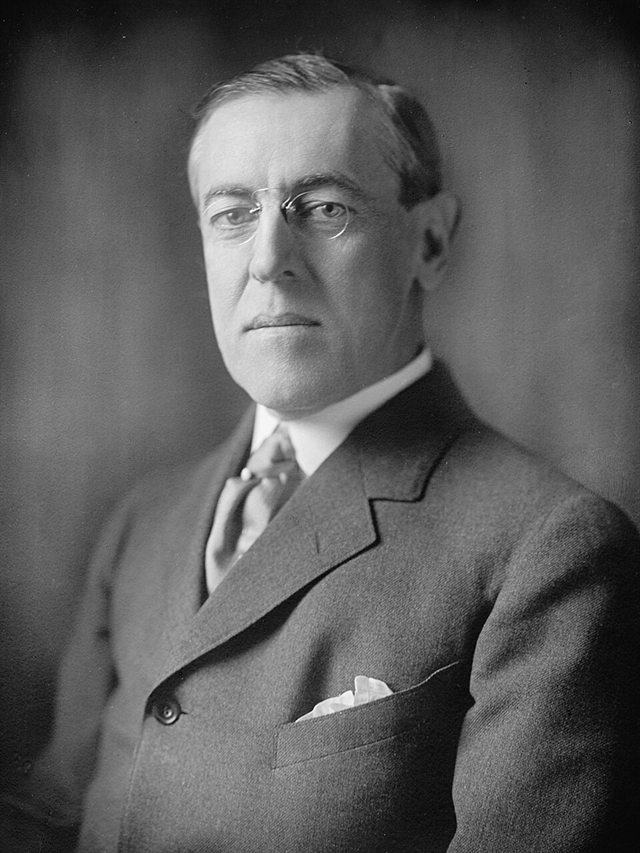
1856–1924
A professor who promised the world self-determination, refused it to the colonies and to black Americans, and died having failed to get his own country into the League of Nations he invented.
Wilson is the most consequential failure in modern diplomatic history. These five chapters follow the academic, the reforming president, the war he was re-elected for staying out of, the peace conference where his principles met Europe's, and the stroke that ended the League's chance in America.
The five chapters
- The Professor — A childhood in the defeated South
- The New Freedom, and the Files Nobody Mentions — Reform in one hand and segregation in the other
- He Kept Us Out of War — A slogan, and then five months
- Paris — Fourteen points, and who self-determination was for
- The Stroke, and the Vote He Would Not Win — A president incapacitated, and a treaty rejected twice
Chapter 1 · The Professor
A childhood in the defeated South
1856 – 1910 · Staunton · Augusta · Princeton
Thomas Woodrow Wilson was born in Virginia in 1856 and grew up in Georgia and South Carolina during the Civil War and Reconstruction. His father was a Presbyterian minister who supported the Confederacy. Wilson's earliest memory, he said, was of hearing that Lincoln had been elected and that there would be war.
That upbringing matters, because he carried a Southern reading of Reconstruction into adult life and into his scholarship: that it had been an imposition, and that the restoration of white control had been a restoration of order. He wrote history saying so, and his books were widely read.
He took a doctorate at Johns Hopkins — he remains the only American president with one — and taught political science, arguing that the American system separated power so thoroughly that nobody could be held responsible for anything, and admiring the British model. He became president of Princeton in 1902 and reformed it energetically, and lost a series of internal fights that left him with a reputation for being unable to compromise once he had decided a matter was one of principle.
That trait made him president in 1912 and destroyed him in 1919.
Why this matters
Wilson's inability to compromise on a point of principle is visible at Princeton twenty years before it cost the United States the League of Nations.
A professor of politics who could not bend. What would you ask him?
Ask Wilson
- “What did growing up in the defeated South leave you with?”
- “Why did you admire the British parliamentary system?”
- “What did the fights at Princeton teach you, if anything?”
- “Should a scholar of politics make a good politician?”
- “How did a university president become Governor of New Jersey in two years?”
Chapter 2 · The New Freedom, and the Files Nobody Mentions
Reform in one hand and segregation in the other
1913 – 1916 · Washington
Wilson won in 1912 because the Republican vote split, and governed as a reformer. The Federal Reserve Act of 1913 created a central banking system the country had been without for eighty years. Tariffs were cut and an income tax introduced. The Clayton Act of 1914 strengthened antitrust law and protected unions from being prosecuted as combinations. The Federal Trade Commission was established. It is a substantial progressive record.
In the same years his administration re-segregated the federal civil service. Departments that had employed black and white clerks alongside each other since Reconstruction introduced separate washrooms, screens between desks, and separate lunch rooms. Black officials were demoted or dismissed. When a delegation led by the newspaper editor William Monroe Trotter came to protest in 1914, Wilson told them segregation was in the interest of black employees and ended the meeting.
He also screened The Birth of a Nation at the White House in 1915 — the first film shown there — a film that presents the Ku Klux Klan as the saviours of the South and quotes his own historical writing on its title cards.
Both records are his. The progressive legislation is real and so is the segregation, and Wilson is one of the clearest cases in the period of a reformer whose idea of the public did not include everybody.
Why this matters
The same administration created the Federal Reserve and put screens between black and white clerks in the Treasury.
Reform and re-segregation from one desk. What would you put to him?
Ask Wilson
- “Why re-segregate departments that had worked together for forty years?”
- “What did you say to William Monroe Trotter, and why?”
- “What was the Federal Reserve meant to prevent?”
- “Why show The Birth of a Nation at the White House?”
- “Who did you mean by 'the people' in your speeches?”
Chapter 3 · He Kept Us Out of War
A slogan, and then five months
1914 – 1917 · Washington · The Atlantic
Wilson kept the United States neutral for two and a half years and was re-elected in 1916 on the slogan that he had kept the country out of war. He also offered repeatedly to mediate, and in January 1917 called publicly for a peace without victory — a settlement neither side could impose — which neither London nor Berlin wanted to hear.
Two things ended neutrality. Germany resumed unrestricted submarine warfare on 1 February 1917, having calculated that it could starve Britain before American forces could arrive. And the Zimmermann Telegram, intercepted and decrypted by British naval intelligence and passed to Washington, proposed a German alliance with Mexico against the United States, with the recovery of Texas, New Mexico and Arizona as the inducement. Its publication in March destroyed what remained of American neutralism.
Wilson asked Congress for a declaration of war on 2 April 1917, saying the world must be made safe for democracy. Six senators and fifty representatives voted against.
American forces took a year to arrive in strength and were decisive when they did — not because of what they did in the field in 1918, though that mattered, but because their arrival made the German calculation impossible. Ludendorff's spring offensive was a race against them, and it lost.
At home the war brought the Espionage and Sedition Acts, under which people were imprisoned for speeches against conscription, including the socialist Eugene Debs, who then ran for president from a prison cell.
Why this matters
The decision that ended American neutrality was made in Berlin, not Washington — and Wilson's wartime record on civil liberties is as harsh as any in American history.
A slogan, a telegram and a sedition act. What would you ask him?
Ask Wilson
- “What did you mean by a peace without victory in January 1917?”
- “Which mattered more, the submarines or the Zimmermann Telegram?”
- “How do you justify imprisoning people for speeches against the war?”
- “Were you honest in the 1916 campaign about what was coming?”
- “What did American entry actually change in the war?”
Chapter 4 · Paris
Fourteen points, and who self-determination was for
1918 – 1919 · Washington · Paris · Versailles
Wilson set out the Fourteen Points in January 1918: open covenants, freedom of the seas, self-determination for the peoples of Europe, and a general association of nations. It was the most influential statement of war aims of the century, and it was made by a country that had been in the war for nine months.
He went to Paris himself, the first sitting president to leave the hemisphere, and was received by enormous crowds. He then spent six months negotiating with Clemenceau, who wanted France made secure against Germany permanently, and Lloyd George, who had just won an election promising to make Germany pay. He conceded a great deal — reparations, the war guilt clause, the Rhineland occupation — to preserve the one thing he would not trade, which was the League of Nations written into the treaty itself.
The limits of self-determination became clear very fast, and they were not accidental. Nationalists from Egypt, India, China, Korea and Vietnam came to Paris expecting the principle to apply to them. It did not: it was applied to the empires that had lost and not to the empires that had won. The disappointment was formative for a generation of anti-colonial leaders, and the Chinese decision at Paris over Shandong produced the May Fourth Movement.
Wilson was awarded the Nobel Peace Prize for 1919.
Why this matters
Self-determination applied to the defeated empires and not to the victorious ones, and that limitation shaped anti-colonial politics for fifty years.
A principle applied to some peoples and not others. What would you ask him?
Ask Wilson
- “Did self-determination apply to India and Egypt, or only to Europe?”
- “What did you give up at Paris to keep the League in the treaty?”
- “Was the war guilt clause a mistake?”
- “Why did you go to Paris in person?”
- “What did you say to the delegations from Asia and Africa?”
Chapter 5 · The Stroke, and the Vote He Would Not Win
A president incapacitated, and a treaty rejected twice
September 1919 – 1924 · Pueblo · The White House · Washington
The Senate had to ratify the treaty, and its Republican majority under Henry Cabot Lodge would do so with reservations — principally that the United States would not be committed to military action under Article X without a vote of Congress. It was a limited change. Wilson's supporters urged him to accept it.
Instead he went to the country, touring by train and making some forty speeches in three weeks. At Pueblo, Colorado, on 25 September 1919 he collapsed. Days later, in Washington, he suffered a massive stroke that paralysed his left side.
For the rest of his term the country did not know how ill he was. His wife Edith and his physician controlled access, decided what reached him and what came out, and the cabinet met without him. It is the most serious concealed incapacity in the history of the presidency, and it produced the constitutional amendment on presidential disability half a century later.
From his bed he instructed Democratic senators to vote against the treaty with the Lodge reservations. They did. It failed twice, in November 1919 and March 1920, and the United States never joined the League of Nations it had invented. Some historians count the votes and conclude that a compromise Wilson refused would have carried comfortably.
He left office in 1921 and died in 1924. The League operated for twenty years without the one power that might have given it force.
Why this matters
The League failed in America over a reservation about Article X, and the president who invented it refused the compromise that would have carried it.
A stroke, a reservation and a treaty rejected twice. What would you ask him?
Ask Wilson
- “Why refuse the Lodge reservations when the votes were there?”
- “Should the country have been told how ill you were?”
- “Could the League have worked without the United States?”
- “Was taking the treaty to the country a strategy or a mistake?”
- “What would you have changed about Paris if you could?”
What Wilson changed
Wilson gave the twentieth century the language of self-determination and collective security, and the institutions to go with them — the League of Nations, and through it the model for the United Nations. He also re-segregated the federal government, imprisoned opponents of the war, applied self-determination only to the empires that had lost, and then refused the compromise that would have taken the United States into the organisation he had created. Very few political lives contain so much that is foundational and so much that undoes it.
A debate that continues
Would the League of Nations have prevented the Second World War if the United States had joined? The question cannot be settled, and the American absence is either the League's fatal weakness or an excuse for its members' own failures.
Keep exploring — ask Wilson
- “Is a principle worth anything if it is applied selectively?”
- “Should a leader compromise on the shape of an institution to get it built?”
- “Who decides that a president is too ill to govern?”
Related lives
- David Lloyd George — The Cottage-Bred Solicitor Who Ran An Empire
- Franklin D. Roosevelt — Try It, And If It Fails Admit It Frankly
- Mahatma Gandhi — Mahatma · Father of the Indian Nation
Related themes
The Paris Peace Conference · Self-determination and empire · Collective security
Continue on Incandio
- Talk to Wilson — every question on this page is one tap from being asked, and the same page carries the Historical Brief, the achievements and the timeline
- All 280 figures · Incandio — learn every idea, teach it, then defend it