Pearson Edexcel International GCSE in Biology · 4BI1 · Free · no account needed
Micropropagation — exam questions
9 original Incandio exam-style questions on micropropagation, 19 marks, about 19 minutes of writing. Each one carries the command word, the tariff and the specification statement it assesses, exactly as a paper presents them. This is an original Incandio practice question, written to reflect the structure and demands of the qualification. It is not an official Pearson Edexcel past-paper question.
This is the practice set for Micropropagation — the lesson that teaches it. Read the lesson first if the idea is new; come here when you want to find out whether you can turn it into marks. Completely free, no account needed to read.
What these questions ask of you
6 command words run through this set, and on Pearson Edexcel International GCSE Biology each one means something precise. Answering the wrong command is the commonest way a candidate who understands the lesson still loses the mark.
- Which (1 mark)
- one option chosen from the set given
- State (1 mark)
- one precise fact, no justification
- Describe (2–4 marks)
- developed, linked statements of WHAT happens — no reason required, but detail is Misread as: giving one bare statement where the tariff asked for a developed account
- Explain (2–4 marks)
- a causal chain — WHY it happens, each link a separate marking point Misread as: describing what happens without giving the reason it happens
- Suggest (1–3 marks)
- a plausible answer applying taught biology to a situation not taught
- Give (1–2 marks)
- a short factual answer drawn from recall or from the data
Assessed on Paper 1 (4BI1/1B) and Paper 2 (4BI1/2B), against AO1, AO2, AO3.
Where these sit in the specification
Pearson Edexcel International GCSE Biology (4BI1) — statements 5.17 · 5.18. Incandio is aligned to this specification; it is not published by, endorsed by or affiliated with Pearson, and it reproduces none of Pearson's wording.
The 9 questions
Answer them on paper, then open the lesson's exam practice to have them marked. The mark scheme, the accepted and rejected answers and the annotated model answer are in Incandio and are not printed here — an answer beside its question is not practice.
-
Table 1 — new plants obtained from one parent orchid in one year by three methods. Method New plants per year Genetically identical to the parent? Facilities needed Growing from seed about 400 no greenhouse Taking cuttings about 12 yes greenhouse Micropropagation about 40 000 yes sterile laboratory (a)
(1)Give
Give the method in Table 1 that produces plants that are not identical to the parent.
Table 1 — new plants obtained from one parent orchid in one year by three methods. Method New plants per year Genetically identical to the parent? Facilities needed Growing from seed about 400 no greenhouse Taking cuttings about 12 yes greenhouse Micropropagation about 40 000 yes sterile laboratory (b)
(3)Explain
Explain why a grower who wants a large number of identical orchids would choose micropropagation over cuttings.
Table 1 — new plants obtained from one parent orchid in one year by three methods. Method New plants per year Genetically identical to the parent? Facilities needed Growing from seed about 400 no greenhouse Taking cuttings about 12 yes greenhouse Micropropagation about 40 000 yes sterile laboratory (c)
(2)Suggest
Suggest why the facilities column matters to a small grower deciding between the three methods.
Table 1 — new plants obtained from one parent orchid in one year by three methods. Method New plants per year Genetically identical to the parent? Facilities needed Growing from seed about 400 no greenhouse Taking cuttings about 12 yes greenhouse Micropropagation about 40 000 yes sterile laboratory (Total for Question 1 = 6 marks)
-
(1)Which
Which term describes the small piece of tissue taken from the parent plant?
Term A a gamete B an explant C a vector D a clone (Total for Question 2 = 1 mark)
-
(1)State
State why every stage of micropropagation is carried out in sterile conditions.
(Total for Question 3 = 1 mark)
-
(4)Describe
Describe the stages of micropropagation.
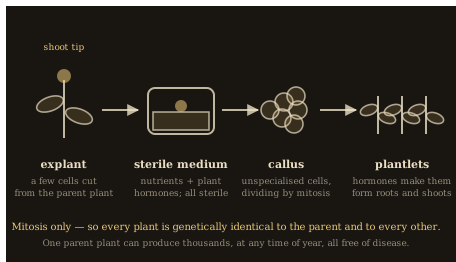
Figure 1 — the stages of micropropagation. (Total for Question 4 = 4 marks)
-
(2)Explain
Explain why every plant produced by micropropagation is genetically identical to the parent.
(Total for Question 5 = 2 marks)
-
(3)Explain
Explain why micropropagation is particularly useful for a plant that has just been bred with a valuable new characteristic.
(Total for Question 6 = 3 marks)
-
(2)Suggest
Suggest one risk to a grower of planting an entire field with micropropagated plants.
(Total for Question 7 = 2 marks)
Have them marked, then defend the answer
Practice tells you the mark; teaching it back tells you whether you understand it. On Incandio a topic counts as mastered only once you have taught it and defended it.
- Mark these questions — 9 questions, marked on Incandio against the authored scheme, with the mistake you actually made named.
- Teach it — explain micropropagation to Ember, an AI pupil who does not have it yet and asks the awkward question.
- Defend it — argue it against Hans Spemann over three rounds, marked against descriptors you can read first.
Completely free. No subscriptions, no paywalls, no account needed to start.
Back to the lesson
- Micropropagation — Growing thousands of identical plants from a few cells — and why this only works because a plant cell never quite gives up its options.
- All of Incandio Biology · Incandio Exam Practice