Pearson Edexcel International GCSE in Biology · 4BI1 · Free · no account needed
Micropropagation
Growing thousands of identical plants from a few cells — and why this only works because a plant cell never quite gives up its options.
Topic 5 · Use of biological resources — one of 8 lessons in this topic, and one of 68 in Biology.
This lesson ends with Hans Spemann. Learn micropropagation, teach it, then defend it against Hans Spemann.
The definition this lesson teaches, word for word — every Biology definition.
- Micropropagation
- Producing very large numbers of genetically identical plants from a small piece of tissue, grown on a sterile nutrient medium containing plant hormones.
What this lesson covers in the specification
Incandio is aligned to this specification. It is not published by, endorsed by or affiliated with Pearson, and it reproduces none of Pearson's wording — the statement numbers are given so you can check every lesson against your own copy.
- 5.17 — Micropropagation (tissue culture) with explants grown in vitro (bold B statement — Paper 2 only)
- 5.18 — How micropropagation produces commercial quantities of identical plants (bold B statement — Paper 2 only)
Specification section 5(c) Genetic modification (genetic engineering) — also taught in Genetic Engineering, GM Insulin and GM Crops.
1 · Understand it
No exam language yet. The only question this section answers is: do I actually understand what is happening?
Suppose a plant breeder finally produces one strawberry plant with everything wanted: heavy fruit, good flavour, resistant to the fungus that ruins the crop. It took years. Now it has to be turned into a field of them — and the ordinary route will not do it. Growing from its seeds means sexual reproduction, which shuffles the alleles, so the seedlings vary and most will not be as good as the parent. Taking cuttings avoids that, because a cutting is a clone, but one plant yields a handful of cuttings a year and a field needs tens of thousands. The problem is not how to make a copy. It is how to make a hundred thousand copies, quickly, from a plant that only exists once.
MICROPROPAGATION solves it, and it can only work because of something peculiar about plants. When a plant cell specialises, it does not lose the ability to go back. Given the right conditions and the right hormones, an ordinary cell from a shoot tip will divide into a mass of unspecialised cells and then build an entire new plant — roots, stem, leaves and all. Most specialised animal cells cannot do this, which is why there is no equivalent procedure for making a hundred thousand sheep from a piece of one. A plant cell keeps its options.
Think of it like a starter kept alive in a kitchen
A baker keeps a jar of sourdough starter. Every few days it is split: half is used, half is fed with fresh flour and water and grows back to full volume, and can be split again. Nothing is bought, nothing is bred, and the culture never runs down — but it does have to be kept scrupulously clean, because it is a warm jar of food and anything that gets in will thrive in it. After ten splittings you have not ten times as much starter but a thousand times, because each splitting doubles what came before. Micropropagation is the same shape of process: a small piece taken, fed, grown, divided again, and the numbers multiply instead of adding. And the same vulnerability — a jar of nutrients is exactly as attractive to mould as it is to the thing you meant to grow.
Micropropagation — the method, and the reason for each step
- A small piece of tissue, an EXPLANT, is cut from the parent plant — usually from a shoot tip, because those cells are dividing already.
- The explant is STERILISED, and everything it touches is sterile, because the growth medium is a dish of nutrients that bacteria and fungi would colonise far faster than plant cells grow.
- It is placed on a sterile GROWTH MEDIUM in a container: nutrients to build with, sugar for respiration, and PLANT HORMONES. This is what IN VITRO means — grown in glass, outside the living plant.
- The cells divide by MITOSIS into a CALLUS, a shapeless mass of unspecialised cells. Because the division is mitosis, every cell carries the same alleles as the parent plant.
- The callus is DIVIDED UP and each piece transferred to fresh medium, where hormones cause the cells to specialise into roots and shoots — the balance of hormones decides which.
- The young PLANTLETS are grown on, then hardened off in a greenhouse and finally planted out. Each is genetically identical to the original parent and to every other.
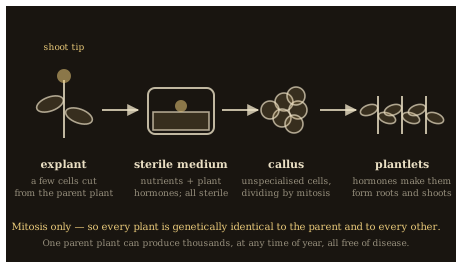
That dividing-again is the answer to the second half of the specification, and it is worth being precise about why it produces COMMERCIAL quantities rather than merely a lot. Each culture can be cut up into several new cultures every few weeks, and each of those grows and is cut up in turn. The numbers therefore multiply: five cultures become twenty-five, then a hundred and twenty-five, then six hundred and twenty-five. Growth that multiplies leaves growth that adds behind almost immediately, and it is why a single parent plant can supply an entire industry within a year. Cuttings cannot do this. A plant that yields ten cuttings a year yields twenty in two years, not a hundred.
The rest of the advantages follow from what the method is. Everything produced is genetically identical, so a grower knows exactly what every plant in the field will do — the same size, the same ripening date, the same quality. It works all year round in a laboratory rather than waiting for a growing season. It can propagate plants that are difficult or impossible to grow from seed, including sterile varieties: the banana grown commercially produces no viable seeds at all, so every plant in every plantation must be a clone of another. And because the starting explant is sterilised and the stock is grown from a few cells, the plants can be raised free of the viruses that accumulate in a parent plant over years.
The costs are equally direct. The equipment and the trained staff are expensive, so it is only worth doing for a valuable crop. A single failure of sterility can destroy an entire batch, because a contaminating fungus in a warm nutrient dish grows very much faster than a plant. And the fundamental one, which is the point this course keeps returning to: the plants have no genetic variation between them. A disease or a pest that one plant cannot resist, none of them can resist, and a whole plantation can be lost at once. That is not a hypothetical — it is roughly what happened to the variety of banana that supplied the world before the 1950s, and the variety that replaced it is now being lost to a fungus in the same way.
2 · Grade 9 Notes
A different job from the section above. You have already understood it; this is the precise set of things to LEARN — definitions to reproduce word for word, processes in order, equations with units, and the answers that score full marks.
Learn this definition · Micropropagation
Producing very large numbers of genetically identical plants from a small piece of tissue, grown on a sterile nutrient medium containing plant hormones.
The words this statement is marked on
- Explant
- The small piece of tissue cut from the parent plant, usually from a shoot tip, that the culture is started from.
- In vitro
- Grown in glass — that is, in a container outside the living organism, rather than in the plant itself.
- Callus
- The shapeless mass of unspecialised cells the explant first divides into, before roots and shoots form.
- Growth medium
- The sterile jelly or liquid supplying nutrients, sugar and plant hormones for the culture.
- Aseptic technique
- Working so that no microorganism enters the culture — sterile instruments, sterile medium, sterilised explant.
- Clone
- An organism genetically identical to the one it came from, because it was produced by mitosis alone.
Statements 5.17 and 5.18 — the method to write, in order
- Cut a small explant, usually from a shoot tip, from the parent plant with the desired characteristics.
- Sterilise the explant, and use sterile instruments and a sterile growth medium throughout.
- Place the explant on the medium, which contains nutrients, sugar and plant hormones.
- The cells divide by mitosis to form a callus of unspecialised cells.
- Divide the callus and transfer the pieces to fresh medium, where hormones make them form roots and shoots.
- Grow the plantlets on, harden them off in a greenhouse, and plant them out.
Why a grower uses micropropagation
- VERY LARGE NUMBERS from one parent, because each culture is divided again every few weeks so the numbers multiply
- EVERY PLANT IDENTICAL to the parent, so the crop is uniform in size, quality and ripening date
- ALL YEAR ROUND in a laboratory, independent of the growing season
- PROPAGATES PLANTS THAT WILL NOT GROW FROM SEED, including sterile varieties such as the commercial banana
- DISEASE-FREE STOCK, because the explant is sterilised and the plants are raised from a few cells
What it costs — the disadvantages worth naming
- EXPENSIVE: specialised equipment and trained staff, so it is only worth doing for a valuable crop
- CONTAMINATION can destroy an entire batch, because bacteria and fungi grow far faster than plant cells in a nutrient medium
- NO GENETIC VARIATION between the plants, so a disease that one cannot resist, none can resist
- The whole crop can therefore be lost at once, and there is no resistant individual to breed from
Micropropagation against growing the same crop from seed
| Micropropagation | From seed | |
|---|---|---|
| Type of reproduction | asexual — mitosis only | sexual — gametes fuse |
| The offspring | genetically identical to the parent and to each other | genetically varied; most differ from the parent |
| Numbers from one parent | many thousands, multiplying with each division of the cultures | limited to the seeds that one plant sets |
| When it can be done | any time of year, in a laboratory | tied to the flowering and growing season |
| Risk | one disease can take the whole crop; contamination can lose a batch | variation means some individuals are likely to survive a new disease |
The two things hormones do here
A. IN THE FIRST MEDIUM the hormones drive division, so the explant grows into a callus of unspecialised cells rather than into any particular structure.
B. IN THE SECOND MEDIUM the balance of hormones makes the cells specialise, so pieces of callus develop roots and shoots and become plantlets.
Model answer [3 marks]
Explain why every plant produced by micropropagation is genetically identical to the parent plant. [3]
The explant is taken from the parent plant, so its cells already carry the parent's alleles. All the division that follows is mitosis, which produces daughter cells with exactly the same chromosomes and therefore the same alleles as the cell they came from. No gametes are involved and no fertilisation takes place, so there is no shuffling or recombining of alleles and no new combinations arise. Every plantlet is therefore a clone of the parent.
Model answer [3 marks]
Explain why micropropagation can produce commercial quantities of plants when taking cuttings cannot. [3]
Each culture can be divided into several new cultures every few weeks, and each of those grows and is divided again, so the number of plants multiplies at every stage instead of increasing by a fixed amount. Only a few cells are needed to start each new culture, so one parent plant supplies far more starting material than it could supply cuttings. The work is done in a laboratory, so it continues all year rather than being limited to a growing season.
Not this: Micropropagation produces plants that are stronger, because only the best parent plant is used.
This: They are not stronger, only identical. They carry exactly the same alleles as the parent, including any weakness it has — and because there is no variation between them, a disease that affects one affects all of them.
Mark-losing trap. The division is MITOSIS. That single word is what makes the plants identical, and it is a mark.
Mark-losing trap. Name the callus stage. An answer that goes straight from explant to plantlet has missed a step.
Mark-losing trap. Sterile is not a detail — say what would otherwise grow in a warm dish of nutrients.
Mark-losing trap. 'Commercial quantities' means the numbers MULTIPLY each cycle. Say that, not just 'lots of plants'.
3 · Prove it — the five questions
The five questions climb Grade 6 → Grade 7 → Grade 8 → Grade 9 → Grade 9 challenge, and are marked inside Incandio on your own device, by rule, with an authored diagnosis of the mistake you actually made. The mark schemes stay in the app so that the practice is worth doing; the questions themselves are here.
- Grade 6 · State [1 mark] — In micropropagation, what is an explant?
- Grade 7 · Explain [2 marks] — Explain why the explant, the instruments and the growth medium must all be sterile.
- Grade 8 · Describe [5 marks] — A grower has one plant with an unusually heavy crop and wants thousands of plants exactly like it. Select every statement that belongs in a full-mark description of how micropropagation would be used.
- Grade 9 · Calculate [3 marks] — A laboratory divides each tissue culture into 5 new cultures every 4 weeks. Starting from a single explant, calculate how many cultures there will be after 12 weeks.
- 9+ · Evaluate [6 marks] — A company plans to supply an entire banana-growing region with plants of one variety, all produced by micropropagation. Select every statement that belongs in a full-mark evaluation of this plan.
The people behind this science
Two ways into the same idea — the one whose entire science needs the cross this method abolishes, and the one who first showed a plant is built of tissues at all. Inside Incandio each of them answers knowing exactly which lesson you have just finished.
Gregor Mendel — the one whose entire science needs the cross this method abolishes
Every result Mendel ever obtained came from a cross: two parents, factors separating into the pollen and the ovule and recombining at fertilisation, and the three-to-one ratios that follow. Micropropagation removes the cross entirely — no gametes, no fertilisation, no recombination — so nothing segregates and no ratio appears. He is also the person who knows best what it costs to get a population that breeds absolutely true, because he spent years selfing peas to obtain lines that would; this method reaches the same place in a fortnight, and skips the generations in which the variation shows up.
- “What happens to your three-to-one ratios if there is no cross at all?”
- “How long did it take you to get a line of peas that bred true?”
- “Is a plant grown from a piece of another plant its offspring, or is it the same plant?”
- “Why does sexual reproduction produce so much variation between the seedlings?”
- “What would you lose if every plant in a garden carried identical factors?”
Marcello Malpighi — the one who first showed a plant is built of tissues at all
This whole procedure begins by cutting out a piece of tissue, which presupposes that a plant is made of tissues that can be taken apart and still be alive. That was not obvious, and Malpighi is the person who established it: his Anatome Plantarum of the 1670s was the first sustained microscopic study of plant structure, describing the vessels, the layers and the small chambers a plant is built from. An explant is a fragment of exactly what he was the first to look at, and the surprise this lesson turns on — that such a fragment can rebuild the whole organism — is the natural next question about his own drawings.
- “What did a plant stem look like under your first lenses?”
- “Why did you study plants as well as animals under the microscope?”
- “How is a plant built out of smaller repeating parts?”
- “Could you tell which parts of a plant were alive and which were not?”
- “What surprised you most about the inside of a leaf?”
Think you understand it?
Reading is the start. On Incandio a topic counts as mastered only once you have taught it and defended it — the two things a revision guide cannot ask of you.
Incandio this topic → Prove it. Teach it. Defend it. What does “Incandio it” mean?
- Prove it — five questions on micropropagation, marked on the spot, that tell you what was missing rather than just what was wrong.
- Teach it — Explain micropropagation in your own words to Ember, an AI pupil who does not have it yet and asks the awkward question. Understanding is credited; wording is not required.
- Defend it — Argue micropropagation against Hans Spemann — three rounds, marked against descriptors you can read before you begin.
- Then the exam — read all 9 authored exam-style questions on this unit, each with its command word and its tariff, then have them marked on Incandio with the mistake you actually made named.
Completely free. No subscriptions, no paywalls, no account needed to start.
Carry on through the course
- Previous lesson: GM Insulin and GM Crops
- Next lesson: Cloning Mammals
- Increasing Crop Yield — Everything a grower does is one of two things — remove whatever is limiting the crop, or remove whatever is competing with it.
- Yeast, Bread and Fermentation — One organism respiring without oxygen — and two industries built on the two different products it makes.
- Yoghurt and the Industrial Fermenter — Bacteria turned into a manufacturing process — and the vessel built to give them the best conditions they will ever have.
- Fish Farming and Selective Breeding — Growing food by controlling every loss of energy — and by doing deliberately what the environment does by accident.
- Genetic Engineering — Cutting a gene out of one organism and making another organism read it — and the reason that works at all.
- All of Biology · Biology key terms · required practicals · Incandio Science · The 4BI1 specification