Pearson Edexcel International GCSE in Biology · 4BI1 · Free · no account needed
Monohybrid Inheritance and Probability
A method for predicting offspring, the ratio it produces — and two honest limits on what that ratio actually tells you.
Topic 3 · Reproduction and inheritance — one of 15 lessons in this topic, and one of 68 in Biology.
This lesson ends with Gregor Mendel. Learn Monohybrid Inheritance and Probability, teach it, then defend it against Gregor Mendel.
The 2 definitions this lesson teaches, word for word — every Biology definition.
- Monohybrid inheritance
- The inheritance of a single characteristic controlled by one gene with two alleles.
- Polygenic inheritance
- Inheritance in which a characteristic is controlled by several genes acting together, usually producing a continuous range of phenotypes rather than distinct categories.
What this lesson covers in the specification
Incandio is aligned to this specification. It is not published by, endorsed by or affiliated with Pearson, and it reproduces none of Pearson's wording — the statement numbers are given so you can check every lesson against your own copy.
- 3.22 — Most phenotypic features result from polygenic inheritance
- 3.23 — Patterns of monohybrid inheritance shown with a genetic diagram
- 3.25 — Predicting probabilities of outcomes from monohybrid crosses
Specification section 3(b) Inheritance — also taught in DNA, Genes and Chromosomes, Protein Synthesis, Alleles, Genotype and Phenotype, Pedigrees and Sex Determination.
1 · Understand it
No exam language yet. The only question this section answers is: do I actually understand what is happening?
A MONOHYBRID cross follows one gene, with two alleles, through one generation. That is a deliberately simple case, and it is worth knowing from the start that most characteristics are not like it — but it is the case where the reasoning is visible, and the reasoning is what transfers.
The routine — five steps, in this order, every time
- STATE WHAT THE LETTERS MEAN. 'T = allele for tall, t = allele for short.' Do this even when the question seems to have told you, because it is often a mark.
- WRITE THE PARENTS' GENOTYPES, two letters each: Tt × Tt.
- WRITE THE GAMETES, ONE letter each, circled or in brackets: (T) (t) × (T) (t). A gamete has one allele of each gene, because it has one chromosome of each pair.
- COMBINE THEM IN A GRID — a Punnett square. Parents' gametes along the top and down the side, and each box filled by taking one letter from each.
- READ OFF THE OFFSPRING. Give the genotypes, then the phenotypes, then the ratio or probability the question asked for.
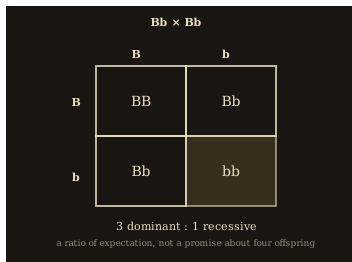
Worked example — two heterozygous tall plants
In pea plants the allele for tall (T) is dominant to the allele for short (t). Two heterozygous tall plants are crossed. What proportion of the offspring would be expected to be short?
- T = allele for tall, t = allele for short.
- Parents' genotypes: Tt × Tt — both heterozygous.
- Gametes: each parent can produce (T) or (t).
- The four boxes of the grid give TT, Tt, Tt and tt.
- Phenotypes: TT is tall, Tt is tall, Tt is tall, tt is short — a ratio of 3 tall : 1 short.
Answer: 1 in 4, or 25 %, of the offspring would be expected to be short.
The 3 : 1 ratio is the signature of a heterozygous cross, and it is worth knowing why it comes out at three rather than two. Four combinations are possible, and three of them contain at least one dominant allele — TT, Tt and Tt. Only tt has none. So the recessive characteristic appears in one box out of four, not because it is weaker but because it is the only outcome with no dominant allele available to mask it.
Now the first honest limit, and it is the one most often examined. A ratio is a PROBABILITY, not a promise. Each offspring is a separate event: the chance of it being short is 1 in 4 regardless of what its brothers and sisters turned out to be. A cross of two heterozygotes might produce four short plants in a row, exactly as four coins might all come up heads. What the ratio predicts is the long-run proportion, and small numbers of offspring will scatter around it — which is precisely why Mendel counted thousands of plants rather than four.
Think of it like two spinners, not like a fixed portion
Each parent spins to decide which of its two alleles goes into a gamete, and both spins are fair and independent. That is not the same as a cake being divided so that exactly a quarter is set aside. If you spin twice and get the recessive allele both times, the offspring is homozygous recessive — and the spinner has no memory, so the next offspring's chances are unchanged. Whenever a question says 'the first child was affected, what is the chance the second will be?', it is testing exactly this, and the answer is always the same as it was for the first.
The second limit is statement 3.22, and it matters because it is where this topic touches real life. Most human characteristics are NOT controlled by a single gene. Height, skin colour, body mass and most others are POLYGENIC — controlled by several genes acting together, often with a substantial environmental contribution as well. That is why such characteristics show a continuous range of values rather than falling into two or three distinct categories, and it is why you cannot draw a Punnett square for height and expect it to work.
So the honest position on a monohybrid diagram is this: it is exactly right for the small number of characteristics genuinely controlled by one gene — many inherited disorders, flower colour in the classic examples, blood group — and it is a teaching model for everything else. Knowing which situation you are in is part of the biology, not a caveat attached to it.
2 · Grade 9 Notes
A different job from the section above. You have already understood it; this is the precise set of things to LEARN — definitions to reproduce word for word, processes in order, equations with units, and the answers that score full marks.
Learn this definition · Monohybrid inheritance
The inheritance of a single characteristic controlled by one gene with two alleles.
Learn this definition · Polygenic inheritance
Inheritance in which a characteristic is controlled by several genes acting together, usually producing a continuous range of phenotypes rather than distinct categories.
Drawing a genetic diagram — the five steps, and the marks attached to each
- State what each letter represents: 'T = tall allele, t = short allele.' Often a mark on its own.
- Write the parental genotypes, TWO letters each.
- Write the gametes, ONE letter each, circled or in brackets.
- Draw a Punnett square: one parent's gametes along the top, the other's down the side; fill each box with one letter from its row and one from its column.
- Read off the offspring genotypes, then the phenotypes, then give the ratio or probability that was asked for.
The three crosses that cover almost every question
| Tt × Tt | Tt × tt | TT × tt | |
|---|---|---|---|
| Offspring genotypes | TT, Tt, Tt, tt | Tt, Tt, tt, tt | Tt, Tt, Tt, Tt |
| Genotype ratio | 1 TT : 2 Tt : 1 tt | 1 Tt : 1 tt | all Tt |
| Phenotype ratio | 3 dominant : 1 recessive | 1 dominant : 1 recessive | all show the dominant characteristic |
| Chance of the recessive phenotype | 1 in 4, or 25 % | 1 in 2, or 50 % | 0 |
| What it is used for | the classic cross — two carriers | a TEST CROSS, to find whether an organism is TT or Tt | producing a uniform heterozygous generation |
Expressing the answer — give the form the question actually asked for
- As a RATIO: 3 : 1 — no units, and the order must match the order of the phenotypes you named
- As a FRACTION: 1/4
- As a PERCENTAGE: 25 %
- As a PROBABILITY: 0.25, or '1 in 4'
- As an EXPECTED NUMBER: multiply the fraction by the total — 1/4 of 240 offspring is 60
- If the question says 'expected', the word is doing real work: the actual result will differ, and more so with fewer offspring
What a ratio does and does not promise
A. IT DOES predict the long-run proportion of offspring, and it is the best estimate for any single offspring — each one independently has a 1 in 4 chance in a Tt × Tt cross.
B. IT DOES NOT guarantee the outcome in a small family. Small samples show wide random variation around the expected proportion, and a previous child's phenotype never changes the odds for the next.
Not this: Two parents who are carriers will have three unaffected children for every affected one.
This: Each child independently has a 1 in 4 chance of being affected. The ratio describes probability across many offspring, not an allocation within one family.
Model answer [4 marks]
In mice, black fur (B) is dominant to brown fur (b). Draw a genetic diagram to show the cross between two heterozygous black mice, and state the expected ratio of phenotypes. [4]
B = allele for black fur, b = allele for brown fur. Parental genotypes: Bb × Bb. Gametes: (B) and (b) from each parent. Combining these gives offspring genotypes BB, Bb, Bb and bb. BB and both Bb offspring have black fur, and bb has brown fur, so the expected phenotype ratio is 3 black : 1 brown.
Model answer [3 marks]
Two parents who each carry one allele for a recessive condition already have one affected child. Explain the probability that their next child will be affected. [3]
Both parents are heterozygous, so each can pass on either the dominant or the recessive allele, and the chance of a child inheriting a recessive allele from both is 1 in 4. Each conception is an independent event, so the outcome of a previous pregnancy does not affect it. The probability for the next child is therefore 1 in 4, or 25 %, exactly as it was for the first.
Model answer [3 marks]
Explain why human height cannot be predicted using a monohybrid genetic diagram. [3]
Height is a polygenic characteristic, controlled by several genes acting together rather than by a single gene with two alleles. It is also strongly affected by the environment, particularly by diet during growth. It therefore shows a continuous range of values rather than falling into distinct categories, and a diagram following one gene with two alleles cannot represent it.
Mark-losing trap. Gametes get ONE letter; organisms get TWO. Writing Tt as a gamete loses a mark on almost every genetic diagram.
Mark-losing trap. State what your letters mean before you start. It is frequently a mark on its own.
Mark-losing trap. A 3 : 1 ratio is EXPECTED, not guaranteed. Each offspring is an independent event.
Mark-losing trap. A previous child's phenotype never changes the probability for the next one.
Mark-losing trap. Give the answer in the form asked for — ratio, percentage, probability or number. A 3 : 1 given where a percentage was wanted may score nothing.
3 · Prove it — the five questions
The five questions climb Grade 6 → Grade 7 → Grade 8 → Grade 9 → Grade 9 challenge, and are marked inside Incandio on your own device, by rule, with an authored diagnosis of the mistake you actually made. The mark schemes stay in the app so that the practice is worth doing; the questions themselves are here.
- Grade 6 · State [1 mark] — Two heterozygous tall pea plants (Tt) are crossed, where T is dominant. What is the expected ratio of tall to short offspring?
- Grade 7 · Apply [2 marks] — In guinea pigs, short hair (H) is dominant to long hair (h). A short-haired guinea pig with the genotype Hh is crossed with a long-haired one. What proportion of the offspring would be expected to have long hair?
- Grade 8 · Explain [5 marks] — A couple who are both carriers of a recessive condition have three unaffected children. They are told that their fourth child is certain to be affected, because the ratio is 3 : 1. Explain why this is wrong. Select every statement that belongs in a full-mark explanation.
- Grade 9 · Calculate [4 marks] — In tomato plants, red fruit (R) is dominant to yellow fruit (r). A heterozygous red plant is crossed with another heterozygous red plant, and 640 seeds are grown. Calculate the number of plants expected to be homozygous dominant.
- 9+ · Analyse [5 marks] — A student crosses two heterozygous tall pea plants and grows 12 offspring, of which 5 are short. They conclude that tall is not dominant after all, since 3 : 1 would have predicted 3 short. Select every statement that belongs in a full-mark evaluation.
The people behind this science
Two ways into the same idea — the one who found the ratio by counting, and the one who understood what a calculation can and cannot promise. Inside Incandio each of them answers knowing exactly which lesson you have just finished.
Gregor Mendel — the one who found the ratio by counting
The 3 : 1 ratio on this page is Mendel's result, and the way he got it is the lesson. He grew and counted tens of thousands of pea plants across seven characteristics, and it was the consistency of the proportion — not any single cross — that forced the conclusion that inheritance comes in discrete units which separate when gametes form. He had chosen peas because they normally self-pollinate and because each characteristic he picked fell into two clear categories, which is exactly the case this page's diagram applies to.
- “Why did you need thousands of plants rather than a few dozen?”
- “What made you choose characteristics with only two forms?”
- “How did the ratio tell you that factors separate when gametes are made?”
- “Did any of your results fail to fit the pattern?”
- “What would you have made of a characteristic with a continuous range?”
Ada Lovelace — the one who understood what a calculation can and cannot promise
This page is really about the difference between a rule and an outcome, which is a question about calculation rather than about biology. Lovelace wrote the first published account of how a machine could be made to follow a general rule and produce results from it, and she was unusually careful about the limits — insisting that such a machine 'has no pretensions to originate anything' and can only do what it is instructed. That is the right attitude to a Punnett square: it computes a probability faithfully, and it cannot tell you what any particular child will be.
- “What is the difference between a rule and the result of applying it?”
- “Can a calculation tell you what will actually happen, or only what to expect?”
- “Why were you so careful about claiming what a machine could do?”
- “How would you explain probability to someone expecting certainty?”
Think you understand it?
Reading is the start. On Incandio a topic counts as mastered only once you have taught it and defended it — the two things a revision guide cannot ask of you.
Incandio this topic → Prove it. Teach it. Defend it. What does “Incandio it” mean?
- Prove it — five questions on Monohybrid Inheritance and Probability, marked on the spot, that tell you what was missing rather than just what was wrong.
- Teach it — Explain Monohybrid Inheritance and Probability in your own words to Ember, an AI pupil who does not have it yet and asks the awkward question. Understanding is credited; wording is not required.
- Defend it — Argue Monohybrid Inheritance and Probability against Gregor Mendel — three rounds, marked against descriptors you can read before you begin.
- Then the exam — read all 11 authored exam-style questions on this unit, each with its command word and its tariff, then have them marked on Incandio with the mistake you actually made named.
Completely free. No subscriptions, no paywalls, no account needed to start.
Carry on through the course
- Previous lesson: Alleles, Genotype and Phenotype
- Next lesson: Pedigrees and Sex Determination
- Sexual and Asexual Reproduction — Two ways to make a new organism — one produces copies, the other produces something that has never existed before. Why any species would want both.
- Flowers, Pollination and Fertilisation — Two completely different solutions to one problem — a plant that cannot move has to get its male gamete to another plant's female gamete.
- Seeds and Germination — What a seed needs to start growing, what it lives on before it has a single leaf — and why light is not on the list.
- The Human Reproductive Systems — Two systems built around the same problem — making gametes and bringing them together — and the hormones that switch them on.
- The Menstrual Cycle — Four hormones, two organs and one repeating question — should the uterus lining be built up, held, or let go?
- All of Biology · Biology key terms · required practicals · Incandio Science · The 4BI1 specification