Pearson Edexcel International GCSE in Chemistry · 4CH1 · Free · no account needed
Esters And How To Make One
An alcohol and an acid, a drop of catalyst and some gentle warmth — and a smell that tells you it worked.
Topic 4 · Organic chemistry — one of 16 lessons in this topic, and one of 61 in Chemistry.
This lesson ends with Emil Fischer. Learn Esters And How To Make One, teach it, then defend it against Emil Fischer.
The definition this lesson teaches, word for word — every Chemistry definition.
- Ester
- A compound formed when an alcohol reacts with a carboxylic acid, containing the –COO– functional group, with water also produced.
One of the 12 Chemistry required practicals.
What this lesson covers in the specification
Incandio is aligned to this specification. It is not published by, endorsed by or affiliated with Pearson, and it reproduces none of Pearson's wording — the statement numbers are given so you can check every lesson against your own copy.
- 4.38 — Esters contain the –COO– functional group (bold C statement — Paper 2 only)
- 4.39 — Ethyl ethanoate from ethanol and ethanoic acid with an acid catalyst (bold C statement — Paper 2 only)
- 4.40 — The structural and displayed formulae of ethyl ethanoate (bold C statement — Paper 2 only)
- 4.43 — Practical: prepare a sample of an ester such as ethyl ethanoate (bold C statement — Paper 2 only) (required practical)
1 · Understand it
No exam language yet. The only question this section answers is: do I actually understand what is happening?
An ESTER is what you get when an alcohol and a carboxylic acid are joined together. Its functional group is written –COO–, and the dashes on both sides matter: unlike every group met so far, this one sits in the MIDDLE of a molecule, with a carbon chain on either side of it.
That middle position is the reason esters are worth a page of their own. Every other family on this course is a chain with something interesting on the end. An ester is two chains held together by a joint, and the joint came from two separate molecules.
Making ethyl ethanoate — statement 4.39
- Start with ETHANOL, CH₃CH₂OH, and ETHANOIC ACID, CH₃COOH.
- Add a few drops of concentrated sulfuric acid as the CATALYST, and warm the mixture.
- The –OH of the alcohol and the –OH of the acid come together, and a molecule of WATER is removed from between them.
- What is left of the two molecules joins directly, through the –COO– group.
- The product is ETHYL ETHANOATE, CH₃COOC₂H₅, and the other product is water.
- CH₃COOH + C₂H₅OH ⇌ CH₃COOC₂H₅ + H₂O.
- Because a small molecule is expelled as the two join, this is a CONDENSATION reaction — and the double arrow shows that it is reversible.
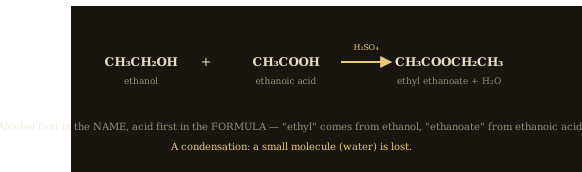
The name has to be read carefully, because it runs the opposite way from the formula. ETHYL comes from the alcohol, ethanol, and it is written FIRST in the name. ETHANOATE comes from the acid, ethanoic acid, and it is written second. But in the formula CH₃COOC₂H₅ the acid fragment CH₃COO– comes first and the alcohol's C₂H₅ comes last. Alcohol first in the name; acid first in the formula.
Think of it like a married surname on a wedding invitation
An invitation might read 'Ellis and Okonkwo' while the couple's front door says 'Okonkwo–Ellis'. Nothing has changed about who is involved; two different conventions simply put them in different orders, and if you assume one order applies everywhere you will address the envelope wrongly. Esters are exactly this. The name lists the alcohol's contribution first and the acid's second. The formula does the reverse. Learn both orders as a pair, and the confusion stops being confusing.
Ethyl ethanoate written out in full as a structural formula is CH₃COOCH₂CH₃. Reading it from the left: a methyl group, then the carbon of the –COO– carrying its double-bonded oxygen, then the single-bonded oxygen, then the two-carbon ethyl chain. Drawing the displayed formula means showing that carbon with a double bond to one oxygen and a single bond to the other, and that oxygen joined on to the next carbon.
The last thing this page needs is the practical itself, and it is worth knowing why each step is there rather than learning the list. The concentrated sulfuric acid is a catalyst, so it speeds the reaction without being used up. The heating is done in a hot WATER BATH rather than over a flame, because ethanol and the ester are both volatile and highly flammable. And the mixture is poured into sodium carbonate solution at the end, because unreacted ethanoic acid has a sharp smell of its own that would completely mask the ester's.
The result is an oily layer floating on the surface, with a sweet, fruity smell often compared to pear drops or nail-varnish remover. The smell is the evidence that the reaction has worked, and it should be sampled by wafting the vapour towards you with a hand, never by putting your nose over the beaker.
2 · Grade 9 Notes
A different job from the section above. You have already understood it; this is the precise set of things to LEARN — definitions to reproduce word for word, processes in order, equations with units, and the answers that score full marks.
Learn this definition · Ester
A compound formed when an alcohol reacts with a carboxylic acid, containing the –COO– functional group, with water also produced.
CH₃COOH + C₂H₅OH ⇌ CH₃COOC₂H₅ + H₂O
Conditions: Concentrated sulfuric acid catalyst, warmed. Ethanoic acid plus ethanol gives ethyl ethanoate and water. Reversible, and a condensation.
The words this page is marked on
- –COO–
- The ester functional group. It sits in the middle of the molecule, with a carbon chain on each side.
- Esterification
- The reaction of an alcohol with a carboxylic acid to form an ester and water.
- Condensation reaction
- One in which two molecules join and a small molecule, here water, is expelled.
- Ethyl ethanoate
- CH₃COOC₂H₅, made from ethanol and ethanoic acid. Smells sweet and fruity, like pear drops.
Required practical 4.43 — preparing a sample of an ester
- Put about 2 cm³ of ethanol and about 2 cm³ of ethanoic acid into a boiling tube.
- Add three or four drops of concentrated sulfuric acid, using a teat pipette and wearing eye protection, since it is corrosive.
- Stand the tube in a beaker of hot water and leave it for about five minutes. Do not heat it over a flame, because ethanol and the ester are volatile and flammable.
- Pour the warm mixture into a beaker containing sodium carbonate solution, to neutralise the remaining acids.
- A colourless oily layer of ester floats on the surface.
- Smell it by wafting the vapour towards your nose with a hand; a sweet, fruity smell like pear drops confirms that ethyl ethanoate has formed.
Variables
Independent (changed) — The alcohol used, when the same preparation is repeated to make different esters
Dependent (measured) — The ester produced, identified by its characteristic smell
| Control variable | Why it must be held constant |
|---|---|
| Volume of carboxylic acid | using more acid gives more ester, so a difference in smell could not be attributed to the alcohol |
| Number of drops of catalyst | the catalyst sets the rate, so an unequal amount changes how much ester forms in the time given |
| Water-bath temperature | a warmer bath speeds the reaction, so more ester would form for reasons unconnected with the alcohol |
| Heating time | the reaction is reversible and approaches equilibrium slowly, so a longer time gives a larger yield |
Sources of error
| Type | What goes wrong | What to do |
|---|---|---|
| Systematic | Heating over a naked flame boils off the volatile ethanol and ester before they can react. | Heat the tube in a beaker of hot water instead. |
| Systematic | Unreacted ethanoic acid left in the mixture has a sharp smell that masks the ester. | Pour the product into sodium carbonate solution before smelling it. |
| Judgement | Identifying an ester by its smell is subjective, and people describe the same smell differently. | Have several people smell the sample independently and compare. |
Why each step of the practical is there
- Concentrated sulfuric acid: a catalyst, so the reaction is fast enough to see in a lesson.
- A hot water bath rather than a flame: ethanol and the ester are volatile and highly flammable.
- Sodium carbonate solution at the end: neutralises the leftover acids, whose sharp smell would mask the ester.
- Wafting rather than inhaling: the standard way to sample any smell safely in a laboratory.
What is observed, and what it means
- A colourless oily layer floats on the surface of the sodium carbonate solution
- It has a sweet, fruity smell, often described as pear drops or nail-varnish remover
- The smell is the evidence that the ester has formed
- The yield is never complete, because esterification is a reversible reaction
Model answer [5 marks]
Describe how you would prepare a sample of ethyl ethanoate in the laboratory, including one safety precaution. [5]
Place a few cubic centimetres each of ethanol and ethanoic acid in a boiling tube, and add three or four drops of concentrated sulfuric acid as a catalyst. Stand the tube in a beaker of hot water for about five minutes rather than heating it directly, because ethanol and the ester are volatile and highly flammable — that is the safety precaution. Then pour the mixture into sodium carbonate solution to neutralise the remaining acids, which would otherwise mask the smell. A colourless oily layer of ethyl ethanoate floats on the surface, and wafting its vapour towards the nose gives a sweet, fruity smell.
Model answer [3 marks]
Explain why the reaction mixture is poured into sodium carbonate solution at the end of the preparation. [3]
Esterification is reversible and does not go to completion, so unreacted ethanoic acid remains in the mixture along with the concentrated sulfuric acid catalyst. Ethanoic acid has a sharp, pungent smell of its own that would mask the sweet smell of the ester, making it impossible to tell whether the preparation had worked. The sodium carbonate solution neutralises both acids, removing that smell and leaving the ester as an oily layer floating on the surface where it can be identified.
Not this: The ester takes its first name from the acid, since the acid is written first in the formula.
This: The first part of the NAME comes from the ALCOHOL. Ethyl ethanoate takes ethyl from ethanol and ethanoate from ethanoic acid, even though the formula CH₃COOC₂H₅ puts the acid fragment first. The name and the formula run in opposite orders.
Mark-losing trap. Alcohol first in the NAME, acid first in the FORMULA. The two orders are opposite, and both are examined.
Mark-losing trap. Concentrated sulfuric acid is the CATALYST, not a reactant. It does not appear in the equation.
Mark-losing trap. Water is the second product. Leaving it out makes the equation unbalanced and loses the condensation mark.
3 · Prove it — the five questions
The five questions climb Grade 6 → Grade 7 → Grade 8 → Grade 9 → Grade 9 challenge, and are marked inside Incandio on your own device, by rule, with an authored diagnosis of the mistake you actually made. The mark schemes stay in the app so that the practice is worth doing; the questions themselves are here.
- Grade 6 · Identify [1 mark] — What is the functional group of the esters?
- Grade 7 · Name [2 marks] — Ethanol and ethanoic acid are warmed together with a few drops of concentrated sulfuric acid. Name the organic product.
- Grade 8 · Explain [3 marks] — Explain why esterification is classified as a condensation reaction.
- Grade 9 · Describe [4 marks] — Select every statement that belongs in a full method for preparing and identifying a sample of ethyl ethanoate.
- 9+ · Evaluate [6 marks] — A student prepares ethyl ethanoate but the product has a sharp, vinegary smell rather than a sweet one, and the oily layer is very thin. Suggest what went wrong and how to improve the preparation.
The people behind this science
Two ways into the same idea — the one whose notation lets you see which half of a product came from which reactant, and the one who repeated this exact reaction until it became a fibre. Inside Incandio each of them answers knowing exactly which lesson you have just finished.
August Kekulé — the one whose notation lets you see which half of a product came from which reactant
This page asks the learner to look at CH₃COOC₂H₅ and see two separate molecules joined at a particular point — the acid's fragment on one side of the –COO– and the alcohol's on the other. That is only possible because of the structural formula, which Kekulé introduced as chemistry's working notation precisely so that a formula would record the ARRANGEMENT rather than merely the composition. Written as C₄H₈O₂ the same compound tells you nothing at all about how it was made. He is the right person to ask what a notation has to do to be useful.
- “What should a formula show that a list of atoms cannot?”
- “How do you decide where one part of a molecule ends?”
- “Can you tell from a structure how a compound was made?”
- “Why did chemists resist writing structures at first?”
- “What is lost when a compound is written as C₄H₈O₂?”
Wallace Carothers — the one who repeated this exact reaction until it became a fibre
The reaction on this page joins one alcohol to one acid and expels one molecule of water. Carothers asked what would happen if each molecule had TWO reactive ends instead of one, so that every product could react again — and the answer was a polyester, a molecule thousands of links long that can be drawn out into a fibre. He also drew the distinction this page relies on, between joining that expels a small molecule and joining that expels nothing. He is the right figure to ask what separates a laboratory curiosity from a material.
- “What changes if each molecule has two reactive ends?”
- “How long can a chain built this way actually get?”
- “Why does a small molecule have to be expelled each time?”
- “What made the first polyester fibre keep stretching?”
- “How did you know you had one molecule and not a mixture?”
Think you understand it?
Reading is the start. On Incandio a topic counts as mastered only once you have taught it and defended it — the two things a revision guide cannot ask of you.
Incandio this topic → Prove it. Teach it. Defend it. What does “Incandio it” mean?
- Prove it — five questions on Esters And How To Make One, marked on the spot, that tell you what was missing rather than just what was wrong.
- Teach it — Explain Esters And How To Make One in your own words to Ember, an AI pupil who does not have it yet and asks the awkward question. Understanding is credited; wording is not required.
- Defend it — Argue Esters And How To Make One against Emil Fischer — three rounds, marked against descriptors you can read before you begin.
- Then the exam — read all 12 authored exam-style questions on this unit, each with its command word and its tariff, then have them marked on Incandio with the mistake you actually made named.
Completely free. No subscriptions, no paywalls, no account needed to start.
Carry on through the course
- Previous lesson: Carboxylic Acids
- Next lesson: Working Out Esters, And What They Are For
- What Organic Chemistry Is — Two facts about carbon generate several million compounds — and three words keep them in order.
- Naming, Drawing And Classifying — A name that tells you the structure, a method that finds every isomer, and three words that cover every organic reaction here.
- Crude Oil And Its Fractions — One mixture, separated by boiling point into six useful materials — and one causal chain that explains every trend down the column.
- Burning Fuels — Two ways a hydrocarbon can burn, and why one of them fills a room with a gas you cannot smell.
- Pollutants And Acid Rain — One pollutant comes out of the fuel and one comes out of the air — and telling them apart decides which fix works.
- All of Chemistry · Chemistry key terms · required practicals · equations · Incandio Science · The 4CH1 specification