Pearson Edexcel International GCSE in Chemistry · 4CH1 · Free · no account needed
Crude Oil And Its Fractions
One mixture, separated by boiling point into six useful materials — and one causal chain that explains every trend down the column.
On the specification this is crude oil as a mixture of hydrocarbons · names and uses of the main fractions — 4CH1 statements 4.7–4.10.
Topic 4 · Organic chemistry — one of 16 lessons in this topic, and one of 61 in Chemistry.
This lesson ends with Dmitri Mendeleev. Learn Crude Oil And Its Fractions, teach it, then defend it against Dmitri Mendeleev.
The definition this lesson teaches, word for word — every Chemistry definition.
- Crude oil
- A mixture of hydrocarbons, mainly alkanes, formed over millions of years from the remains of ancient marine organisms.
What this lesson covers in the specification
Incandio is aligned to this specification. It is not published by, endorsed by or affiliated with Pearson, and it reproduces none of Pearson's wording — the statement numbers are given so you can check every lesson against your own copy.
- 4.7 — Crude oil as a mixture of hydrocarbons
- 4.8 — How industrial fractional distillation separates crude oil into fractions
- 4.9 — The names and uses of the main fractions
- 4.10 — The trend in colour, boiling point and viscosity of the main fractions
Specification section 4(b) Crude oil — also taught in Naming, Drawing And Classifying, Burning Fuels.
1 · Understand it
No exam language yet. The only question this section answers is: do I actually understand what is happening?
Crude oil is not a compound and has no formula. It is a MIXTURE of hydrocarbons — mostly alkanes, with chains of every length from one carbon to fifty or more — formed over many millions of years from the remains of marine organisms buried under sediment. Because it is a mixture, its components are not chemically bonded to one another and can be separated by physical means.
Untreated, crude oil is close to useless. The chains are all mixed together, so it will not burn cleanly in an engine and cannot be poured onto a road. What makes it valuable is that the different chain lengths boil at different temperatures, which is a difference an industrial process can exploit.
Why longer chains boil at higher temperatures
- In a liquid hydrocarbon, the molecules are held to one another by weak forces of attraction BETWEEN the molecules.
- The longer the chain, the more contact there is between neighbouring molecules, and so the greater the total attraction between them.
- Boiling means separating the molecules from one another completely, so the stronger those attractions, the more energy is needed.
- More energy needed means a higher temperature required, so boiling point RISES as the chain gets longer.
- The same attractions make the liquid harder to pour, so longer chains are also more VISCOUS, and they are darker in colour.
- Note carefully what is NOT happening: the covalent bonds inside each molecule are not broken at all during boiling. Only the forces between molecules are overcome.
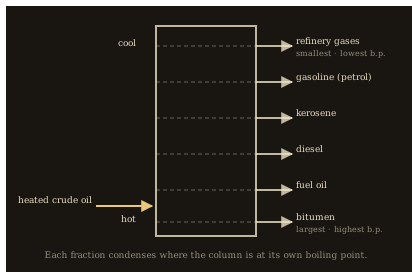
What actually happens inside the column
- The crude oil is heated until most of it has vaporised, and the vapour is fed into the bottom of a tall tower.
- The tower is kept HOT at the bottom and progressively COOLER towards the top — a continuous temperature gradient, not a series of separate heaters.
- Vapour rises. As it goes up it cools.
- Each hydrocarbon condenses when it reaches the level at which the temperature has fallen to its own boiling point.
- Molecules with long chains and high boiling points therefore condense LOW DOWN, and short chains with low boiling points travel much further up before condensing.
- The liquid collecting at each level is drawn off as a FRACTION — not a pure compound, but a group of hydrocarbons with similar chain lengths and similar boiling points.
- The very lightest hydrocarbons never condense at all and leave the top of the tower as refinery gases.
Think of it like runners dropping out of a hill race
Imagine a field of runners all starting together at the bottom of a long climb, which gets steeper the higher it goes. The heaviest runners drop out first, near the bottom. Lighter ones keep going and drop out further up. The very lightest run all the way over the top. Nobody has been sorted deliberately — each runner simply stops at the point where the hill defeats them, and the sorting happens as a consequence. A fractionating column sorts hydrocarbons the same way: each one rises until the temperature falls to the point where it can no longer stay a vapour, and stops there.
The fractions are collected in a fixed order down the tower, and both their names and their uses are examinable. From the top: refinery gases, used as bottled gas for heating and cooking; gasoline, better known as petrol, used to fuel cars; kerosene, used to fuel aircraft; diesel oil, used to fuel lorries and some trains; fuel oil, burned in ships and in power stations; and at the very bottom bitumen, which is not a fuel at all but is used to surface roads and roofs.
One point of vocabulary that examiners test: this is a physical separation, not a chemical reaction. No bonds within the hydrocarbon molecules are made or broken, no new substances are formed, and every molecule that comes out of the column went into it unchanged. That is exactly what it means to say crude oil is a mixture.
2 · Grade 9 Notes
A different job from the section above. You have already understood it; this is the precise set of things to LEARN — definitions to reproduce word for word, processes in order, equations with units, and the answers that score full marks.
Learn this definition · Crude oil
A mixture of hydrocarbons, mainly alkanes, formed over millions of years from the remains of ancient marine organisms.
The words this page is marked on
- Fraction
- A group of hydrocarbons with similar chain lengths and boiling points, collected together at one level of the column.
- Fractional distillation
- Separation of a mixture of liquids by their different boiling points.
- Viscosity
- How thick a liquid is and how poorly it flows. Long-chain hydrocarbons are more viscous.
- Volatility
- How readily a liquid turns to vapour. Short-chain hydrocarbons are the more volatile.
The six fractions, in order down the column
| Chain length | Main use | |
|---|---|---|
| Refinery gases | Shortest — 1 to 4 carbons | Bottled gas for heating and cooking |
| Gasoline (petrol) | About 5 to 10 carbons | Fuel for cars |
| Kerosene | About 10 to 16 carbons | Fuel for aircraft |
| Diesel oil | About 16 to 25 carbons | Fuel for lorries and some trains |
| Fuel oil | About 25 to 40 carbons | Fuel for ships and power stations |
| Bitumen | Longest — over 40 carbons | Surfacing roads and roofs |
Going DOWN the column, everything increases except one thing
- Chain length INCREASES
- Boiling point INCREASES
- Viscosity INCREASES — the liquid becomes thicker and flows less easily
- Colour DARKENS
- Volatility DECREASES — this is the one that goes the other way
- Ease of ignition DECREASES — the lower fractions are harder to set alight
Industrial fractional distillation, in the order an answer needs
- Heat the crude oil so that it vaporises, and feed the vapour into the base of the fractionating column.
- Maintain the column hot at the bottom and cool at the top.
- Allow the vapour to rise and cool as it goes.
- Each hydrocarbon condenses at the level where the temperature equals its own boiling point.
- Draw off the liquid collecting at each level as a fraction; the uncondensed gases leave from the top.
Model answer [4 marks]
Explain why bitumen is collected near the bottom of the fractionating column and refinery gases at the top. [4]
Bitumen consists of hydrocarbons with very long chains. Longer chains have greater attractions between neighbouring molecules, so more energy is needed to separate them and the boiling point is high. Bitumen therefore condenses as soon as the temperature falls a little below the base temperature, which happens near the bottom of the column. Refinery gases have very short chains and much weaker attractions between molecules, so their boiling points are very low. They stay as vapour all the way up the column, condensing only at the top, if at all.
Not this: Boiling a long-chain hydrocarbon takes more energy because its covalent bonds are stronger.
This: The covalent bonds inside the molecule are not broken when it boils. What is overcome is the attraction BETWEEN molecules, and a longer chain has more of that attraction because there is more contact with its neighbours.
Mark-losing trap. A fraction is a group of hydrocarbons with similar boiling points, never a single pure compound.
Mark-losing trap. The column is HOT at the bottom and COOL at the top. Getting this the wrong way round undermines the rest of the explanation, because every later step depends on it.
Mark-losing trap. Fractional distillation is a physical separation. No new substances are made, so it is not a chemical reaction.
3 · Prove it — the five questions
The five questions climb Grade 6 → Grade 7 → Grade 8 → Grade 9 → Grade 9 challenge, and are marked inside Incandio on your own device, by rule, with an authored diagnosis of the mistake you actually made. The mark schemes stay in the app so that the practice is worth doing; the questions themselves are here.
- Grade 6 · State [1 mark] — Which fraction from the fractionating column is used as fuel for aircraft?
- Grade 7 · Describe [2 marks] — Describe what happens to the viscosity and the boiling point of the fractions as you move DOWN the fractionating column.
- Grade 8 · Explain [3 marks] — Explain why the hydrocarbons in crude oil can be separated from one another without any chemical reaction taking place.
- Grade 9 · Explain [4 marks] — Select every statement that belongs in a full explanation of why diesel oil condenses lower in the column than gasoline.
- 9+ · Predict [5 marks] — A refinery collects an unfamiliar fraction between kerosene and diesel oil. Predict its viscosity and its ease of ignition compared with kerosene, and give the reason.
The people behind this science
Two ways into the same idea — the one who studied the oilfields and argued the crude should never simply be burned, and the one who pulled a single pure compound out of an oily industrial residue. Inside Incandio each of them answers knowing exactly which lesson you have just finished.
Dmitri Mendeleev — the one who studied the oilfields and argued the crude should never simply be burned
Mendeleev is remembered for the periodic table, but he spent years on petroleum: he visited the Baku oilfields, advised the Russian government on refining, and pressed for continuous fractionating plant rather than the crude batch stills then in use. He also made the argument this page implies but does not state — that separating oil into fractions turns a raw material into chemistry, and that burning the crude directly wastes everything it could have become. He is the right figure to ask what a barrel of oil is actually for.
- “What did you see at the Baku oilfields that alarmed you?”
- “Why is burning crude oil directly such a waste?”
- “What should a country do with the oil it has?”
- “How would you separate a mixture that has no fixed composition?”
- “Is oil a chemical feedstock or a fuel?”
Michael Faraday — the one who pulled a single pure compound out of an oily industrial residue
In 1825 Faraday was handed the greasy residue left in the cylinders of the gas company's oil-gas apparatus — an industrial waste product, and a mixture of hydrocarbons much like the one this page separates. By repeated distillation and cooling he isolated from it a new pure compound, which we now call benzene. That is exactly the operation a fractionating column performs, done by hand and on a bench, and he is the right person to ask how you convince yourself that what you have separated is really one substance.
- “How do you get one pure substance out of an oily mixture?”
- “How could you tell your new liquid was not still a mixture?”
- “What made you interested in a residue everyone else discarded?”
- “Why does repeated distillation separate better than one attempt?”
- “What did you use to measure whether a separation had worked?”
Think you understand it?
Reading is the start. On Incandio a topic counts as mastered only once you have taught it and defended it — the two things a revision guide cannot ask of you.
Incandio this topic → Prove it. Teach it. Defend it. What does “Incandio it” mean?
- Prove it — five questions on Crude Oil And Its Fractions, marked on the spot, that tell you what was missing rather than just what was wrong.
- Teach it — Explain Crude Oil And Its Fractions in your own words to Ember, an AI pupil who does not have it yet and asks the awkward question. Understanding is credited; wording is not required.
- Defend it — Argue Crude Oil And Its Fractions against Dmitri Mendeleev — three rounds, marked against descriptors you can read before you begin.
- Then the exam — read all 12 authored exam-style questions on this unit, each with its command word and its tariff, then have them marked on Incandio with the mistake you actually made named.
Completely free. No subscriptions, no paywalls, no account needed to start.
Carry on through the course
- Previous lesson: Naming, Drawing And Classifying
- Next lesson: Burning Fuels
- What Organic Chemistry Is — Two facts about carbon generate several million compounds — and three words keep them in order.
- Naming, Drawing And Classifying — A name that tells you the structure, a method that finds every isomer, and three words that cover every organic reaction here.
- Burning Fuels — Two ways a hydrocarbon can burn, and why one of them fills a room with a gas you cannot smell.
- Pollutants And Acid Rain — One pollutant comes out of the fuel and one comes out of the air — and telling them apart decides which fix works.
- Cracking — Breaking long molecules nobody wants into short ones everybody does — and the reason a refinery has to.
- All of Chemistry · Chemistry key terms · required practicals · equations · Incandio Science · The 4CH1 specification